The blank white insides of Blah Blah Gallery shine like a star in the late winter afternoon. But inside those tightly bound walls, bursts of color and play erupt as you enter its enclosure of whimsy. Blah Blah Gallery’s juried exhibition, Holding Pattern, shown from Jan. 15 to Feb. 28, encapsulated its theme of transitory contradiction in life while also speaking to the role that art has in our lives, outside the white cube and in our imagined communities.
The Bella Vista gallery reveled in each of its chosen pieces: 2–D works of radiant abstraction, sculptures, and fiber arts that moved against the grain. At the intersection of tension and freedom, the show’s title depicts a contradiction within each of the works: moments of motion represented in stasis or organic movement frozen in time; memories that live on and a feeling that the art itself “resists resolution”; or intimacy in the abstract sense.
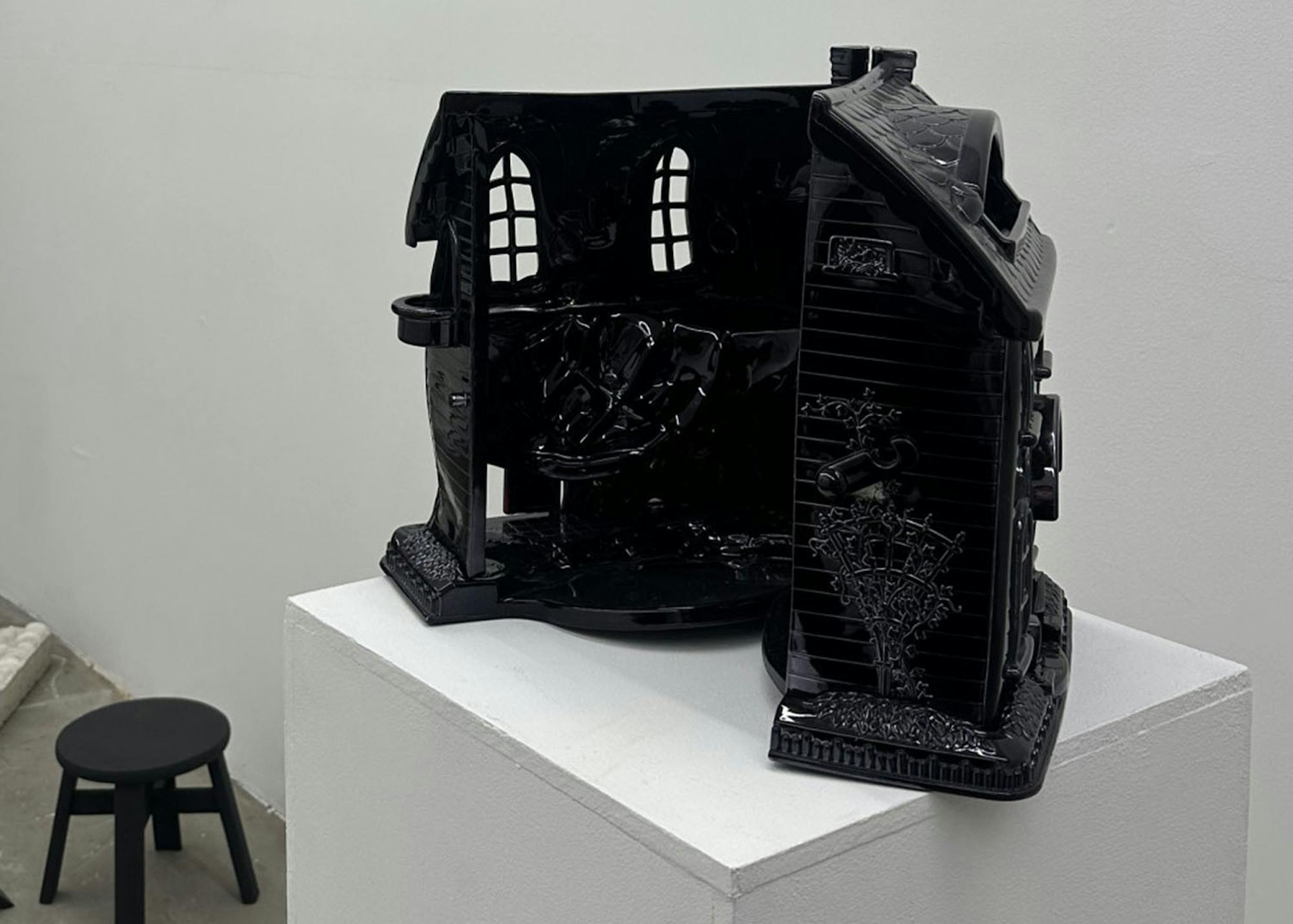
Natessa Amin’s triplet of wintry geometric squares (In Between Breath, 2025; The Veil is Thin, 2025; Threshold, ca. 2025) showed this with the interjection of flowing lines through its pattern, resisting the finality of shape or the notion of a continuous tile. Additionally, Aimee Koran’s Memories Don’t Leave Like People Do, 2024 is a striking, glossy chrome play house that appears like melted tar yet still dollhouse–like and nostalgic. The lightheartedness comes center stage in these pieces, small and big.
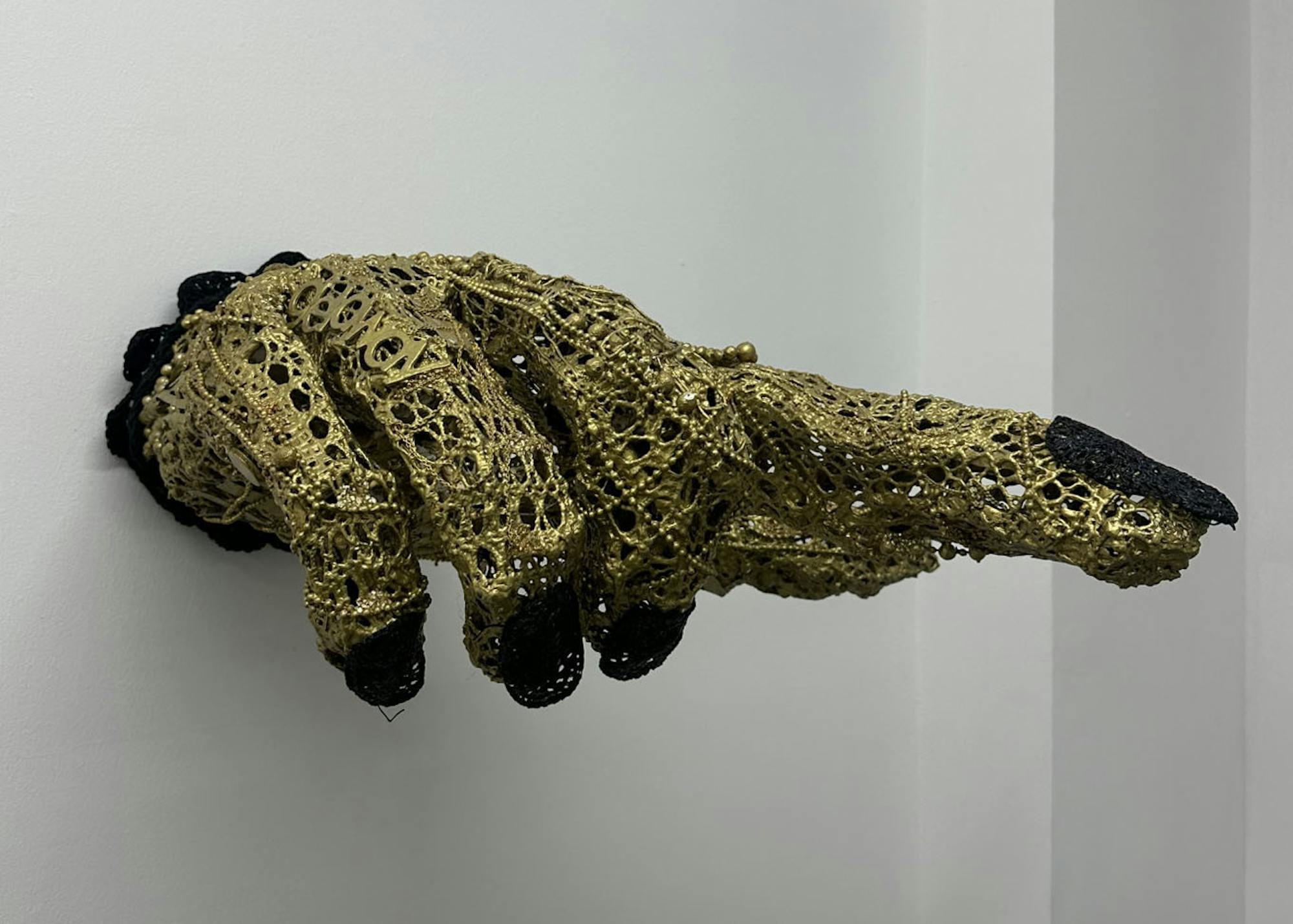
One of the largest works in the show, Sara Yourist’s A Spark of Unrequited Lust, 2023 is a saccharine, surreal, and theatrical moment of two stagnant porcelain dolls caught in the ephemeral moment of a lit spark. Just as impressive, Caitlin McCormack’s You Should Have At Least Sent A Card, 2025 depicts a large right hand—pointed outwards, dwarfing the viewer—emerging stoutly from a flat azure blue panel.
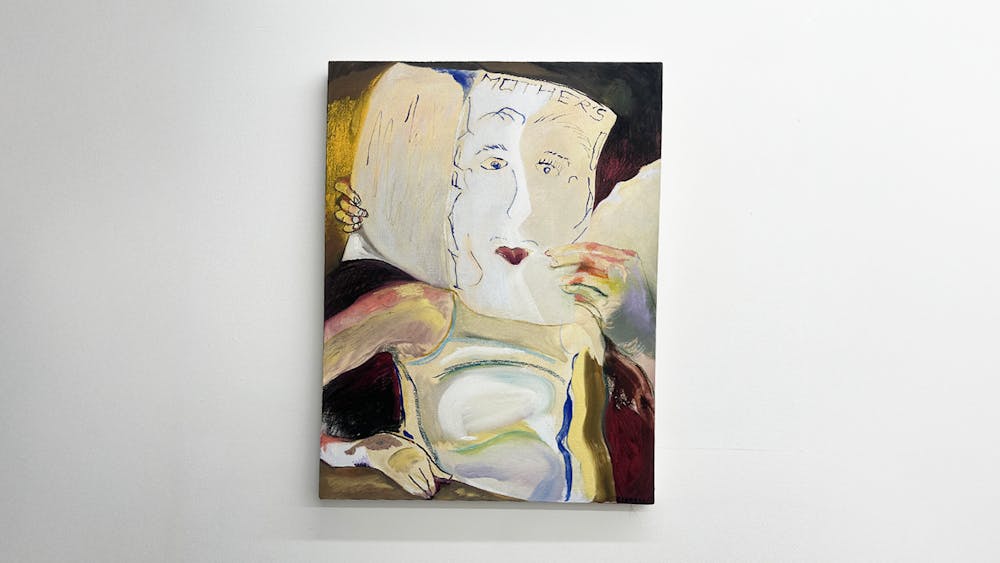
One of the most striking pieces that embodies the contradictions of “Holding Pattern,” is Happy Mother’s Day with Tongue, ca. 2025, by Anna Correll, a New York–based painter and photographer. The painting pictures a figure—which Correll confirmed was herself—with their tongue poking through a ‘Happy Mother’s Day’ card, held up by another set of hands—her father. The painting is based off of an old photograph dating back to when Correll was around 4 years old and investigates her personal interest in the mystery of coming of age. In our conversation about the work, Correll reflects on the uncanny image of her fleshy tongue, poking through the rough paper. To her, it exposed and gave starkness to the ambiguity of touch and sensing within oblivion of memory.
Regarding the show as a whole, Correll remarks how she felt her piece—with a figure at its core—was on the fringe of the exhibition. However, it’s Correll’s conception of the body itself and her process that ties together its dialogue with the other pieces, which mostly verged on abstraction.
“I always think about … the layering of the self over time—the sort of passing over and over and over of the self with layers of paint or layers of self–knowledge,” she says. “They build up a figure in our lived existence, but also on the canvas.” Just like the moment of creativity when the younger Correll created the card and posed with her tongue out, she contemplated a transformation of her own body with the painting’s process. Through the reinterpretation of an old family photograph, Correll reinterprets memory and the body’s expression through time.
She recalls photography as a creative, autonomous act, revealing a depiction of the self. With her two younger sisters, they allowed the camera to show a way of “seeing each other and ourselves in a way that was fully independent of what any adult was saying or doing or telling us.” But this “development of the self” in front of the camera then became transitive in her process of painting. She notes that painting, for her, is an act where she can grow a sense of play and find joy in creating a new depiction of self. Through both the creation of art and her subjection to it, Correll’s work exhibits a physical relationship between being and growing. She continues, “It’s not like you shrink and you shrink. Actually, you grow up and [you] grow out ... you’re growing in [layers of knowledge], layers of bodily experience, emotional experience, [and] intellectual experience.”
Towards the end of our interview, I am struck by the connection Correll makes between coming of age, bodies, and the process of art–making itself. “I’m thinking about how it would look if emotions were mapped visibly onto a body … how [and] where do emotions and memories land in us?” When in front of a camera or behind a painting apparatus, there is a unique free will and shape shifting that happens—especially in youth, where it feels there are no rules. Happy Mother’s Day, in its richness of color and quiet recalibration of memory, self, and body reaches deep into the skin and does not ask for completeness or definition. Rather, the contrasting flat gaze of the card and the wet, curved tongue reveal how much art has on the transformation of the body, internally and externally.
Through the gallery’s visual delights, Blah Blah’s Holding Pattern evokes a sense of people, shadows, and memories beyond the physical to the space itself. Correll’s painting is gestural in its dialogue with the more abstract pieces of the show, revealing an intimacy and delicate quality of self that each of the other pieces share at different degrees. As with all the shows at Blah Blah Gallery, Holding Pattern features all female or non–binary artists, and the gallery is known for nurturing early career artists that choose to place themselves at the intersection of DIY and traditional gallery spaces. As the gallery is a home for emerging artists of Philadelphia, Correll asks me what my experience at the gallery was like as an audience member. This experience is intertwined with the city for me. Just like the movement of our resilient public transport or my stop into the art bookstore connected to the gallery, we are imbued with the streets through our waiting and watching. I feel a personal, artistic esprit de corps amongst the works that speak not only to the shared body of the gallery as a place of movement for its exhibiting artists, but for ourselves and our city.
“Resolution happens when you’ve planted enough seeds for the [viewer] to get what you meant,” Correll shares. The finality of a hung gallery art piece is reversed to Correll in this sense, where resolution is reached within each of the bodies that engage with a work rather than other empirical qualities. “I think that the joy of painting is getting to decide exactly what you reveal and conceal.” Blah Blah Gallery and the show work together to exhibit this precious state of suspension—like a moment of respite—and create a nuanced, corporeal community from it.