
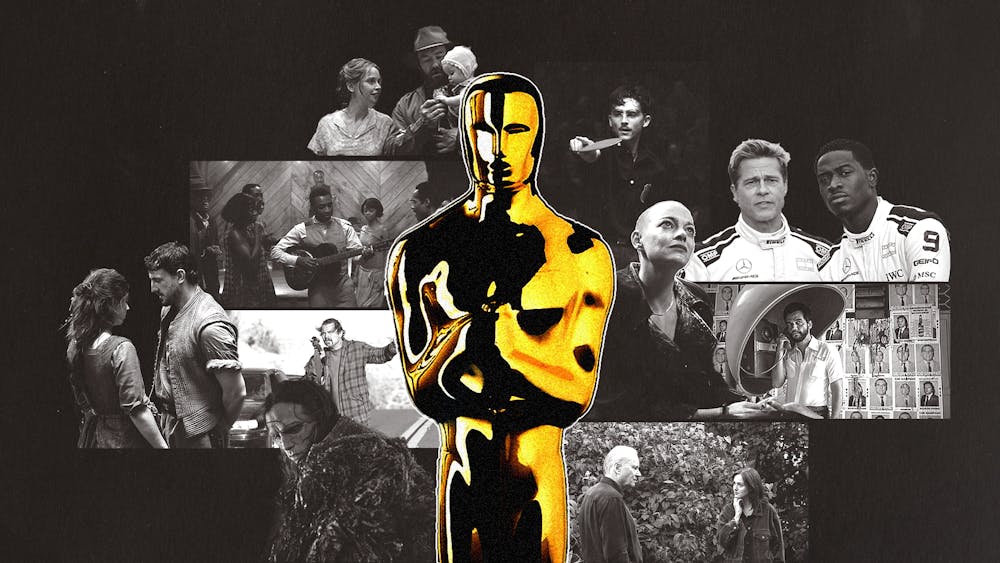
What is the point of award shows? To a pessimist, it is a room full of adults deciding which other adults deserve tiny gold statues for pretending to cry on camera—all while wearing outfits whose price tags could fund a small charity drive. To an optimist, it is a celebration of the human race: our ability to create art and make strangers feel emotions they have never experienced. The truth, like most things in Hollywood, probably sits somewhere in the middle.
The 98th Academy Awards will take place on Sunday, March 15 at the Dolby Theatre in Los Angeles, airing live on ABC and Hulu, and hosted by Conan O’Brien. Whether you watch the whole ceremony or tune in only for the major categories, the night will likely run long, feature a few surprises, and give the internet plenty to argue about the next morning.
Dear reader, you have a daunting task ahead of you: 15 categories, 24 blurbs, and one restless Film & TV section. For our Oscars 2026 roundup, we gathered bold predictions, strong opinions, and a few spirited arguments on more awards than the average viewer could name off the top of their head.
Following each category, you will see a Street Prediction and a Street Pick. The first reflects what our writers collectively think will win. The second represents what we hope to win—because if award shows are about anything, it’s having a take.
So grab your ballot, disagree with us loudly, and remember: If the Academy gets it wrong, you heard it here first.
Best Picture (in alphabetical order):
Bugonia: Bugonia is one of those movies that you won’t understand from just one watch, but that’s part of its genius. It perfectly reflects the subversive progression of American society, albeit in a bizarre and intense way. If you think of it solely as a movie in which a high executive officer gets kidnapped by conspiracy theorists, you’re not seeing the point. Though the absurdity of Jesse Plemons and Aidan Delbis’ performance is amazingly contrasted with Emma Stone’s rational girlboss, the spectacular acting is not what got the film nominated. The beginning is eccentric, the middle is thrilling, but the end—which I will not spoil—is mind boggling and ultimately the reason this film deserves its nomination. Yorgos Lanthimos’ new film is peculiar yet timely and will undoubtedly be looked back on as a great work of art reflecting American culture.
–Susannah Hughes, Film & TV beat
F1: Joseph Kosinski’s F1 joins a long line of films obsessed with our need for speed, including Rush, Ford v Ferrari, Gran Turismo, and more. Yet Kosinski’s addition doesn’t feel redundant, all thanks to the film’s technical mastery and dedication to immersing the viewer into the fast–paced, exclusive world of motor racing. Backed by Lewis Hamilton and Apple TV—and featuring a beautiful, heart–accelerating score by Hans Zimmer—the film centers around veteran driver Sonny Hayes (Brad Pitt) as he competes for an underdog team on the grid while having to contend with his hot–headed rookie teammate Joshua Pierce (Damson Idris). Kosinski worked with Formula 1 officials to film scenes during real race weekends, while real Formula 4 cars—slower but powerful single–seaters—were customized to replicate the look of an F1 car. Director of Photography Claudio Miranda commissioned special camera rigs attached directly to the cars, throwing the viewer right into the heart of racing action.
–Élan Martin–Prashad, Film & TV beat
Frankenstein: If you haven’t read the book, Guillermo del Toro’s Frankenstein adaptation is a decent movie. However, if you look back at Mary Shelley’s masterpiece, the film’s flaws become obvious. The adaptation glosses over all of the nuance that makes the book so compelling—del Toro changes Victor Frankenstein’s (Oscar Isaac) motivation for creating the monster (Jacob Elordi) from hubris—doing it simply because he thinks he can cheat death—to an attempt to prove his father wrong, entirely missing the point of the story. In addition, del Toro’s decision to make Elizabeth Lavenza (Mia Goth) Victor’s future sister–in–law rather than his wife cheapens the connection between the two. Frankenstein’s departures from the original novel detract from the film’s essential meaning, resulting in a movie that lacks depth and, arguably, is undeserving of its spot on the list of Best Picture nominees.
–Shannon Katzenberger, Film & TV beat
Hamnet: Heading into the Oscars, Chloé Zhao’s Hamnet has gained significant critical acclaim, and for good reason. The film, based on the 2020 novel of the same name by Maggie O’Farrell, follows Jessie Buckley as Agnes Hathaway, the supposed daughter of a forest witch who feels the joys of love and motherhood as well as their requisite sorrows. Paul Mescal is mesmerizing as her husband, William Shakespeare, delivering a heartbreaking performance of the “To be, or not to be” monologue. Young Jacobi Jupe delivers a scene–stealing performance as Hamnet. The final sequence at the Globe Theatre, with Agnes and the audience reaching out to Hamlet, could win Hamnet the Best Picture award on its own. Overall, the film is a masterclass in characterization, cinematography, and acting, and if it wins the Best Picture Oscar, it will be fully deserved.
–Shannon Katzenberger, Film & TV beat
Marty Supreme: Have you ever watched a great film and thought to yourself, “Oh no, the movie’s about to end!”? Personally, I can’t remember the last time I felt that. Maybe it was saying goodbye to Woody and Buzz—not once, but twice—or maybe I’ve been a cynic longer than I realized. That is, until I was sunk in my chair for over two hours into Marty Supreme on a random Sunday night in January—forgetting to check my phone or watch the entire time.
If I had to summarize what there is to love and hate about Josh Safdie’s latest thrill ride in a single phrase, it would be this: “You feel like the movie lasts for years.” For many, including myself, that feeling is the whole point. The endless ups and downs of table tennis player Marty Mouser (Timothée Chalamet) are anything but dull. You may want to leave the theater and escape the stress, but even that reaction feels like part of the journey.
Do I think it will win Best Picture? No. But it already did something I thought was impossible: it made me wish the credits never rolled.
–Henry Metz, Film & TV editor
One Battle After Another: One Battle After Another has seen a lot of controversy in the press, with conservatives naming it “left–wing propaganda” and critics praising it as a masterpiece. However, if one were to look at it from a nonpolitical lens, the genius of it is in how flawed each side is. The beginning is undoubtedly liberal–coded with epic refugee breaks and active rebellion, but even the revolutionaries become degenerate after the first half hour. The point is that reckless violence fails, and the only thing left are the familial connections and the community that people must rely on. Additionally, the cinematography is brilliant, the soundtrack is insane, and the casting is phenomenal. Paul Thomas Anderson’s dark comedy has been often misunderstood in the media as pure propaganda, but if you look past the political, you’ll see a radically emotional film well deserving of its nomination.
–Susannah Hughes, Film & TV beat
The Secret Agent: If there is a Best Picture nominee this year that feels engineered to make voters uneasy—in the best way—it’s The Secret Agent. Set in 1970s Brazil during the military dictatorship, the film follows a professor forced into hiding after drawing the attention of powerful enemies. What unfolds resembles a political thriller stripped to its core: A man trying to stay alive while the systems around him close in. Wagner Moura’s performance anchors the film, portraying a man pulled between fear, responsibility to his family, and the quiet hope of escape. The story rarely erupts into spectacle. Instead, director Kleber Mendonça Filho builds tension scene by scene, letting paranoia and uncertainty seep into the viewer’s psyche. In a year of loud, genre–bending nominees, The Secret Agent stands apart for its restraint. Beneath the calm surface lies a portrait of life under authoritarian rule, where danger rarely announces itself and survival becomes its own form of resistance.
–Henry Metz, Film & TV editor
Sentimental Value: Sentimental Value is definitely a two percenter—those who don’t enjoy deep character studies are unlikely to appreciate it, but for those who do, it’s absolutely incredible. The story follows Nora Borg (Renate Reinsve), an actress who is forced to come to terms with her family’s history as she attempts to repair her relationships with her father, Gustav (Stellan Skarsgård), and sister (Inga Ibsdotter Lilleaas) after the death of her mother. Throughout the film, Gustav is creating a film that explores the life (and eventual suicide) of Nora’s grandmother, helping the audience better understand the Borg family’s situation. Put together, Joachim Trier crafted a beautiful exploration of the issues that make us human—love, loss, mental health, and trauma—all with undoubtedly stunning cinematography and fantastic acting.
–Shannon Katzenberger, Film & TV beat
Sinners: On its surface, Ryan Coogler’s Sinners is simple. A vampire horror set in the American South, following a tight–knit Black community as this supernatural terror collides with generational wounds. But to reduce it to any of those labels would be missing the point. Sinners shattered records for the most Oscar nominations for a single film, and it’s easy to see why. Its storytelling is bold and wholly original, it braids horror, action, and historical fiction into a deeply emotional and thought–provoking narrative about faith and survival. It’s also a technical masterpiece, with melodic cinematography, a thunderous score, and production design that situates every frame in its right place.
Peel back the curtain and you find a Black director, a majority–Black cast, and a film that is unmistakably steeped in the Black experience—and it is embraced as mainstream cinema. The film interrogates what a “Black film” is supposed to look like, refusing white saviors or torture porn that turns trauma into spectacle. It’s not just a movie, it’s a standalone cinematic event, and a rare Best Picture contender that expands who gets to occupy the silver screen, and challenges assumptions about what stories are treated as universal.
–Chenyao Liu, Film & TV beat
Train Dreams: Train Dreams might be the most deceptively small film in the lineup. On paper, it follows a single man (Joel Edgerton) moving through decades of American life, working on railroads and drifting through the vast landscapes of the early 20th century. Yet the film slowly reveals itself to be something much larger: a meditation on solitude, memory, and the quiet passage of time. Where other nominees chase spectacle or narrative twists, Train Dreams builds meaning through patience—through long stretches of silence, natural landscapes, and the gradual accumulation of moments. By the time the film reaches its final act, the story of one laborer begins to feel like a portrait of an entire era. It is the rare Best Picture nominee whose power lies not in scale, but in how much emotional weight it draws from simplicity.
–Henry Metz, Film & TV editor
Street Prediction: One Battle After Another
Street Pick: Sentimental Value or Sinners
Actor in a Leading Role:
One of the tightest Oscar races this year is undoubtedly for Best Actor. Just look at the awards season so far: Timothée Chalamet (Marty Supreme) won the Critics’ Choice Award and Musical/Comedy Golden Globe, while Wagner Moura (The Secret Agent) took home the companion Globe for drama. Previous winner Leonardo DiCaprio (One Battle After Another) has taken home awards from the multiple Film Critics Associations, the Irish Film & Television Awards, and National Board of Review, but none of these place him in a frontrunner position. Michael B. Jordan (Sinners) surprised many by winning the prestigious Outstanding Performance from the Actor Awards (formerly SAG Awards). Meanwhile, first–time nominee Ethan Hawke (Blue Moon) has won awards from the National Society of Film Critics and Los Angeles Film Critics Association. Out of the blue at the BAFTAs—where four of the five Oscar nominees were also in contention—Robert Aramayo (I Swear) won Leading Actor. And get this: he’s not even Oscar nominated this year. Taken together, it is nothing but clear that this is not an easy race to predict.
–Henry Metz, Film & TV editor
Street Prediction: Timothée Chalamet (Marty Supreme)
Street Pick: Michael B. Jordan (Sinners)
Actor in a Supporting Role:
The Best Supporting Actor race this year is highly contested. Although all nominations are well deserved, there are two clear frontrunners: Sean Penn and Stellan Skarsgård. Penn’s acting in One Battle After Another is brilliant because his character, Colonel Lockjaw, is so hateable yet full of nuance. In contrast, Skarsgård is powerful because his character, Gustav Borg, makes terrible decisions yet remains deeply sympathetic. Awards throughout the season have been evenly split between the two, so they’re favored to win over their fellow nominees. Of course, Delroy Lindo does amazing work in Sinners; Jacob Elordi’s performance was one of the few aspects of Frankenstein that was well executed; and Benicio del Toro offers fantastic comic relief in One Battle After Another, but either Penn or Skarsgård is extremely likely to win on March 15th.
–Shannon Katzenberger, Film & TV beat
Street Prediction: Sean Penn (One Battle After Another) or Stellan Skarsgård (Sentimental Value)
Street Pick: Delroy Lindo (Sinners) or Stellan Skarsgård (Sentimental Value)
Actress in a Leading Role:
Jessie Buckley delivers a brutal but brilliant performance in Hamnet, her raw maternal grief making her a clear contender and a favorite of many film critics. Rose Byrne fully leans into her character’s downward mental spiral in If I Had Legs I’d Kick You. And two–time Oscar winner Emma Stone is nominated again for Bugonia in which she also leans into the bizarre with captivating intensity. However, the extreme nature of these films, whether dark comedy or full drama, may turn the academy off and promote the more heartfelt nominations. Renate Reinsve plays, sincerely, a grounded and concerned daughter in Sentimental Value, while Kate Hudson’s performance as the resilient Claire Sardina in Song Sung Blue is commendable, albeit a bit of a long shot in this nomination.
–Susannah Hughes, Film & TV beat
Street Prediction: Jessie Buckley (Hamnet)
Street Pick: Jessie Buckley (Hament)
Actress in a Supporting Role:
This category has a widely recognized frontrunner, and that is Teyana Taylor for her role in One Battle After Another. She delivers an audacious performance as the reckless revolutionary Perfidia Beverly Hills, which both energizes and (intentionally) repels audiences. However, there are so many amazing nominees in this category including Amy Madigan, who genuinely terrified viewers as the bone–chilling Aunt Gladys in Weapons. Wunmi Mosaku plays a mysterious yet wise Hoodoo practitioner, as well as Smoke’s wife, in Sinners. Additionally, both Elle Fanning and Inga Ibsdotter are nominated from Sentimental Value—Fanning as a young naive American actress and Inga Ibsdotter as a loving but uncompromising sister.
–Susannah Hughes, Film & TV beat
Street Prediction: Teyana Taylor (One Battle After Another)
Street Pick: Wunmi Mosaku (Sinners)
Animated Feature Film:
Animated movies did not come to play in 2025. Frontrunner, and most popular Netflix film of all time, KPop Demon Hunters captured the hearts of audience members around the world, transcending generations of viewers. Its thematic exploration of identity and self–acceptance, alongside a captivating narrative and very catchy music, makes for an incredibly enjoyable, heartwarming, and uplifting movie–watching experience. Science–fiction film, Arco, is a powerful call to action for audiences regarding climate change, connecting two worlds: one past (overtaken by wildfires and extreme weather) and one future (abandoned and desolate). Disney and Pixar’s Elio discusses loss and self discovery in a vibrant and colorful intergalactic universe. Little Amélie or the Character of Rain, based on the autobiography by Amélie Nothomb, tells a story of cultural identity, mortality, and memory in postwar Japan through beautiful, hand–drawn, and watercolor–like animations. Disney’s highest grossing animated film ever, Zootopia 2, continues to tackle complex social issues introduced in the first movie, such as prejudice, racism, and oppression—leaving audiences with a reflective and thought–provoking viewing experience. While KPop Demon Hunters is a favorite to win this year, each and every one of the animated films within the category are incredible: they are charming, entertaining, and most importantly, inspiring and emotionally–moving stories.
–Sophia Leong, Film & TV beat
Street Prediction: KPop Demon Hunters
Street Pick: KPop Demon Hunters
Casting:
The first new Oscars category since Best Animated Feature Film in 2001 arrives in a year where it almost feels pre–written. Though I don’t want to play favorites, there is something poetic about Marty Supreme releasing at the exact moment the Academy decides to honor casting. In an industry built on movie stars, what would it mean if the first winner were a film whose ensemble isn’t composed of A–list actors?
Yes, accomplished leading man Timothée Chalamet anchors the film and its marketing. But look at who surrounds him: Kevin “Mr. Wonderful” O’Leary of Shark Tank fame, renowned magician Penn Jillette, musician Tyler Okonma (better known as Tyler, the Creator), and New York Knicks superfan Luke Manley, discovered after a viral street interview caught director Josh Safdie’s attention. The result isn’t stunt casting, but a collage of personalities that feels inseparable from the film’s texture.
The other nominees (Hamnet, One Battle After Another, Secret Agent, Sinners) boast formidable stars and ensembles. Still, it is difficult to ignore the singularity of Marty Supreme’s choices—and how fully its casting defines its identity.
–Henry Metz, Film & TV editor
Street Prediction: Marty Supreme
Street Pick: Marty Supreme
Directing:
Aside from Best Picture, Best Director is the award everyone will be watching for. This year’s all–star lineup of nominees does not disappoint. One definite favorite seems to be Paul Thomas Anderson, after he recently won Best Director at the BAFTA Awards for his intensely political drama One Battle After Another. Meanwhile, Ryan Coogler emerges as another top prediction, particularly after Sinners received a staggering 16 Oscar nominations, a record for the Academy. His genre–melding vampire flick is sure to carry him far in this year’s awards ceremony. Josh Safdie, director of the intense, character–driven Marty Supreme, comes in a close tie for third with Chloé Zhao, who directed the hauntingly beautiful but melancholic Hamnet. Finally, Joachim Trier emerges as a dark horse for his work on the carefully paced and deeply psychological drama Sentimental Value, praised for its thoughtful performances and deep character studies.
–Élan Martin–Prashad, Film & TV beat
Street Prediction: Paul Thomas Anderson (One Battle After Another)
Street Pick: Ryan Coogler (Sinners)
Film Editing:
Best Editing may seem hard to define, but oftentimes, this award has also gone to the winner for Best Picture. Sinners and One Battle After Another both already took home this year’s top ACE Eddie Awards for best live action feature, so it’s possible that one of them could win the Academy Award. However, F1 emerges as a strong contender, engineered to replicate the thrill of Formula 1 through racing cinematography, a thrilling Hans Zimmer soundtrack, and a smooth balance between beautiful composition and adrenaline–charged quick cuts. Additionally, Marty Supreme’s fervent editing, chaotic pacing, and gorgeous color grading position the film well for a win. Sentimental Value’s careful emphasis on emotion and internal turmoil through composition, scoring, and the use of long–lasting black screens makes it a silent force in this award category.
–Élan Martin–Prashad, Film & TV beat
Street Prediction: One Battle After Another
Street Pick: F1
International Feature Film:
It is a fighting year for Best International Feature, and it’s always thrilling to see such a wide range of top–tier films representing distinct corners of the globe. Norway’s Sentimental Value, directed by Joachim Trier, follows a fraught father–daughter reunion as a celebrated director tries to cast an American actress in his autobiographical film, turning art into an intimate battleground. Brazil’s The Secret Agent tracks a former professor fleeing persecution in a paranoid political thriller that swept major prizes in Cannes, France. France’s entry, It Was Just an Accident, directed by Jafar Panahi, is a revenge drama shot in secrecy in Iran. Spain’s Sirāt plunges into the Moroccan desert and underground rave scene for a hypnotic, desolate odyssey, while Tunisia’s The Voice of Hind Rajab draws on a real recording of a young girl’s final words to craft a searing portrait of resistance.
Sentimental Value and The Secret Agent remain the clear standouts, bolstered by their Best Picture nominations and sustained critical acclaim. And in keeping with this season’s quiet pattern, even these fiercely local stories seem subtly calibrated for the American gaze—sometimes critiquing it, sometimes courting it, always aware of who’s holding the statuette.
–Chenyao Liu, Film & TV beat
Street Prediction: The Secret Agent (Brazil) or Sentimental Value (Norway)
Street Pick: Sirāt (Spain)
Music (Original Score):
The choice here feels somewhat obvious, but I’ll say it anyway: if Sinners doesn’t win, I’ll be personally offended like I worked on it. A film with such a heavy narrative emphasis on music demands an essentially perfect score, and Ludwig Göransson delivers with ease. Known for his bright strings, the Swedish composer somehow perfectly captures the feeling of a hot summer day with all the oppressive humidity and vibrant sunshine the Deep South has to offer. With Sinners, the focus always seems to fall on soundtrack standouts like Miles Caton’s stellar vocals, the time–transcendent “I Lied to You,” or the iconic “Rocky Road to Dublin” dance scene—which are in fact cinematic history and should be treated as such—but so much of the film’s staying and immersive power comes from the instrumentals. The moment in Annie’s cabin where the guitars in “Why You Here / Before the Sun Went Down” sync up with her three strikes of a match say it all—that music moves us even when we’re not aware of it.
–Liana Seale, Film & TV beat
Street Prediction: Ludwig Göransson (Sinners)
Street Pick: Ludwig Göransson (Sinners)
Music (Original Song):
There is something so special about a song being made specifically for a film—and while the two can exist without one another, their messaging and impact are much more powerful when paired together. The layered and building acoustics in “Dear Me” (from Diane Warren: Relentless) bring listeners through the emotional journey of Diane Warren’s path towards healing and hope. “Golden”’s rhythmic tempo and key modulations guide audiences through a climactic turning point in KPop Demon Hunters’s narrative. “I Lied To You” from Sinners traces the history of Black music through seamless transitions between musical genres like blues, gospel, and hip–hop, while also highlighting the film’s themes of racial oppression and resilience. “Sweet Dreams of Joy”’s operatic and uplifting orchestral sound encapsulates opera singers and musicians’ happiness and love for creating music as seen in Viva Verdi!. And lastly, the reflective lyricism of “Train Dreams” renarrates the emotional journey of protagonist Robert Grainier (Joel Edgerton) through grief, mourning, and memory. While all of the original songs are strong contenders, “I Lied To You” and “Golden” stand out as being the predicted winners within the category.
–Sophia Leong, Film & TV beat
Street Prediction: “Golden” – KPop Demon Hunters
Street Pick: “I Lied to You” – Sinners
Cinematography:
Cinematography, where artistry and technical precision collide, is at its best when it deepens the viewer’s immersion without distracting from the story. It sharpens a scene for the subconscious while allowing us to remain fully absorbed in the moment. This year’s nominees make a compelling case for paying close attention to the camera’s hand. Three cinematographers are first–time nominees—including Sinners cinematographer Autumn Durald Arkapaw, who is the first woman of color and the fourth woman in history to be nominated. She’s joined by Darius Khondji for Marty Supreme, Michael Bauman for One Battle After Another, Dan Laustsen for Frankenstein, and Adolpho Veloso for Train Dreams.
Khondji’s masterful use of light and shadow captures the grit of 1950s New York, while Bauman’s kinetic camera—especially in the film’s climactic car chase—redefines how momentum should be shot. Laustsen and Voloso favor meticulous composition, preserving the textured beauty of each frame. Still, Arkapaw is the undeniable standout. Even if a late fight sequence hints at her blockbuster past, the fluid, electrifying oner in the juke joint is pure cinematic exhilaration, making Sinners the genre–blurring celebration of life that it is. If Arkapaw wins, she would become the first woman ever to take home the Oscar for Best Cinematography—a milestone long overdue, especially considering this was the last non–acting category to nominate a woman (and only did so for the first time in 2018).
–Chenyao Liu, Film & TV beat
Street Prediction: One Battle After Another
Street Pick: Sinners
Writing (Adapted Screenplay):
It is already a daunting process to build a script and story from scratch, but there is arguably more pressure when having to base it off of pre–existing (and oftentimes beloved and well–known) material. This year’s nominees showed they were up to the challenge. While nominees Bugonia, Frankenstein, Hamnet, and Train Dreams adapted source material well, predicted winner One Battle After Another went above and beyond. Of course, it is not possible to translate everything for the screen, as screenwriter and director Paul Thomas Anderson acknowledges in press materials: “Vineland was going to be hard to adapt. Instead, I stole the parts that really resonated with me and started putting all these ideas together.” Despite shifts in dynamics between characters and viewers and changes to the novel’s ambivalent ending, Anderson still captures the complexities and nuances of the novel “Vineland” by Thomas Pynchon exceptionally and integrates powerful storytelling to create a compelling and emotional narrative.
–Sophia Leong, Film & TV beat
Street Prediction: One Battle After Another
Street Pick: One Battle After Another
Writing (Original Screenplay):
What makes a screenplay great? Luckily, I don’t need to decide the winner, but two key aspects stand out: dialogue and story. I know, nothing novel, yet both matter more than one initially thinks. A film might show a premise you have never seen, but stiff dialogue pulls you out of the moment. Meanwhile, sharp dialogue with no clear story leaves no reason to care.
Each nominee uses these two aspects in wildly differing ways. Jafar Panahi’s It Was Just an Accident follows a former political prisoner who spots a man he believes served as his captor. The entire film runs on a single question: Is he right or not? The tension lives in the writing rather than the action. Ronald Bronstein and Josh Safdie’s Marty Supreme moves in the opposite direction; characters talk fast, plans shift every scene, and the dialogue drives the pace.
Sinners blends genres in a way few scripts attempt. Vampires, action, and character drama sit in the same story without collapsing into chaos. Blue Moon centers on character voice, where conversation carries the drama while taking place, essentially, in only one location. Sentimental Value focuses on family memory and conflict, with scenes built around restraint and what remains unsaid. Each script succeeds through a different path, yet all return to the same core truth: If the words matter and the story holds together, the screenplay works.
–Henry Metz, Film & TV editor
Street Prediction: Sentimental Value
Street Pick: Sinners
Are you still there? Good. Thank you. Many movies were watched, rewatched, paused, debated, and defended like we were on payroll. The outcome on March 15 will either validate our entire personalities or force us to pretend we never said any of this.
If you agree with us, you have taste and you should tell your friends. If you disagree with us, I guess you’re also welcome here, since half the point of awards season is arguing with people you like about movies you all watched for different reasons.
And when the night ends and the speeches run long and someone thanks their publicist before their mother, remember the most important rule of the Oscars: The movies still exist after the trophies are handed out. Go watch the ones you missed. Rewatch the ones you loved. And if the Academy gets it wrong, don’t worry—they’ll do it again next year.