
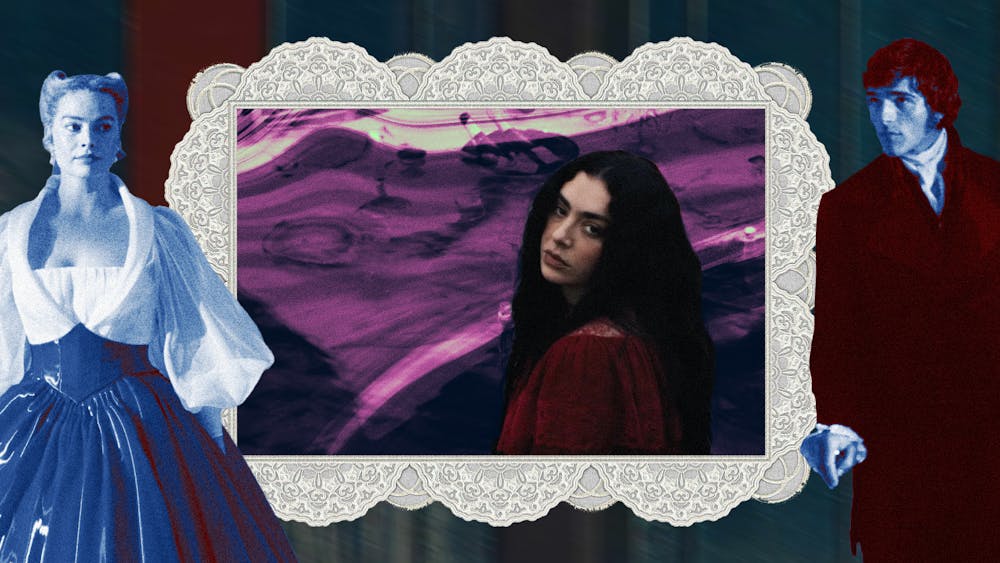
What happens when the architect of “brat summer” turns her attention to 19th–century misery? The result is an irresistible but radically inaccurate treat where Charli xcx’s and Emerald Fennel’s creative minds merge. On Wuthering Heights, Charli xcx trades sweaty club floors for windswept moors, and in the process, proves that obsessive love sounds surprisingly good with a bass drop.
The album dropped February 13, just two weeks after The Moment, a mockumentary–style film where gay Charli xcx stans sign up for brat–themed credit cards, hit theaters. Wuthering Heights, the second–ever soundtrack by the singer, accompanies an equally heated adaptation of the gothic classic novel by the same name.
This album has no shortage of debate. There’s been significant uproar over summer 2025’s most infamous party girl autotuning over a trailer for a period piece, followed swiftly by a series of moor–core music videos with an excessive amount of crows and slo–mo hair flipping—as one does in in the late 18th century—and that TikTok trend where everyone seems to be “dying in this house.”
While “brat summer” now just evokes nostalgia, the soundtrack’s cataclysmic marketing strategy shows that Charli xcx still has a knack for getting our attention—or at least for internet virality. Her cultural savvy shouldn’t come as a surprise—I mean, this is the same woman whose “apple is rotten right to the core,” who has impelled one of the largest electropop revivals in recent history, and who basically discovered Addison Rae.
However, the album’s brilliance lies not in its internet fame, but in Charli xcx’s genre–wide pivot in the wake of a career–defining record. After a deluxe version, a remix album, 70 bright green vinyl designs, an A24 movie, and even a presidential campaign based on the brat era, it turns out she has more to feed us—and we’re waiting, cutlery in hand.
Even when Charli xcx isn’t wielding her talents for dance–pop chart–busters, her ability to dive into unfamiliar styles is a treat we all should enjoy. The first track and lead single on the record is evidence that she forces the mainstream pop world to fit her vision. “House featuring John Cale” exists in an orchestrally eerie middleground between XCX World—as some fans eagerly awaiting the unreleased third studio album might call it—and Emerald Fennel’s imaginative fantasy. Guitarist John Cale broods over strings that sound like holding a candle to walk around a dark house instead of a phone flashlight, speaking as a perfect prisoner of obsession. When Charli xcx comes in with edge and unease, the song quickly loses control, accentuating the obsessive, destructive nature of Wuthering Heights.
According to her Substack commentary on the album, Wuthering Heights is a space of escapism. “House” materializes much of the morii–filled burnout detailed in her post, wherein a pursuit to make a perfect moment last longer just got draining. If anything, the song justifies her flight to the Yorkshire Moors of England for a little bit.
Much like Fennel’s film, the album abandons a lot of source material—a choice that some consider provocative and others view as ignorant. The album isn’t just a soundtrack to a narrowed, romanticized version of the classic novel—it rises above. The track list is a Charli–coded, entertaining sequence of pieces underscoring Fennel’s highly aestheticized, teenage, and wildly hormonal fantasy.
The second track, “Wall of Sound” is a thesis in trying and failing to resist a destructive love affair, with layers of harmony that sound like taking steps indulgently towards a better time, just when the escape is a breath away. Pressure and tension ooze from heavy strings until we finally reach that melancholic, screeching wall that immobilizes the listener. On “Always Everywhere,” she evokes romanticized images of the Yorkshire Moors to describe a loss that almost feels like that of widowhood—a corpse bride floating down an aisle of yellowish grass. In stark contrast, “Out of Myself” is an illustrious, synth–heavy discovery of one’s favorite kinks.
Though grounded in Fennel’s world, the album stays true to Charli xcx’s character, with many songs employing her characteristic rasp, auto tune, and glitching instrumentals as defense mechanisms against emotional vulnerability. Though anachronistic, this oddly translates well to the rough and wild nature of characters who can’t decide if they love or hate each other. “Dying for You” plays as a pop song that could rival “party 4 u” in style and appeal, even title–wise, juxtaposed with lyrics comparing love to “pain,” “torture,” and a “noose” around her neck. The song feels much like “How I’m Feeling Now” for its ability to dance through questionable decisions and angst, an accurate backdrop to the brief and anxious bliss experienced by Heathcliff and Cathy during their affair (yes, I know this didn’t happen in the book). “Chains of Love” drifts in like a stray shard of “True Romance” found in a lost folder of Charli xcx’s google drive. The moody, glassy pop sheen treats love less like a feeling and more like an invisible spell. In the music video, that spell flings her into danger as if she’s caught in its orbit.
A highlight of the album is found in “Altars,” a moody and effectual ballad that could have been written by Lana Del Rey. Herein lies Fennel’s pitch to Warner Brothers for “Wuthering Heights”—a sexy ode to the push and pull on a doomed and all–encompassing romance. The song even includes one of the most obvious nods to the story, as Charli xcx smolders over a slow beat with “You’re gonna end up killing me,” lamenting an exchange where Catherine claimed Heathcliff’s actions killed her, and in turn, he begs her to haunt him.
That being said, “House” is a lead single so far divided from her old work that labeling Wuthering Heights as a “Charli xcx album” feels downright surprising. Granted, that notion may come from holding an innovative artist to a different standard than that of artists who so often reheat stale nachos. Ultimately, she gave the film the true Charli xcx treatment, crafting a record that is sure to spur trends and future pop bangers. However, in a less gracious eye, she has somehow sold back to the mainstream on an album dedicated to escaping it.
There’s a deeper concern for listeners. This album has faced widespread outrage over pervasive changes to the story in the movie, as many fans believe that Fennel and Charli xcx were obligated to showcase the racism against Heathcliff or the intergenerational nature of Healthcliff and Catherine’s toxicity—especially in a time where the representation of minorities is under attack in mainstream media.
Yet, within the context of this limited world, Charli xcx has effectively and engagingly captured Fennel’s vision, having managed to bridge the century–wide gap between classics lessons on destructive obsessions and the chronically online “Von dutch” fanatics. It’s no small feat to cross that divide, which alone delineates this album as a smart and engrossing tool for immersing a brand new generation in a story, albeit one that omits the heart of the novel.
On the final track, “FunnyMouth,” she says goodbye to the world she’s been documenting for the past 11 songs. Wuthering Heights was an escape to a world where pressures exist in obsession with another person, with interspersed blinks of the place where she has a similar relationship with the spotlight. Waking up from the dream, it seems that The Moment and Fennel’s Wuthering Heights arriving in tandem is less of a coincidence and more of a convergence—two stylized worlds driven by obsession and fantasy. In that overlap, it becomes clear that there was probably no one better for this soundtrack than Charli xcx.