
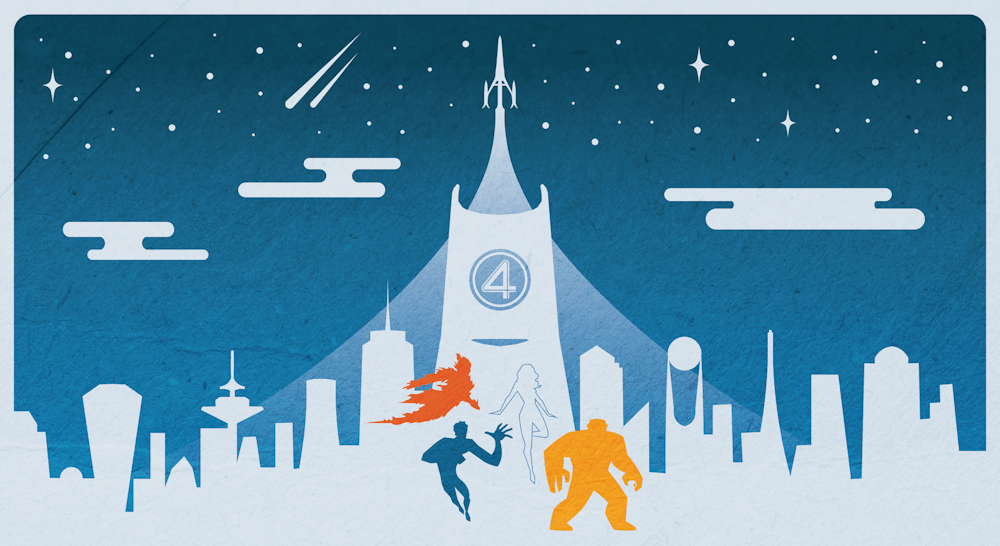
There are some superhero movies that you forget the moment the credits roll. And then there’s Matt Shakman’s The Fantastic Four: First Steps, a retrofuturistic elegy that doesn’t just redeem Marvel’s long–misunderstood “First Family,” but imbues their story with a new emotional weight.
Since their debut in 1961, the Fantastic Four have been a core part of Marvel’s vision for the “golden age of heroes.” Written by Stan Lee and designed by Jack Kirby, they weren’t warriors defined by their trauma or brooding vigilantes fueled by revenge—they were explorers, scientists, and dreamers. The Fantastic Four—brilliant physicist Reed Richards (Pedro Pascal), his best friend Ben Grimm (Ebon Moss–Bachrach), his wife Susan “Sue” Storm (Vanessa Kirby), and her brother Jonathan “Johnny” Storm (Joseph Quinn)—begin as astronauts venturing into the vast unknown of space. A storm of cosmic radiation mutates their DNA, giving them extraordinary powers: Reed becomes Mr. Fantastic, capable of stretching his body beyond human limitations; Sue becomes The Invisible Woman, a powerhouse wielding force fields and invisibility; Johnny burns as The Human Torch, airborne and ablaze; and Ben is transformed into The Thing, cursed and blessed with indestructible rocky skin.
For decades, Hollywood struggled to translate the team's trademark sense of wonder to the silver screen. From the unreleased 1994 Roger Corman oddity to the mid–2000s adaptations starring Jessica Alba and Chris Evans, film adaptations have long reduced the Fantastic Four to cartoonish banter and generic plots. The 2005 film and its 2007 sequel, The Rise of the Silver Surfer, made money—both grossed over $300 million globally—but were critically derided and creatively uninspired. Then came the 2015 reboot, which stripped away the little wonder left and offered nothing in return. Despite a talented cast starring Miles Teller and Michael B. Jordan, the film barely grossed $167 million worldwide and was panned by critics and audiences alike.
First Steps is the first adaptation to understand what made the Fantastic Four “fantastic” in the first place. Through tonal and thematic reinvention, it finally does the team justice by weaving together a cosmic epic about identity, family, sacrifice, and transformation. Shakman course–corrects from past adaptations, infusing the film with a modern melancholy while staying faithful to the comics by evoking the space race optimism of the 1960s. Gone is the forced camaraderie of heroes reluctantly teaming up. Present is a family both bound by blood and defined by shared sacrifice. What’s truly remarkable is how self–contained the film is, taking place in an entirely different universe from the rest of the Marvel Cinematic Universe. For once, you don’t need a syllabus to enjoy a Marvel movie. General audiences can walk in with nothing and walk out with everything: a spectacular story, strong emotional arcs, and characters that feel like family.
The film’s visual language is its greatest triumph, featuring direct homages and tributes to Jack Kirby’s mesmerizing comic book panels. Kirby, whose bombastic composition and almost–surrealist style gave Marvel its iconic look, is honored in every frame. Galactus (Ralph Ineson) and the Silver Surfer (Julia Garner) loom and dazzle like ancient gods painted in a celestial fresco. The film’s changing landscapes and aesthetics also mirror the unfolding of its dramatic arc. When the four leads are merely a group of explorers, entering the unknown out of curiosity and a sense of adventure, space is depicted as vast, still, and unknowable. As the film progresses, the aesthetic mutates, leaning into retro–sci–fi surrealism. The sense of grandeur fades into unease as the Fantastic Four are perceived by the masses as threats, rather than the protectors Earth needs. The cosmos, once wondrous, becomes hostile. It stops being an invitation and becomes a warning.
Amid these cosmic stakes, the film's opening scenes ground it in something deeply human: Sue’s long–awaited positive pregnancy test. The name First Steps attains a double significance, referring not only to the first outing of the Fantastic Four in the MCU, but also to the birth of Reed and Sue’s child.
The film avoids redoing the classic superhero origin story by presenting a brisk, stylized montage of archival footage from before and after the team's fateful space flight. Shakman avoids the missteps of past reboots and trusts the audience to figure out the basics, freeing up space to tell a different kind of story—one oriented around Sue’s pregnancy rather than the Fantastic Four’s origin story.
Sue takes center stage as the team’s leader and creator of the Future Foundation, determined to preserve humanity’s existence. Eagle–eyed fans can catch a glimpse of Latveria, a fictional country ruled by Dr. Doom, through its empty seat at the Foundation’s gathering—an Easter egg for the upcoming Marvel film Avengers: Doomsday. The film doesn’t force a cameo, but the shadow of Dr. Doom teases a future story without hijacking the present one.
Anxious genius Reed, perfectly portrayed by Pascal, tries to understand the potential abilities of his unborn child. Haunted by what’s coming, his behavior mirrors Tony Stark’s obsession with protection as he “babyproof[s] the world” by tracking all criminal activity around their home in New York City. It’s an echo of Project Insight, HYDRA–infiltrated S.H.I.E.L.D.’s attempt to predict the fate of a person as hero or villain in Captain America: The Winter Soldier. Pascal captures the anxiety of a genius trying to outbuild fate, just as Tony attempted to “put a suit of armor” around the world in Avengers: The Age of Ultron. In this story, the man who bends is the man who breaks—mentally, emotionally, and philosophically. In the beginning, Reed is pure optimism: a genius chasing mystery, convinced that knowledge—his knowledge—could save Earth. “The unknown will become known, and we will protect you,” he declares. In the aftermath of their failed mission, however, he sees their powers—particularly Ben’s “monstrous” form—as his mistakes.
Ben and Johnny, having incorporated their newfound abilities into their daily routines, are finally portrayed not as antagonists but as brothers. Their banter is affectionate and warm. Quinn’s Johnny is impulsive, not reckless, and his sacrificial love for his family becomes a core theme of the film. His dynamic with Garner’s Silver Surfer, Galactus’ herald, is particularly striking. Ethereal, distant, and haunting, the Surfer, in one of this year’s most iconic and viral scenes, delivers terrifying news to the people of Earth—Galactus is coming to devour the planet. In a transcendent moment, Johnny chases the Surfer across the stars in search of answers, and comes away believing that they “had a moment.” He’s portrayed as a charmer, not a womanizer, unlike in past adaptations.
In an epic second act, the film shifts into full sci–fi grandeur. It feels like Interstellar with its faster–than–light travel, a planet devoured in mere moments, and scale that defies comprehension. Enter Galactus—making the IMAX viewing that much more worth it—played with primordial menace by Ralph Ineson. Silent but seismic, Galactus finally graces the screen, and the Surfer becomes a mere speck in front of Galactus’ face.
Galactus, sensing the unparalleled abilities of the unborn Franklin, offers to trade Franklin for the fate of Earth. The Fantastic Four make a narrow escape, as Sue goes into labor and gives birth on their spacecraft, all while Reed buys Earth time by trapping the Surfer in the gravity of a neutron star. Once heralded as heroes, the team is scorned for their refusal to sacrifice one for the many. Reed devises a solution to teleport Galactus to the edges of the universe, while Johnny deciphers the Surfer’s native language to confront her, causing her to make the ultimate sacrifice—pushing Galactus into Reed’s wormhole. Sue collapses after using the last of her abilities to force Galactus away, until Franklin revives her with his newly awakened abilities. It’s clearly the beginning of something larger for the MCU.
First Steps also continues the Marvel tradition of teasing the future through short scenes after the main film. The film's midcredit scene reveals a figure cloaked in green holding a mask, a similar shot to the Thunderbolts* post–credit scene in May. Both scenes were directed by the Russo brothers (Anthony and Joe Russo), who are returning to the MCU for Avengers: Doomsday, their first Marvel film since Avengers: Endgame. Robert Downey Jr. returns as well—not as Tony, but as Victor Von Doom.
It’s the kind of meta–casting that sent shockwaves through the fandom. Marvel is betting on nostalgia, subversion, and spectacle, raising the stakes to impossible levels in the process. If Doomsday fails, it won’t just be another sequel that didn’t land. It will have to be a moment of real reckoning for Disney. Because what does it mean if Doomsday flops with this creative team? If Downey’s return can’t reignite the magic for general audiences? It spells disaster for the MCU, and raises impossible questions about the future of comic–book cinema.
Despite the threats to the genre’s existence, First Steps roared into theaters with a strong box office debut, while IMAX alone pulled in $16 million—13.6% of its total haul that weekend. That’s the second–highest IMAX market share for any Marvel film ever, which is no surprise given the scale and wonder of the Silver Surfer’s sequences and the jaw–dropping arrival of Galactus. Then there’s DC’s Superman. James Gunn’s highly anticipated reboot landed just two weeks before First Steps, and the comparisons were inevitable. Both promised reinvention. Both ditched cynicism for sincerity. But while Superman aimed for grounded optimism by centering the human side of Krypton’s last son, First Steps rocketed in the opposite direction by leaning into space, sacrifice, and sci–fi scale. First Steps’ $218 million global debut barely edged out Superman’s $217 million, but the second weekend's box office numbers were definitely in Superman’s favor.
Lingering questions about the MCU’s future aside, First Steps is a film where sacrifice isn’t treated as a throwaway plot point, but a character–defining choice. It has a sense of wonder and risk that recalls the earliest days of Marvel storytelling, clinging to the belief that superhero films can still say something and mean something. By bringing back the spectacle and cosmic glory we thought superhero cinema had lost, Marvel’s First Family has finally been done justice. First Steps doesn’t just deserve to be seen—it demands to be remembered.