
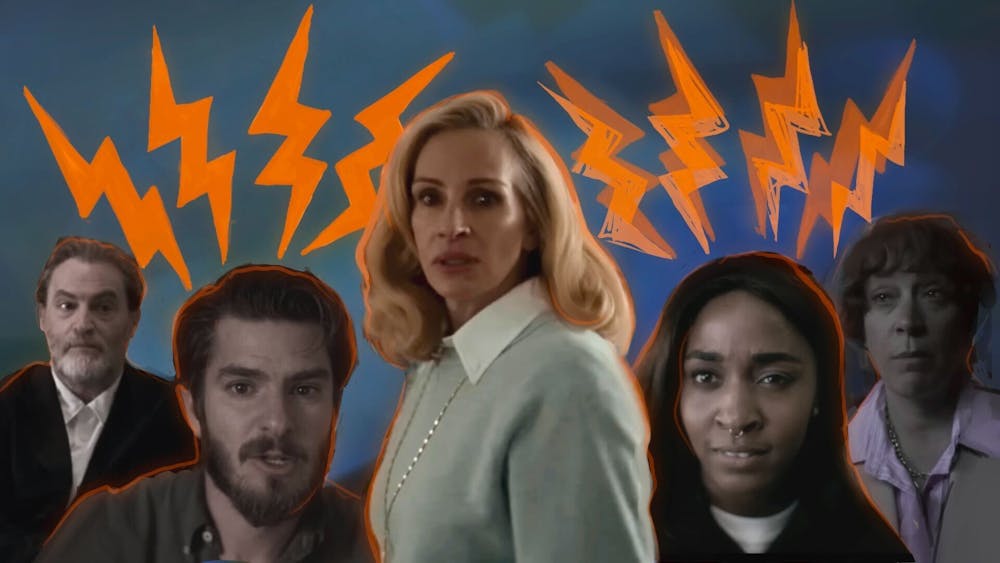
After the Hunt arrived at the New York Film Festival as a thriller that’s less about crime than it is about perception, power, and the institutions that shape both. Set in the cloistered world of an Ivy League university (Yale, luckily, and not Penn), the film follows Alma (Julia Roberts), a tenured professor who finds herself entangled in accusations, betrayals, and the unforgiving politics of elite education.
Luca Guadagnino has built his reputation exploring desire—films like Call Me by Your Name and Challengers thrive on it—but here he pivots to an inquiry into power. The film doesn’t ask what the truth is, but instead how many versions of it can be told—and who gets to decide which one counts. The premise, which mirrors an Agatha Christie puzzle, is more compelling in concept than in execution. Though its ambiguity frustrates as much as it fascinates, the film’s atmosphere and stellar cast never let the audience's attention go.
At a student roundtable hosted by MGM at the New York Film Festival, screenwriter Nora Garrett shares that she drew many of the film's details from her own Yale experience, where “the Gothic architecture was … both oppressive and lofty.” It was also a place whose privileged atmosphere stood “in stark contrast” to the state of the surrounding town of New Haven. That perpetual tension, she explains, made academia “the perfect space to tell this story.” And in the film, Yale’s cloistered environment becomes a metaphor for the characters’ own self–containment—a world where even authenticity feels performed.
Maggie (Ayo Edebiri) is an apparent star student of the Yale philosophy department who deeply admires Alma. The dynamic between Maggie and Alma personifies Guadagnino’s shift from desire to dominance. Their dynamic turns mentorship into a contest of control. But Edebiri is quick to resist any neat generational reading.
“I don’t think this film is necessarily saying you can’t expect mentorship from somebody older or with more privilege,” she says at the roundtable. “There are places where Maggie has power over Alma, you could argue. But between the two of them as human beings, there definitely was a sense of betrayal.”
Andrew Garfield, who plays Hank, another professor caught in the fallout, picks up on that point.
“Something about true mentorship—it has baked into it betrayal,” he says. “There has to be something broken for the younger to grow beyond what the mentor expected of you.”
The tension between power and performance defines every relationship in the film, and Guadagnino extended that tension past the on–camera action. On screen, characters struggle to maintain their composure; on set, the actors worked under similar pressure.
“With Luca, it’s one take—maybe two,” Garfield says. “He shoots on film, and it makes the space between action and cut sacred.”
This discipline is central to Guadagnino’s artistry. His filmmaking method suits a film obsessed with control and collapse, where every frame feels like a performance on the edge of breaking. Long takes trap characters in hallways and classrooms, while the camera lingers on hands—striking, clawing, or comforting—as if the characters' gestures reveal more than their words.
Michael Stuhlbarg, who provides much of the film’s warmth and humor as Alma’s husband Frederik, describes the task facing the actors:
“We take the information that’s given to us and we shape lives from that,” he says. “Even if our characters are doing something disagreeable, the viewer brings their perspective. You put it out there and let the chips fall where they may.”
His calm presence and dry humor grants the film some rare moments of release, proof that even in Guadagnino’s tight framework, humanity seeps through.
The ensemble cast thrives under that philosophy. Roberts is riveting in her restraint, Edebiri sharp in her volatility, Garfield menacing in a rare turn away from heroism, and Stuhlbarg strong as a needed source of levity.
Of all the performances, Roberts’s portrayal of Alma feels the most demanding. She plays the role with icy precision and admits to the difficulty of sustaining her character’s constant affectation.
“The details and the performative nature of Alma as a person and as a professor—all that posturing and what it would say or withhold—that was exhausting,” Roberts said. “I’m a much more wide open, frank person. To deal with posturing at all times was an immense challenge.”
After the Hunt is not a conventional thriller. Its pace is slow, sometimes to a fault, and its ambiguity may leave audiences unsettled. Yet it offers moments of humor and intimacy that break through the gloom, especially in Stuhlbarg’s scenes. More than a story about misconduct or scandal, the film becomes a study of optics—how appearances, headlines, and performances can matter more than the truth.
Guadagnino’s campus is a mirror of the world beyond it—polished, performative, and perpetually on the edge of collapse.
What lingers after the film's close is a certain bitter aftertaste: the sense that power and privilege are always shifting, that even those closest to us remain partly unknowable. As Guadagnino suggests at the roundtable, the mentor–mentee bond itself carries the inevitability of disappointment. Perhaps the film argues the same about institutions—they promise stability but eventually betray our trust.
Whether that argument feels profound or elusive will depend on the viewer. For me, the film's premise outpaced its execution, but its atmosphere—charged by sharp performances and Trent Reznor and Atticus Ross’s driving score—rarely let up and kept me engaged well past midnight. In the end, After the Hunt may not deliver catharsis, but it does deliver the unnerving feeling that truth is never final.