The 2300 Arena is sequestered in a lonely area of South Philly. Locating it by public transport involves navigating a convoluted matrix of bus lines, many of which begin far into West Philly before diverting across the Schuylkill. The arena itself is unassuming; it sits within a corrugated facade, bounded by narrow unlit streets. Yet inside is one of the best places in the city to experience the odd alchemical magic of pro wrestling.
The arena was not always the 2300. In the 1990s to the early–aughts, it was the Extreme Championship Wrestling (ECW) arena, the birthplace of death match wrestling in the American independent wrestling circuit. Death matches are as staged as any other type of pro wrestling, but do not depend on the sleight–of–hand of a “blade job”—that is, smuggling a thin razor into the ring and relying on clever camera–work to hide the moment the wrestler cuts themselves open. Instead, death matches use nail boards, knives, broken glass, and the occasional exploding barbed wire to draw blood “hardway.” No tricks; only a body breaking apart.
Death match wrestling, and the promotions like ECW that specialize in it, has thrived in the post–kayfabe era. Kayfabe is the myth that pro–wrestling storylines are “real,” maintained by a highly coordinated effort by wrestlers both inside and outside the ring. It became increasingly difficult to sustain in the 1980s, and eventually ruptured entirely when a widely televised match in 1996 revealed that wrestlers who played in–storyline mortal enemies were in fact close real–life friends. Death match wrestling has responded to the death of kayfabe by exploiting the porous boundary between the unreality of the storyline and the reality of the wrestlers’ suffering, proudly displaying the guts of the match and daring the audience to look away. See the glint of thumbnails driven into her back? Still think this is fake? The moment that blood is drawn, everything becomes grotesquely, inescapably real.
ECW was eventually bought out by the World Wrestling Entertainment (WWE) promotion in the 2000s. Its stars were either subsumed into the milquetoast family—friendly programming of the larger company or chose to chance their fortune in the dying American indie circuit. Other deathmatch promotions limped onwards but faced growing pressure as they hemorrhaged talent recruited by the WWE. It was not until 2019 that the spirit of hardcore American independent wrestling was revived with the establishment of All Elite Wrestling (AEW), a promotion founded by wrestlers who had spent most of their careers on the independent circuit.
That brings us to Sept. 11, 2025. AEW has been running shows in the arena for the past week, and the crowd is still pulsing with frantic energy. The arena itself is relatively small; the ring is surrounded by four rows of tightly packed seats, encircled by a general standing area where people manage to squeeze in. Being in the crowd is almost suffocating, but the closeness feels good in a place like this—where the roar of the crowd becomes indistinguishable from your own thoughts.
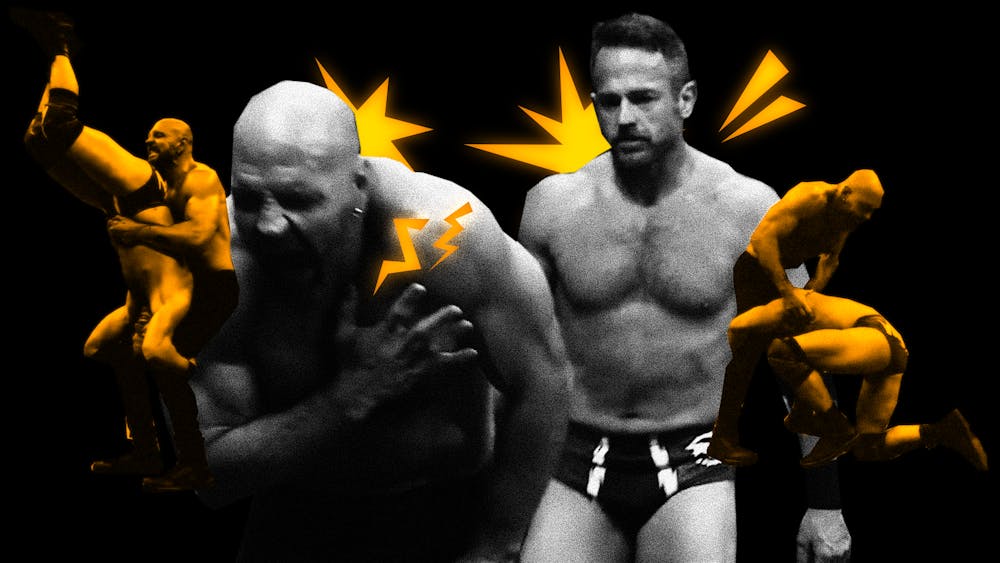
Tonight’s card is formed around a main event that seems calibrated to reference the history of the building. On the heel (villain) side: former AEW champion Jon Moxley and his new turncoat protege Daniel Garcia. On the face (hero) side: underdog Roderick Strong and doe–eyed Kyle O’Reilly. In storyline, Moxley has been involved in a months–long effort to forcibly convert AEW to his brutal, merciless vision of pro–wrestling. O’Reilly and Strong, both veterans in their own right, represent the stalwart heart of AEW.
Mox is the wrestler with the most obvious connection to the 2300. Before his rise to fame in the WWE, Mox was a kid out of Cincinnati, doing backyard wrestling before moving into the Northeast hardcore circuit. One of his last matches in the 2300 before his departure to the WWE was on a card evocatively titled It’s Always Bloody in Philadelphia. Mox starts bleeding early in the match from a rather clumsily executed blade job. The crowd’s reaction is tepid; after all, even then, Mox was known for his affinity for blood. But then the chairs come out, and the glass, and as the match enters its climactic moments, Mox picks up his opponent and slams him through a glass sheet perched between two metal chairs. The camera immediately zooms in on his opponent’s heaving back, where thin rivulets of blood have begun to run. Mox grins, near–manic at the sight. He’s still laughing when he gets slammed through his own sheet of glass.
Mox makes a characteristic entrance for the match tonight: a trek through the bowels of the 2300 into the screaming crowd. He projects a prowling energy as he stalks through the narrow walkway, his arrival accentuated by harsh white strobe lights. This is a building that suits him. As he steps through the ropes, the crowd hurls obscenities at him and grows even more venomous at the sight of his faction mate Wheeler Yuta, a native Philly kid who used to work as a stagehand for the 2300 before becoming a wrestler. One particularly biting insult comes from a young woman in the front row, who shrieks, “Wheeler Yuta loves the Cowboys!!”
The match itself is relatively predictable: a squash match meant to establish Mox’s malignant sway over his impressionable young faction mates. It is, objectively, not the best match. But this is the magic of seeing pro–wrestling live: even mediocre matches take on a startling physicality. You can never tell how very loud matches are from the television broadcast: no visuals can communicate the awful tactile reverberation of a body colliding with the mat. A simple bodyslam becomes terrifying. It helps, too, that Strong and O’Reilly suffer beautifully, spectacularly, brushing their hair from their faces during moments of high tension so the crowd can see their agonized expressions. The work pays off: through it all, the audience gasps in horror, screams in delight, and, by the end, descends into a simmering fury as the heels cheat their way to victory.
The most interesting moment, though, is quiet. Near the end of the match, when Mox has been tagged out, he touches his hands to his lips. His fingers come away bloody. He turns to the nearest camera and opens his mouth to show the audience his blood-slicked teeth. This is not the bait and switch of a blade job: this is proper blood, drawn hardway, offered freely to us. Mox in the 2300, it seems, is finally back home.