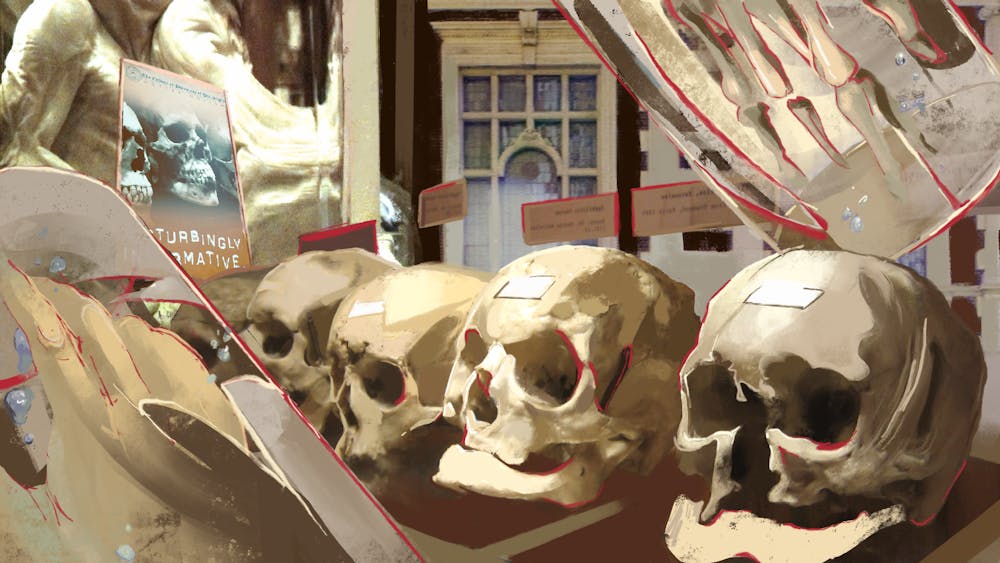
The Mütter Museum in Philadelphia is known for its Victorian–cabinet style spectacle of medical anomalies and preserved organs. Strolling through, visitors can see the Mütter American Giant—the tallest human skeleton on display in North America—or examine drawers from the Chevalier Jackson collection filled with objects removed from patients’ airways or digestive tracks. Other cases hold malignant tumors and pathological specimens, ranging from slices of Albert Einstein’s brain to Grover Cleveland’s tumor. One of the museum’s most well–known exhibits is the plaster death casts and conjoined liver of Chage and Eng Bunker, the original Siamese twins.
What makes this museum important today is that, when walking through its halls, visitors can feel as though they are stepping into a medical museum from the early 1900s.
Erin McCleary, senior director of collections and research, and Sara Ray, senior director of interpretation and engagement, both emphasize that institutions like the Mütter were once commonplace.
“I think it's really important to put into context that the Mütter feels really unique. It feels like something that just Philadelphia has, but these institutions were very widely found in the period from about 1830 to 1940,” McCleary says. “So in North America, virtually every medical school and many hospitals had museums like the Mütter … [they were] very widely spread. And so what's unique about the Mütter is that it has survived into the present day.”
McCleary pointed to Penn’s own history as an example. The University once housed the Wister & Horner Museum of Anatomy, which still exists, while the Penn pathology department maintained a pathological museum closely resembling the Mütter. Over time, the remaining specimens from Penn’s pathology collection were eventually transferred to the Mütter where they are now preserved as part of its holdings.
The majority of the Mütter’s remains were acquired between 1860 and 1940 through surgeries and autopsies performed in hospitals across Philadelphia. The museum’s burgeoning collection coincided with a broader scientific interest in using human cadavers to better understand disease, but many specimens were collected before modern rules about patient consent had been codified. Exhibits served a clinical and educational purpose rather than fulfilling mere anthropological curiosity. Because the Mütter’s collection grew out of the 19th– and early 20th–century medical culture, a substantial portion of the remains came from local residents, unlike most present–day anthropological collections.
“Most of the remains in our collection come from Philadelphia … from a wide range of socio-economic classes,” Ray said. “Because we can learn a lot about the remains within our collection, we can learn a lot about the people that are in the collection, and we can tell different stories about them [as individuals].”
However, in recent years, public fascination has raised questions of consent and display. During Kate Quinn's tenure as executive director from 2022 to 2025, the museum began a formal review of how it displays and contextualizes human remains. The process, titled Postmortem: Mütter Museum, included an audit of the collection, temporary changes to exhibitions and online content, and public engagement around ethical standards. The backlash from longtime supporters followed efforts under the museum’s previous leadership to remove or revise several high–profile displays of human remains to limit photography of the collection. These changes, supporters said, were implemented without sufficient transparency.
In 2023, employees and museum attendants created a petition to protect “the integrity” of the Mütter Museum. Many felt that collection removals were sanitizing historically significant material to minimize backlash.
This reassessment unfolded following the 2021 controversy surrounding the Penn Museum’s handling of MOVE bombing victims. On May 13, 1985, the police dropped an explosive on a West Philadelphia rowhouse occupied by the Black liberation group MOVE. It killed 11 people and displaced 61 families, including children. In 2021, it emerged that the remains had been retained and used for teaching without the consent of the victims’ families, prompting public scrutiny over how institutions retain—and showcase—human remains. In light of increased public scrutiny, the Mütter Museum became a focal point for ethical critique.
To combat rising dissent, the museum adopted a new human remains policy in 2025: “The Mütter Museum of The College of Physicians of Philadelphia has announced official policies in August 2025 that stress clear guidelines for the use, acceptance, and exhibition of human remains that will guide future donations and photography of the 6,500 remains in our collection.”
The rebranded policy reflects the new administration’s effort to reconcile the museum’s 19th– and early 20th–century collecting practices with contemporary ethical standards. Because many of the remains entered the collection before patient/family consent was formally required, the museum now seeks to acknowledge its contentious acquisition process while limiting future acquisitions of human remains. Moving forward, they plan to only consider those offered by a living donor or through a bequest, retaining the right to decline such gifts.
Much of the controversy surrounding the museums stems from how the Mütter’s collection was acquired in ways that we can now recognize as ethically problematic. In early 2023, a national investigation into institutions holding Indigenous remains revealed that the Mütter had not yet made all eligible remains available for repatriation, prompting a wider reassessment of its professional ethicality. As part of a two–year review process called the Postmortem Project, the College of Physicians of Philadelphia and the museum updated its human remains policy to set guidelines aimed toward “contextualizing their history and provenance,” rather than feature them as curiosities.
The revised policy included several repatriation efforts. Since April 2024, several remains that were thought to be of Native American individuals have been returned to tribes under federal law. At the same time, longtime supporters have pushed back against changes they feel alter away the institution’s legacy and unique appeal. The controversy, Ray suggested, comes from people talking past one another.
“Everything is kind of just asking for the same thing, which is just more context,” she says. “I just think they’re talking about those things or asking for those things in slightly different languages.”
She also describes the tension as a clash between bioethics and museological ethics. “Those are not the same set of professional ethics,” Ray said, adding that conversations often stall when “people are asking the question from one ethics and answering the quotes from another ethics.”
So what does this divide look like in practice?
Bioethics focuses on consent and the moral treatment of human bodies, both in life and after death, while museological ethics centers around preservation and an institution's responsibility to care for and present collections to the public.
That split is rooted in how different kinds of museums have historically justified keeping human remains. Medical museums used bodies to demonstrate disease, anatomy, or surgical knowledge; remains were retained for their instructional value, even when individual consent was unclear. Anthropological museums, by contrast, developed ethical standards. These were shaped by the questions asked on ancestry and cultural harm. The medical framework asks, “What does this body teach?” and the anthropological framework asks, “Who does this body belong to?” The tensions come to surface when human remains are treated as both scientific evidence and human beings with social and ethical claims.
Determining the museum’s vision for its future collections is an ongoing project led by McCleary and Ray. Both are Penn alumni with PhDs from the History and Sociology of Science program. Under the museum’s new leadership structure—sans the position of the museum director—Ray oversees how the museum interprets and presents its collections through exhibitions and public programming. McCleary leads archival and historical research into the museum’s human remains through historical sources.
The Mütter's new approach foregrounds historical context. The idea is that the future of the museum lies in changing how human remains are understood. That work begins behind the scenes. Through hands–on archival work, McCleary’s team hopes to uncover the life stories behind each organ and their medical narrative.
“We’re doing this good old gumshoe detective work through paper archival records,” Ray says. “[That includes] vital records, death records, census records … these are really the methods of the humanities, not of the sciences … it’s actually less efficient than just using the data that we get from the way that these materials were donated … and using those as the basis for going into other paper records. So, it’s a fascinating detective story, but it’s really one that’s … drawing from the methods of the humanities.”
That balance between scientific inquiry and humanistic interpretation mirrors the approach emphasized in Penn’s HSOC program. The major looks at how scientific knowledge is produced within social and historical contexts. Ray pointed to the program as an example of how integrating humanities–based methods can change how scientific institutions understand or perceive their work.
“[My old students] write to me and say [how their] HSOC education actually gave them a really significant edge within those scientific disciplines, because they were able to ask questions and solve problems in ways that their pure scientific education didn’t necessarily [prepare] them to do.”
These fragments matter because they complicate the idea that the collection is anonymous. While the remains are often treated as specimens, many belonged to people who lived and died in the same city where the museum still stands.
McCleary emphasizes that the museum’s revised approach is not meant to excuse the institution’s problematic past.
“This is not giving a pass to historical actors,” she says. “This is laying out the historical circumstances under which this collection was obtained, and really thinking through what those past power differentials look like, what those past relationships looked like, and sharing that information with our audiences. [The goal is to present] the historical circumstances under which this collection was obtained.”
McCleary says the goal is to move questions away from the online conflict and toward in–person dialogue.
Looking forward, the museum is shifting toward what Ray calls “communities of care” rather than focusing solely on biological descendants. The language of “care” is framed as amplifying stories that foreground the identities of the deceased, asking how disability or illness may have shaped their lived experiences.
“If we know who this person was and where they lived in the city and what kind of job they had, whether they had a disability and how they moved through the world, we can think really creatively about how to integrate that person’s humanity into the story we tell through their body.”
For now, the practice of that is still taking shape; the Mütter's revisions remain an ongoing project. However, Ray believes that true change requires moving beyond rethinking how the museum presents bodies to a broader reevaluation of how visitors are asked to see them.