There’s nothing quite like a speedster vaporizing a woman to introduce a new series. From its premiere in 2019, the critically acclaimed series The Boys has achieved a level of success rare in the industry today. Its masterful references to topical events, combined with its use of unique marketing tactics, has allowed it to garner an audience dialed into its criticism of capitalist America.
The characters in The Boys find themselves caught in a familiar dynamic of inequality when our main protagonist, everyman Hughie Campbell (Jack Quaid), joins a rebellion against “the world’s number one supe,” the villainous Homelander (Antony Starr), and his Justice League–spoof team The Seven. His adventures take him very quickly from his somewhat grounded everyday life to a fantastical and weird (though nonetheless relatable) journey of high–octane combat and suspenseful espionage, rumbling with both corporations and governmental figures.
The show’s success has inspired an expansion of the universe in the form of the spin–off series The Boys Presents: Diabolical and Gen V, both of which play into the same forms of satire that fueled the success of The Boys.
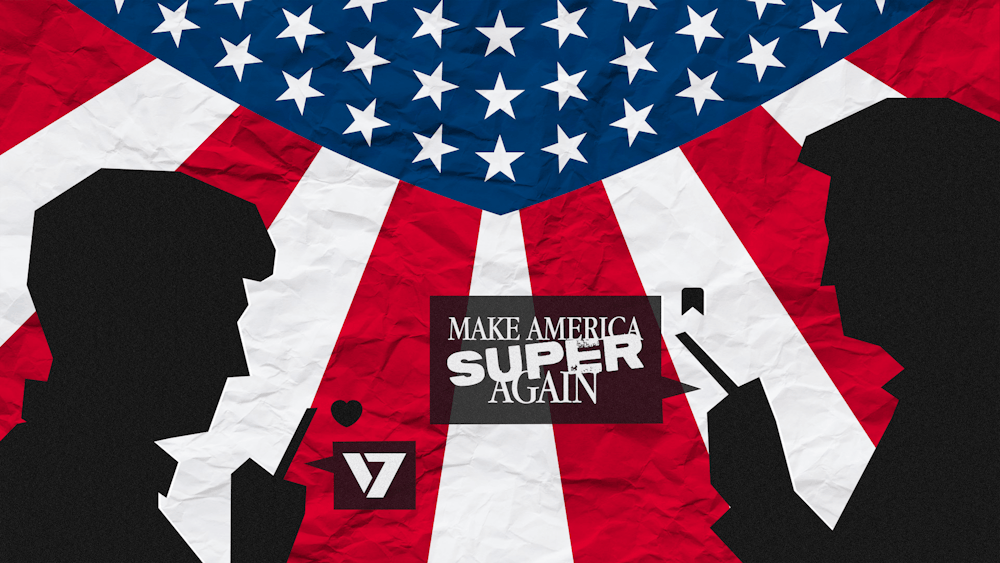
Given the Digital Age’s tendency to blur the lines between reality and fiction, it should come as no surprise that eventually, this phenomenon would reach television—and The Boys stands strong as one of its foremost cases. Witty, sharp, and timely, the show’s plotlines often dramatize real–world events, following the rapidly shifting state of American politics. In the real world, political developments are often communicated through social media channels from both sides of the aisle. The Boys plays on this fact through a uniquely immersive marketing strategy: the incorporation of social media posts and news dispatches into its advertising campaign.
Vought International, the fictional company that funds and houses The Seven, has created accounts on social media platforms like YouTube, Instagram, and X, which house a number of fictitious shows and podcasts. These serve to flesh out more of the shows' universe and connect seasons of the show through exclusive content—take, for instance, Seven on 7, a companion news channel run by in–universe news anchor Cameron Cole (Matthew Edison) that reports on canonical events between seasons two and three of The Boys. These range from propagandized coverage of the in–universe Secretary of Defense to a humorous—though quite real—G–Fuel sponsorship. Vought's combined subscriber count currently sits at over one million, and content ranges from real–world collaborations with popular companies like Opera and Activision to hints at future in–universe events. There is also a dedicated Vought website and a website for Godolkin University—the central location of the aforementioned Gen V—complete with an online tour of the campus and merch store.
God U has deep ties to Vought via its secretive testing labs, and features a black main protagonist, Marie (Jaz Sinclair), who must navigate racism and questions of sexuality along with all the other trials of college and herodom. Following Marie’s adjustment to college life, Vought has posted a slate of new videos and advertisements, with their content remaining equal parts cryptic and humorous. While these posts operate primarily as promotional materials, they also continue to play into the established secondary strategy of spoofing real events, with a greek life video and energy drink advertisement referencing classic college experiences. These videos additionally feature some of the college’s new faces, like Sam Riordan (Asa Germann) and Cate Dunlap (Maddie Phillips), who served as minor antagonists in the previous season.
There is a rare refusal of censorship within this franchise that has allowed it to fully capitalize on controversial political happenings throughout its run. Perhaps the most relevant example would be the release of the “Herogasm” files in The Boys, a play on the first phase release of the Epstein files facilitated by Attorney General Pam Bondi in February. The files are doctored, with added names like Starlight (Erin Moriarty), a character viewers know to be staunchly anti–Vought. The beauty in this level of engagement is that it gives the audience a place to meditate on real–world events in a safer way, since they’re criticizing fictional characters instead of real political figures. This campaign has been received astonishingly well, with forums and online subspaces praising its immersiveness, variety of content, and integration into and alongside real–world advertising.
Cashing in on real–world developments allowed The Boys to first capture the attention of the American public in the midst of President Donald Trump’s controversial first term. Beyond standard advertisements, the show's engagement of technology and social media has helped expand the scope of its interactions with the real world. But the relationship between the show and its social media outgrowths is not a one–way street—the canon generated by these pages’ content also contextualizes the overall narrative. We come to better understand the ways in which Homelander generates propaganda for the American people by viewing clips of the in–universe podcast The Truthbomb, moderated by superheroine Firecracker (Valorie Curry), this universe’s stand–in for the recently deceased American political personality Charlie Kirk. The adoption of and commitment to such layered levels of engagement lend special credence to the show’s immersive nature and distinct parodizing ability.
There are other implications to this type of engagement, though. The entire IP does well to humor audiences and delivers a salient message, but it also acts as a form of dialogue in and of itself. The show speaks to the fact that superheroes are constantly being marketed to the world, from the draft–like nature of God U’s top 10 heroes list to the films and merchandise that surround established heroes. Each and every piece of social media communication within the universe is built for a distinct purpose, and though we as an audience should be able to recognize this, our responses do not necessarily convey that we do.
The Boys has been caught in a political tug–of–war between the left and right, both claiming it as a representation of their beliefs. And while the showrunners have come out and firmly established the show as a critique of Trump and corporate America, one can only worry that perhaps the show has been too effective in committing to the bit. There's no doubt that The Boys is a brilliant piece of satire. But in an age of concerns over media literacy and challenges to critical thought, one is forced to ask how much of it can really be taken as jest, and how much plays into the narrative a little too closely.
Only time will tell. With Gen V’s second season now airing, audiences can look forward to new content from this universe. And while series like South Park have seen their content affected by the rapidly developing effects of political activity on various forms of media, we will hopefully see a continued consistency in the spoofing of real–world events in the episodes to come.