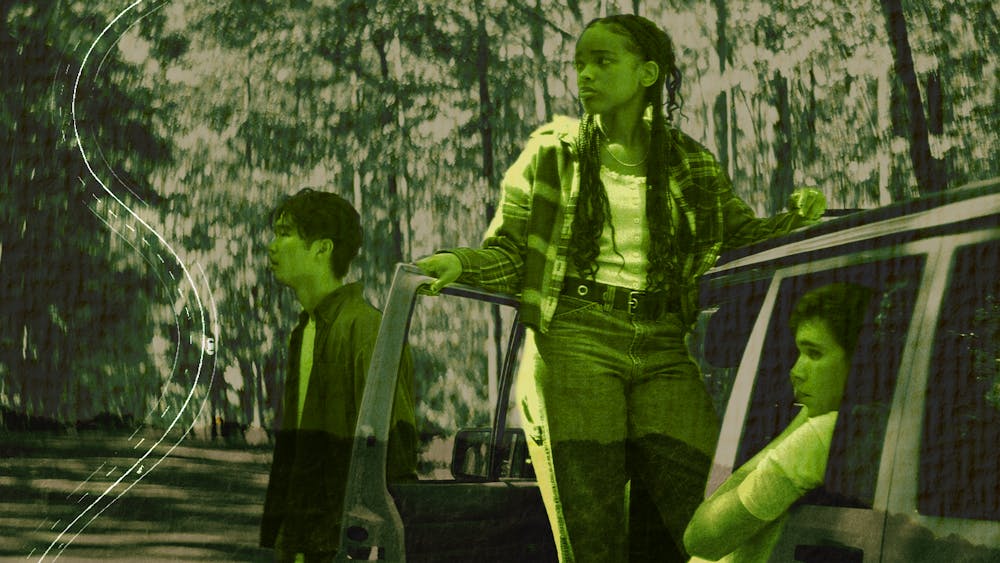
There’s a moment in It Ends when a car’s headlights catch the glint of something in the trees and James (Phinehas Yoon), the film’s uptight and hyper–rational protagonist, can only say: “We need to keep going.” The others don’t protest. No one knows what’s ahead, but stopping means danger. For anyone else in their twenties right now, it feels painfully familiar. We all keep driving, even if we don’t know what the road before us looks like anymore.
That’s the basic premise of It Ends, the highly conceptual debut project of director, writer, and editor Alexander Ullom. Four college–aged friends pile into a cramped Jeep Cherokee for what’s supposed to be one last drive together, only to realize the road they’ve turned onto won’t end. No matter how long they drive, they can’t escape. The forest stretches forever, their phones won’t map the way out, and whenever they try to stop, shrieking silhouettes spill out from the trees, yelling for help. It’s a literal trip through hell and a metaphor for the limbo of adulthood—navigating the terrifying space between who you were and who you’re supposed to become.
The group is instantly recognizable. There’s Tyler (Mitchell Cole), the hard–working unspoken leader who skipped college altogether and now works in HVAC repair. There’s Day (Akira Jackson) and Fisher (Noah Toth), an aimless pair drifting between creative projects. And then there’s James, the overachiever who’s already half–checked out; he's the guy with a job lined up and a thinly–veiled disdain for his friends’ lack of direction.
Ullom sketches these characters out with a startling degree of realism. Their banter is the kind of spontaneous, absurd, and occasionally cruel humor that defines most Gen Z friendships—both disposable and deeply intimate. When I watched It Ends, I didn’t just believe these people knew each other. I felt like I’d been in the backseat with them before. The rhythm of their teasing, the mix of affection and passive–aggression—it was all too familiar. Ullom takes the members of a typical iMessage group chat and drops them straight into hell.
That naturalism is what gives It Ends its emotional punch. The existentialist mystery hooks you in, but it’s the growing realization that each of these characters embodies a different way of dealing with the uncertainty of life that makes the film so compelling. Ullom’s purgatory is less of a physical space than it is a psychological prison. The road becomes a trap not only because it goes on forever, but because the people inside the car don’t know who they are when they can’t move forward.
All the characters cling to different reasons to keep going—or eventually, to give up—but James is the one that stuck with me most. His rigidity, his arrogance, his inability to relax even as reality collapses around him—everything about him hit too close to home. Maybe that’s because Ullom, who’s also a part of the Asian diaspora, seems to be working through his own past through James.
In a post–screening Q&A at the Philadelphia Film Festival, Ullom confesses that James’ opinions on the road were the ones he lived.
“I have friends that are very like Tyler, especially growing up in Florida, but specifically, I am James,” Ullom says. “As I got older, it was weird deconstructing the stuff that I was trying to articulate about the systems that were making me feel that way.”
James is a child of overachievers, the kid who learned early on that success is survival. He turns philosophical arguments into competitions. When the car becomes their prison, he’s the first to verbally spiral—not because he’s scared of dying, but because he can’t stand the lack of logic to what’s happening. There’s no way to fix it.
The film can be interpreted in many ways, but for James, it’s a quiet tragedy. He’s raised to believe that control is everything, and suddenly, he’s forced into a situation where it means nothing. He’s left in a place where the only thing he can control is how he reacts, and the intensity of that revelation drives a wedge between him and the friends that could’ve comforted him.
Ullom weaves this personal conflict into the film’s larger existential horror story. It Ends isn’t just about a cursed road; it’s about how young people handle the quiet terror of having nowhere to go. Ullom confirms that the film is made for “anyone who’s ever grown up before,” but more specifically, it targets those “inheriting a world without any sort of structure.” For a generation entering adulthood during a pandemic, a sociopolitical crisis, a recession, and a climate emergency, it’s perfect. Ullom understands that the scariest part of growing up right now isn’t dying—it’s inertia.
That’s why the film’s ending leaves the audience with so many complicated thoughts. Without giving away too much, it’s both nihilistic and weirdly hopeful. There’s a small, human, and defiant gesture that suggests meaning might exist even if escape doesn’t. It’s the kind of ending that refuses closure, but still lingers. In a lesser film, the ambiguity would feel lazy. For It Ends, it feels like a reflection of our lives. Even when the pacing lags or the metaphors feel a bit too on–the–nose, there’s something incredibly magnetic about watching the four archetypes cycle through their coping mechanisms.
Though the title may give away the ending, Ullom makes It Ends worth the watch for a generation born into uncertainty. The film peels back our walls, exposing our ugliest impulses and deepest fears. It doesn’t hand over any easy answers—but maybe that’s the point. Even when the road we’re on refuses to let us go, Ullom reminds us that salvation was never at the end—it was sitting beside us the whole time.