I love Juicy Couture. Not the TJ Maxx, high–waisted, poor–quality Juicy Couture, but the Britney Spears, Paris Hilton, Lindsay Lohan Juicy Couture. When I explain this to my dad, he asks, “Is there actually a difference?” I gasp. What an absurd question! Every cultured man and woman should understand the dichotomy of the then and now Juicy Couture. The juicy story is a classic tale of success and iconography, coupled with economic distress and deep detriment. It is far more interesting than The Old Man and the Sea or any PBS program ever (except for the 60 minutes episode about that Russian umbrella poisoning).
In 1988, Gela Nash–Taylor and Pamela Skaist–Levy met while both working at a boutique. They initially created a maternity clothing line together, Travis Jeans for the Baby in You. But in 1995, the women decided to pivot to something different. With $200 and a line of credit, the nectar of the Gods and some fairy dust, Juicy Couture was created. The vision: luxury casual apparel, with a hint of attitude (hence the cheekiness of a casual brand called “couture”). Their first product was a V–neck T–shirt, and after came Juicy Jeans, and some accessories. But it wasn’t until the dawn of the 21st century that Nash–Taylor and Skaist–Levy utterly and completely tipped the Earth off of its axis.
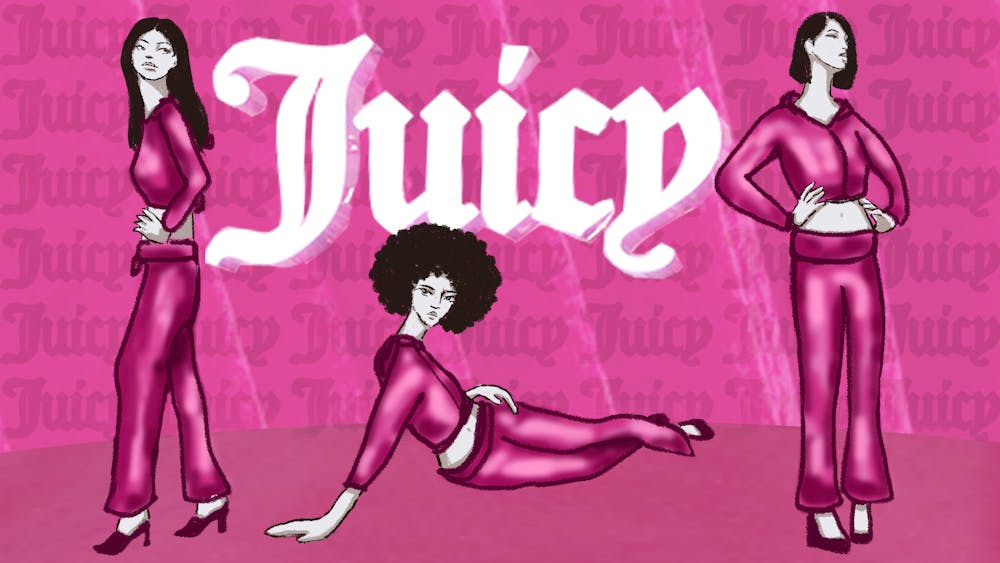
In 2001, the women released the Juicy Couture tracksuit. Every detail of the tracksuit was iconic: the jacket cropped, but not too cropped, zipper shaped like a little “J.” The pants were low waisted and bootcut, and the material a cozy terry cloth in practically any color. Some were plain, some rhinestoned, and some with cheeky slogans on the back, like “Choose Juicy.” For $155—not exactly a bargain, but not completely egregious—the tracksuit could be yours.
From Beyonce to J–Lo to Regina George’s mom, every it–girl, or wannabe it–girl was decked out in candy colored Juicy tracksuits. Paris Hilton, the OG Juicy girl, told Vogue that “I just fell in love with the brand and it [the tracksuit] basically became my uniform—I was not only wearing them to the airport, chilling at my house in them, but I was going out at night in them and I was rocking them with everything.”
In 2003, Juicy Couture was sold to Liz Claiborne (Kate Spade & Company), for $226 million. The brand was so fun, flashy, colorful, and lighthearted; “It makes people happy” said Skaist–Levy. Net sales nearly doubled from 2006 to 2007, apparel being sold in practically every department store nationwide. In 2008, the brand had 100 of its own stores racking up $605 million in sales. They were producing tracksuits in both terry cloth and velour, an even softer material. They were selling the most gorgeous handbags in the world, accessories including jewelry and sunglasses, and even had a perfume line, Viva La Juicy.
One of my personal favorite Juicy products is their old graphic T–shirts, which hosted an assortment of ironic mantras, like “Juicy Pop Royalty,” “good girls go to heaven but Juicy girls go everywhere,” “loosen up wear juicy,” “I don’t want your love I want Juicy,” the famous “dump him” tee, and so on.
But then, the 2008 recession hit, and—like the economy—fashion receded. Showy, neon, sparkly, branded clothing felt inappropriate and exorbitant, and thus began a shift towards minimalism. This is the sentiment behind the Hemline Index: as the economy prospers, women's hemlines shorten; as the economy recedes, hemlines become longer. In 2008, luxury brands rapidly shifted their designs to darker colors, geometry, and dystopia. Unfortunately, Juicy was everything but minimalistic, and sales began to plummet. Skaist–Levy and Nash–Taylor left the company in 2010, and three years later Juicy was sold to Authentic Brands Group for less than $200 million.
The brand just could not get off of the struggle bus. In July of 2014, Authentic Brands Group announced that all existing Juicy locations would be closing. Authentic Brands Group later made a deal with Kohl's to sell Juicy apparel. So Juicy never died, it just went from Bergdorf Goodman to the discount store. Which wouldn’t matter, if it didn’t also happen to plummet in style and quality as well. This is where my angry rant begins.
To whoever is making production decisions at Juicy Couture, what in god's name are you doing? The “velour” you are using is now thin and stretchy, giving your tracksuits a subtle but horrible sheen. The fit of most of your clothing is, frankly, horrifying. High waisted? Tapered bottoms? Overly cropped hoodies? Scalloped edged shirts? Horrible fonts? That odious waistband? You even managed to ruin the once adorable J zipper.
Every modification screams mass production. The design feels unintentional in the sense that it does not consider the consumer, but the cheapest means of production. Juicy used to be ahead of the trends; now it lags so far behind, it is embarrassing. Juicy is manufacturing products with a Temu budget and then selling them for over $200 a set. The apparel is so oversaturated, it has detached from the care and intention that Nash–Taylor and Skaist–Levy bestowed upon the brand.
Though Juicy is beginning to see the light with their Heritage Velour line, they are barely harnessing their full potential. But the sloth of modern Juicy Couture doesn’t mean that our desires must be stunted. This is my battle cry to scour the depths of eBay, lowball those Depop shops, and barrel through Goodwill after Goodwill. I want to walk down Locust Walk, a sea of navy, grey, and black, and see students scampering about in fuzzy pastels and neons and jewel tones. We need a Juicy Renaissance. Now. These are trying times, and what better cure to misery than bright colors, rhinestones, and irony? Choose whimsy! Choose Juicy!