Every year, the comic book market leaves behind a paper trail of what actually matters. Not what critics praise, not what goes viral online, but what retailers order in bulk and what readers consistently pick up. The best–selling comics of 2025, viewed month by month, offer a revealing snapshot of where the industry’s commercial center of gravity now sits and what kinds of storytelling it is quietly incentivizing.
At a glance, the lists look chaotic: superheroes (duh), crossovers, reboots, events, and alternate universes all jostling for attention. Look closer, though, and two patterns begin to dominate the data. One character appears with relentless consistency, and one publishing strategy appears almost everywhere else.
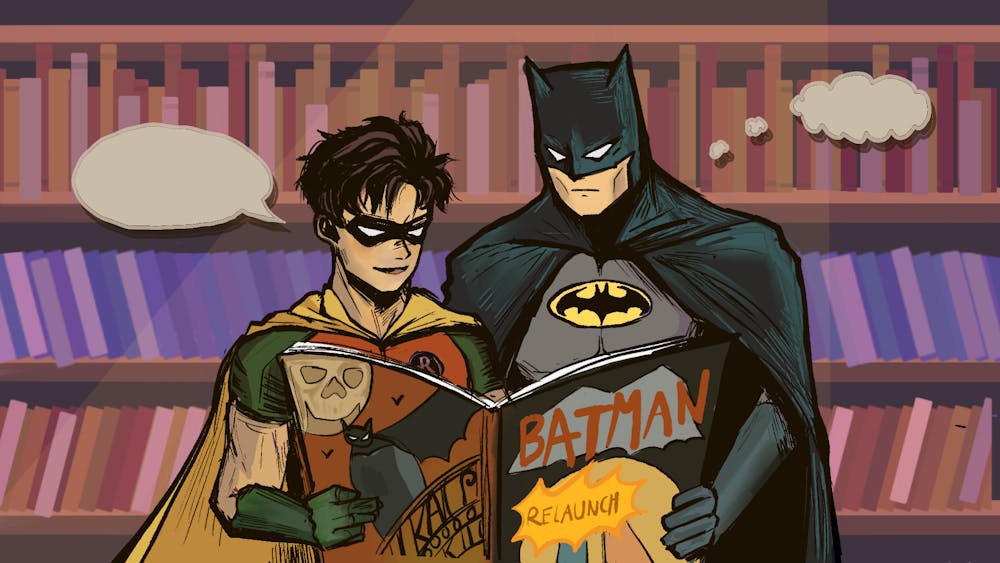
Batman. And the constant relaunch (“Issue #1!!”).
Neither trend is new, but 2025 crystallizes how central both have become to the business of comics—and how deeply they shape the way the medium now operates.
Start with Batman. Across the entire year, he never meaningfully disappears from the charts. Core Batman issues, Absolute Batman, annuals, crossover specials, relaunches, and event tie–ins all cycle through the top ten. Most months feature multiple Batman titles simultaneously. The specifics change, but the presence does not.
This pattern becomes even clearer when the numbers are placed side by side. When the year’s best sellers are directly compared—title against title—it becomes almost laughable. Batman occupies 16 of the top 20 spots and 19 of the top 25 globally. The performance of Marvel, Batman’s rival comic company, underscores the imbalance: its two highest–selling books of the year were not core line issues, but a Batman crossover followed—a gaping 21 spots later—by Ultimate Wolverine #1. The takeaway isn’t simply that Batman sells, it’s that the market rewards what’s familiar—so much so, that even Marvel’s biggest wins arrive either through shared branding or the artificial spike of a relaunch and alternate universe.
Batman’s dominance becomes even more pronounced when placed alongside another recent trend: how often comics start over.
A relaunch is typically when an ongoing series “ends” its current run and, with little to no gap in publishing schedule, continues with a new numbering system—beginning with #1. It is not a “new series” (like Batman Beyond, following a far distant future version of Batman); rather, it’s a soft reset designed to lower the barrier to entry. Sometimes, it means resetting to a certain status quo (their relationship status, power level, coterie of villains), but sometimes not. Sometimes, it means an entirely new creative team. Occasionally, publishers have “initiatives” that lead to their entire slates relaunching—like DC’s New 52 and Rebirth with their in–universe shake ups and reboots. Occasionally, it seems as if series are chosen at random to “restart.”
Take Amazing Spider–Man #1 in 2025, for example. It followed directly from the previous run with no meaningful narrative break—same world, same continuity, often the same unresolved threads—just a reset number designed to signal accessibility. All of it is purely cosmetic. Other times, a relaunch carries the promise of change without fully committing to it. A new writer or artist may take over, a tone may shift slightly, or a character’s circumstances may be rearranged just enough to justify the new #1 on the cover. Rarely is continuity erased; far more often, it is selectively ignored or streamlined, allowing long–running narratives to continue while being marketed as a fresh start.
That glorious “#1” tells retailers to order more copies, tells lapsed readers it’s “safe” to jump back in, and tells new readers they won’t be punished for missing what came before. In that sense, a relaunch is less a creative event than a commercial one—a way of periodically resetting attention without truly resetting the story.
Scan the monthly leaders and low issue numbers dominate: Fantastic Four #1. Captain America #1. Amazing Spider–Man #1. Batman #1. Absolute Flash, Martian Manhunter, and Green Lantern #1. Ongoing series are frequently renumbered or relaunched to simulate a fresh beginning. The #1 issue has become the industry’s most reliable sales tool.
The logic is straightforward. A first issue promises accessibility by lowering the barrier to entry. Retailers order more copies because new readers are more likely to sample something labeled “#1” than issue #47, let alone #500. In the short term, it works. The charts prove it. What’s changed is how dependent the industry has become on that tactic.
In 2025, comics have reoriented themselves around interchangeable entry points rather than cumulative storytelling. Series are no longer rewarded for endurance, escalation, or payoff; they are rewarded for being easy to pick up and easy to put down.
Even Batman is not immune to relaunches, but his are rare and never frustrating. He thrives under this model not just because he’s popular, but because he’s unusually flexible. His meaning is not bound to a single life stage, emotional arc, or personal circumstance. Batman does not have a fixed status quo so much as a governing idea: a billionaire orphan who turns trauma into a weapon and wages a never–ending war on crime. Everything around that idea—the Bat–family, Gotham’s politics, even Batman’s own temperament—can evolve without breaking the character. Alfred has been dead in continuity for nearly a decade with no clear plan to reverse it. Robins come and go. Gotham itself shifts tone and scale. Batman absorbs change rather than resisting it.
Spider–Man, by contrast, is defined by accumulation. His appeal is emotional and cumulative: a struggling Peter Parker juggling power, responsibility, money problems, relationships, and guilt. When fans complain that “Marvel editorial is butchering Spider–Man,” what they’re often reacting to is how aggressively that status quo is protected. Yes, the general public thinks of Peter as a broke, single photographer for the Daily Bugle, but he has been so much more than that. Unfortunately, Marvel seems to be attempting to tailor to that general public opinion. Marriage, parenthood, professional stability—each time Peter grows into something new, the story eventually snaps him back. The popularity of alternate–universe Spider–Man stories—especially Ultimate Spider–Man by Jonathan Hickman—comes from finally giving readers what the main line refuses to: a Peter Parker who is allowed to move forward.
Batman doesn’t lose trust when he restarts because readers don’t need his life to progress linearly. He functions as an idea that can be reinterpreted endlessly (see how many different takes on Batman exist: Immortal Legend Batman, Batman Beyond, Absolute Batman, Gotham by Gaslight, Earth One); Spider–Man functions best as a life story that gains meaning over time, but under a market built on constant #1s and soft resets, he is caught between what readers want him to become and what the publishing model insists he remain.
That dominance is amplified by Absolute Batman which has become the single most successful publishing experiment in mainstream comics over the past few years. Briefly, DC’s Absolute universe is a gritty, alternate world containing some of their most popular characters, stripped down to their core traits. Of the top 20 best–selling issues of 2025, Absolute Batman alone accounts for 11—despite publishing only 13 issues total that year. It succeeds because it embraces a “reset” as a creative mandate rather than a cosmetic trick.
For most properties, that Bat–safety net doesn’t exist. When a mid–tier or new series relaunches, the implicit message is that the previous version failed to justify its own continuation. Over time, this trains both readers and creators to treat stories as provisional.
For example, Carol Danvers’ Captain Marvel has relaunched seven times since 2012, often without meaningful narrative breaks. Guardians of the Galaxy has relaunched nine times since 2008, cycling creative teams and tones before momentum can solidify. Each new #1 produces a brief sales spike, then fades; the more often they restart, the harder it becomes for any single version to matter.
Taken together, the trends of 2025 point to an industry optimizing for immediacy. Crossovers (Batman / Deadpool, Godzilla Vs. Spider–Man, and Superman / Spider–Man in 2026) promise spectacle without permanence. Alternate universes (Marvel’s Ultimate line and DC’s Absolute universe) offer novelty without obligation. Events (D.C. K.O., Ultimate Endgame, Godzilla Destroys the Marvel Universe) spike attention without demanding follow–through. Batman sits at the center of it all because he bridges the old and the new—legacy without fragility, familiarity without stagnation.
The charts suggest an industry working aggressively to remain viable. But they also reveal what the market now rewards: accessibility over accumulation, brands over patience, and restarts over endurance. Comics are uniquely vulnerable to this shift because they are the only major storytelling medium with relentless, weekly output—dozens of new issues every Wednesday, year after year, with no natural pause. Movies and novels don’t create the same anxiety about “catching up” because their release schedules are finite and event–based. The result is a comics market that prioritizes immediacy not because long–form storytelling stopped mattering, but because the volume itself has made endurance feel like a burden rather than a reward.
Batman thrives because he can withstand that environment. The question left open in 2025 is whether anything else can grow under the same conditions—or whether the industry is slowly training itself to rely on fewer and fewer pillars to hold everything up.