
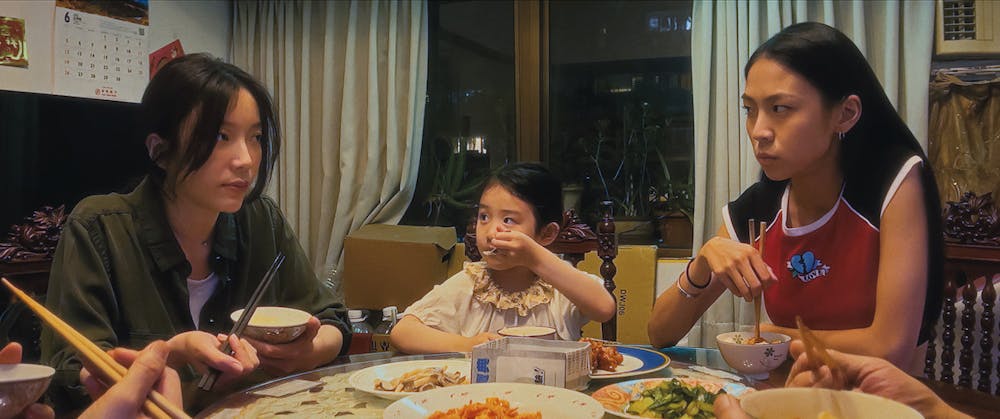
In Shih–Ching Tsou’s Left–Handed Girl, Taipei glows like a fever dream. It’s a city that never stops selling—night–market snacks, secondhand kitchenware, wholesale jewelry, you name it—but it also trades in the lives of its people. The film’s neon–lit streets and humid night markets form the backdrop for a portrait of working–class womanhood that’s both romantic and devastating.
The film follows Shu–Fen (Janel Tsai), a single mother who returns to Taipei with her 20–year–old daughter I–Ann (Shih–Yuan Ma) and five–year–old I–Jing (Nina Ye). Shu–Fen sets up a small noodle stall in a night market, stretching every dollar whilst trying to shield her daughter from the hardship she herself endures. While I–Ann takes a job at a betel–nut stand, I–Jing drifts through the night market, absorbing the world around her. Each woman is shaped by a different set of social forces: I–Ann by the contradictory demands of contemporary femininity, I–Jing by conservative family members bent on disciplining her innate left–handedness, and Shu–Fen by debts, widowhood, and the lingering weight of her family’s judgement. Subdued and empathetic, the film lets small routines, frictions, and humiliations accumulate, tracing how generational pressures settle uneasily within a single household. Shot entirely on an iPhone, the vibrant yet naturalistic cinematography creates a sense of lived–in melancholy. With its slow–building tension, Left–Handed Girl unfolds as an intimate character study of how three generations of women try—and sometimes fail—to survive in Taipei.
Under Tsou’s lens, each of the women is portrayed with tremendous realism and detail. Shu–Fen’s life is shaped by obligation. After her abusive ex–husband’s death, she’s stuck with his debt, paying for his hospital bills and funeral despite barely being able to afford her own rent. Her refusal of help from Johnny (Teng–Hui Huang), the well–meaning vendor beside her stall, speaks to a self–sacrificing ethic of womanhood she's inherited from a more traditional generation. She clings to the illusion of self–sufficiency, as if enduring sacrifice could prove her worth. Her actions are both moral and masochistic, a product of the traditional values that bind her tighter than financial constraints ever could.
I–Ann’s rebellion seems the opposite of her mother’s stoicism, but it’s driven by the same desperation. I–Ann’s job as a “betel nut beauty”—a distinctly Taiwanese phenomenon where young women sell the mild stimulant from garishly lit glass enclosures while wearing sexy clothes—turns her body into a commodity. She performs confidence and control in front of lustful customers and an exploitative boss. Yet behind that performance, she’s still trapped in a kind of servitude—the power she feels is actually harming herself. Her rebellion is less a form of liberation than it is another kind of self–destruction, promising autonomy while hollowing her out.
Then there’s I–Jing, the titular left–handed girl. Her childhood becomes a microcosm of the forces shaping her mother and sister. Labeled “the devil’s hand” by her conservative grandfather who carries historical and cultural prejudices, her left–handedness serves as a site of intergenerational anxiety. But even as she bows to the demands of her relatives, I–Jing maintains her mischief. She decides that if her left hand is the “devil’s,” then it can get away with devilish acts—stealing toys and trinkets from night–market stalls and even taking forged visas she hopes to sell. Her hand does the devil’s work, so she doesn’t have to take any responsibility for it. Though her coping mechanism is humorous and warm, it’s no less revealing. Even at five years old, I–Jing is forced to navigate a world ready to punish her for what she can’t change.
The arcs of these three women all echo each other’s: although Shu–Fen, I–Ann, and I–Jing inhabit different ages, attitudes, and versions of womanhood, the structures shaping them are remarkably consistent. What shifts isn’t the conditions they’re in, but the coping mechanisms each of them exhibits. Shu–Fen’s self–destruction is disguised as sacrifice, while I–Jing’s self–hatred is masked by tradition and I–Ann’s is framed as liberation. Across generations, the same pressures take new forms. All three rationalize their acts as ways to survive systems that refuse to grant them dignity—familial obligation, sexualized labor, conservative discipline, and the omnipresent demand to endure whatever comes their way.
But Tsou doesn’t just observe these patterns; she condemns them. The film suggests that the conditions shaping these women aren’t personal failures or isolated hardships—they are structural legacies that persist despite Taiwan’s rapid modernization. Taipei’s neon lights and bustling night markets showcase what is, on the surface, a contemporary, globalized city, but the forces that govern these women’s lives are relics of an earlier time, still passed down like heirlooms. The repetition highlights how little has truly changed, even as each woman imagines she’s forging a different path. Left–Handed Girl presents these parallels not as coincidence but as a form of critique. It asks what it means for a society to modernize its skyline but not its culture. It questions who benefits from societal progress and who is left navigating the same restrictions with a new vocabulary. By showing a child as young as I–Jing already internalizing shame and discipline, the film makes clear that the cycle simply begins again.
This film isn’t just Tsou’s breakout debut, but Taiwan’s submission to the Oscars for Best International Feature Film. Chosen for its vivid depiction of Taiwanese night market culture, its uncommon perspective for a coming–of–age story, and its contemporary aesthetic, it’s clear that Taiwan is elevating a story that doesn’t gloss over the inequalities woven into everyday life. Instead of submitting a historical epic or nationalist narrative, Taiwan put forward a small, intimate film about women whose struggles remain largely unchanged across decades. Left–Handed Girl becomes not just a national export but a national confession—an acknowledgement that modernization hasn’t erased the burdens placed on women. The lives of working–class women are still shaped by hierarchies that many refuse to see.
Ultimately, the film lays bare the realities of survival for these working–class women without stripping them of complexity or hope. Tsou affirms their humanity by showing them in all their contradictions: stubborn, wounded, resourceful, and tender. Left–Handed Girl ends on a quietly optimistic tone, not because their problems are all solved, but because they have each other—and because the act of naming those pressures is the first step in beginning to resist them.




