It’s hard to maintain critical distance from a film when you keep bumping into its director on the street, but Urchin (2025) made that impossible anyway. I immediately saw it a second time while at Cannes, partly because the film was so good and partly because the universe kept throwing Harris Dickinson directly into my path. I ran into him on the Croisette three separate times like some sort of strangely tailored omen, and then capped off the week by getting a photo with Frank Dillane right after he won Best Actor at the Un Certain Regard closing ceremony.
UCR has always been Cannes’ little petri dish for wild cards—films that are formally risky, politically sharp, or possess a specific kind of tenderness that helps them serve as the Main Competition’s eclectic little sibling. It’s the home of debuts that have teeth. For Dickinson—an indie heartthrob, Rhode Beauty’s first male ambassador (Hailey Bieber’s brand, making him canonically a “Rhode boy”), and one of the few young British actors willing to speak plainly about the U.K. housing catastrophe—it’s a fitting launchpad. During the festival, he even wore a T–shirt that read, “Living on the streets is not a lifestyle choice, Suella,” a nod to former Home Secretary Suella Braverman’s infamous framing of homelessness as a matter of personal preference.
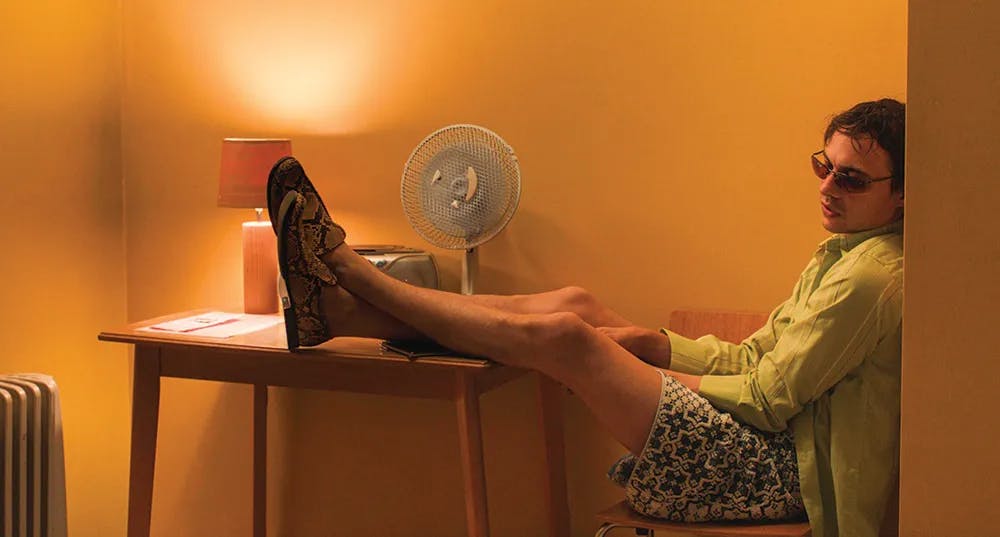
Urchin follows Mike (Frank Dillane), a homeless young man drifting through London with addiction as both his shadow and his compass. After mugging a stranger that offers to buy him a hot meal, Mike is arrested, released, and shoved back into the messy purgatory of reintegration: a halfway house, a job trial in a restaurant kitchen, a tentative romantic connection, one step forward and a few violent relapses back. Dickinson pulls double duty: he directs and plays Nathan, Mike’s longtime street companion—the friend who’s close enough to share a doorway and still steal your wallet. What Dickinson does beautifully is walk an impossible line, making you care deeply about his character without ever absolving him. Urchin is a film about both damage and accountability. It neither performs moral absolution for the audience nor sanitizes its protagonist for their comfort.
What’s striking is how Urchin refuses the usual narrative scaffolding that films about homelessness feel compelled to build. There are no speeches about austerity, no cutaways to Parliament, no tragic backstories designed to explain Mike away. Instead, the film lets the political reality sit in the background like weather—inescapable, shaping everything. That’s what makes Suella Braverman’s “living on the streets as a lifestyle choice” comment so revealing. It vocalized a broader national delusion about how homelessness happens. The UK once had a functioning council estate system—purpose–built public housing meant to serve as a genuine social safety net. Right to Buy stripped that stock, austerity gutted support services, and entire estates were left to decay or sold off. The state effectively demolished the floor, then blamed people for falling. Rough sleeping in Britain is the visible consequence of a country that dismantled its own infrastructure for keeping people housed.
Frank Dillane’s performance as Mike is unreal. There’s something raw and flickering about him, like he’s always half in the room and half somewhere you really don’t want to follow him to. He moves through the film like a frayed electrical wire—jumping, sparking, threatening to short out at any moment. The performance is all jumpy nerves, hollow–eyed yearning, and this swampy, humid kind of poetry that matches the film’s murky textures.
Part of what makes the performance so gripping is how little the film gives you to cling to in terms of backstory. Mike’s family is mentioned once or twice and then left behind in the fog. When he calls his mother from the police station after assaulting the man who tried to buy him a meal, her voice is flat and tired—less angry than simply weary. Later, he mentions offhand that his parents are alive and “nice folks,” but he trails off quickly, the way people do when the truth is too shapeless to articulate. Beyond that, all we know is that he once worked picking up rubbish. No tragic childhood montage or tidy psychological roadmap. Just a man whose life collapsed, and who now wanders through the wreckage with nothing but instinct and impulse.
And yet there are moments—tiny, glimmering things—where he lights up. Singing karaoke with his new friends from his restaurant job. Bantering in the kitchen. Teetering into something that almost looks like safety. You want to root for him so badly it feels embarrassing, like you’re falling for a mirage. That flicker of joy, that split second where you think he might actually claw his way out—that’s where Dillane destroys you. Because you know it won’t last, and he knows it won’t last, but for a moment, the film lets you believe it anyway. What’s devastating is that the feeling he’s chasing in those joyful moments—connection, quiet, the brief suspension of self—is the same one he later tries to recreate through guided meditation and, eventually, hallucinated transcendence. Spirituality enters the film as a substitute for the belonging he can’t sustain.
The film’s spiritual undercurrent starts small and almost silly. As part of his reintegration routine, Mike listens to guided meditation tapes: breathing exercises, affirmations, the kind of soft–focus mindfulness content people put on when their lives are sliding off a cliff. At first, he’s skeptical, borderline mocking. But slowly, he warms to them. He even recommends them to his parole officer, as if he’s briefly found a language for calming the chaos inside him. But as his relapse accelerates, that small ritual becomes unbearable. The tape player becomes this reminder of the version of himself he almost managed to inhabit, and in one of the film’s most quietly devastating scenes, he destroys it. It’s the closest the film ever gets to saying out loud that he wants transcendence, but he keeps choosing oblivion.
That’s where the film’s nature imagery begins to bleed in. Dickinson shoots nature the way other directors shoot war zones—dark, humid, pulsing with the threat of self–knowledge. Moss–covered caverns, dripping stone, trees that seem to breathe. The cave motif is the most potent. Every time Mike spirals, the film cuts to that cavern—a wet, womb–like space that feels equal parts Dante’s descent and Orpheus’ failed rescue mission. It feels like an exploration of the unconscious not as a source of enlightenment, but as a place you get dragged back into when your coping mechanisms fail.
It’s Eastern spirituality refracted through the grime of addiction: transcendence filtered through the sewer system. The affirmations and breathing exercises Mike listens to aren’t random—they’re drawn from a very particular strain of Westernized Buddhism and mindfulness culture, the kind built around detachment, visualization, and the soft promise that quieting the mind will quiet the pain. The tapes tell him to breathe into stillness, to imagine flowing water, to release the self. But in Mike, that rhetoric curdles. Instead of rising into clarity, his “non–attachment” becomes dissociation; instead of water, we get damp stone and stagnant runoff.
The film’s climax cracks the whole spiritual framework wide open. Up until now, the spiritual scenes have been swampy, moss–lit and ambiguously Eastern. But the final sequence abandons that language entirely and drags him somewhere unmistakably Catholic. And it is straight–up nightmare–fuel: the stone hallway, the chapel room, the robe, the altar, the suffocating darkness around the edges of the frame. Everything Catholic–coded in Urchin is claustrophobic, punitive, and shame–soaked. Eastern spirituality offers the fantasy of dissolution; Catholicism forces exposure.
When Harris Dickinson reappears in the final sequence—no longer Nathan, the friend and fellow rough sleeper, but something ritualistic, wordless, almost priest–adjacent—his transformation is unsettling but deliberate. He sits in a robe before an altar, accepts Mike without judgment, embraces him, and then abruptly shoves him through a door that feels less like a portal and more like a verdict. There’s no sermon, no moral accounting. It’s the most violent grace the film offers.
Mike falls, graceless and weightless, into an infinite darkness. The fetal curl he folds into at the end—small, self–protective, embryonic—feels regressive because that’s the only comfort left to him. The world has no room for him; transcendence won’t hold him; accountability has crushed him; his coping mechanisms are shattered; even his visions have abandoned metaphor and turned literal. The void is the only place where nothing is asked of him.
And that’s the bleak miracle of Urchin: the final image is neither redemption nor damnation. It’s pure surrender. A person collapsing inward because going backward is the closest thing he can get to peace. The film refuses the neat arc, the cinematic “breakthrough,” the clean catharsis. Instead, it leaves you with the image of a man dissolving—not spiritually, not transcendentally, but simply because he has nowhere left to stand.