Content warning: This article contains mentions of violence towards children that can be disturbing and/or triggering for some readers.
Theatre Two at the Philadelphia Film Society Bourse is so full that I can hardly find a seat. I manage to squeeze past a few people and fit into the second row, but those who come in after me linger and look around. When the film starts, they don’t leave—they stand in the back, determined to see what they came here to see, even if it won’t be comfortable.
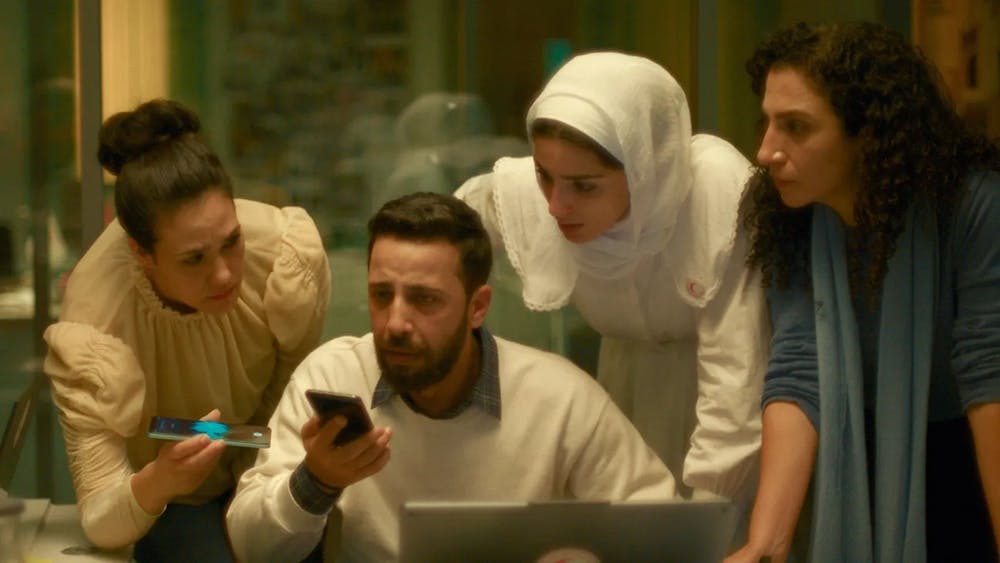
The Voice of Hind Rajab, directed by Tunisian filmmaker Kaouther Ben Hania, premiered at the Venice International Film Festival to a 23–minute standing ovation, the longest in the festival’s history. Its United States release has been highly anticipated, and I was fortunate enough to get access—and a seat—at the Philadelphia Film Festival this year. The film is based on the true story of Hind Rajab Hamada, a six–year–old girl who was murdered by Israeli soldiers during the evacuation of the Tel al–Hawa neighborhood in January of 2024. Its 90–minute runtime follows the first responders in the Palestinian Red Crescent center who attempted to negotiate her rescue over the course of an entire day. Despite being categorized as a “docudrama,” the events of the film are hardly dramatized—and the characters aren’t dramatized at all. Each of the people on screen—Rana Hassan Faqih, Nisreen Jeries Qawas, Omar A. Alqam, and Mahdi M. Aljamal—is a representation of a real–life Red Crescent worker who was there on that day. In its relentless commitment to realism and unapologetic depiction of the horrors of the occupation, The Voice of Hind Rajab exposes the ongoing genocide for its intentional cruelty and highlights the dehumanization of Palestinians forced to beg for help from a world intent on ignoring them.
The film opens on the afternoon of Jan. 29, 2024. Dispatcher Omar (played by Motaz Malhees) receives a phone call from a man in Germany who pleads for him to check on his brother and family as they evacuate from Tel al–Hawa, believing them to be stuck in the car they were using to flee. He calls the number the man gives him and speaks briefly to a woman before shots are heard and the line goes dead. A few minutes later, he receives another message: a six–year–old is still alive in the car. Call again.
He does. She answers. “Come get me.” He can’t.
Omar calls his supervisor Rana (Saja Kilani) over to speak to the girl, who tells them that her name is Hanood—later revealed to be an affectionate nickname for Hind. Through a series of careful questions, Rana asks Hind who she’s with and whether any of them are alive. Hind, traumatized and disoriented, insists that her family is “sleeping.” Rana, although she knows better, tearfully tells her to let them sleep, and Hind cries out that they’re dead. Despite her fractured mental state, Hind remains insistent on one thing. “Come get me.” It’s a request, a demand, a plea she repeats over and over throughout her communication with Rana and Omar. She can’t understand—she’s speaking to people who say they’re going to help her. Why won’t they do the one thing she needs?
Director Ben Hania makes absolutely sure that we, as the audience, comprehend the wider scope of the humanitarian crisis in Palestine, even if Hind cannot. In a conversation between Omar and center manager Mahdi (Amer Hlelel), Mahdi explains the logistical nightmare that is getting aid to people in Gaza. In order to safely send an ambulance to Hind—and the closest one is only an eight minute drive away—Mahdi must go through the process of getting clearance from the Israeli army, who will then send an approved route back. In showing this to Omar, he diagrams the steps on a glass wall—forming an infinity symbol that represents the never–ending hoops they’re forced to jump through to negotiate with the very people who are killing them; the absurdity is not lost on him, Omar, or the audience. Only after they receive the safe route will the rescuers be able to safely reach Hind—and, as Mahdi declares, he refuses to lose another rescue worker by not following the rules to a T.
As night falls, the volunteers stay on the line with Hind, attempting to distract her with questions about her favorite color, what school she goes to, and the reading of a prayer from the Quran. The waiting is agonizing—Mahdi paces, Omar shouts, Rana cries—and Nisreen (Clara Khoury) attempts to provide emotional support to both her coworkers and Hind. Hours go by. Phones don’t ring. At one point, they put Hind on speakerphone and begin livestreaming the call, hoping for donations, awareness, compassion, anything. Omar, whose fuse is already short after repeatedly begging Mahdi to do something, explodes. He shouts that the world knows what’s happening. Hearing her voice won’t make any difference when she’s not the first and won’t be the last.
He isn’t wrong. The history of Israeli occupation in Palestine spans a hundred years, and has only been getting real, constant global attention for the past few. Even then, the number of people who refuse to get involved because it’s “too divisive,” who refuse to call it a genocide, who bury their heads in the sand, is staggering. At the end of the day, the excuses don’t hold up when it’s not a political issue but a human one. Palestinians plead for empathy from a world that once declared, “never again.” When they’re forced to turn to social media, begging the privileged and apathetic not to scroll past their pleas for help, is that not further dehumanization? Further trauma? Further heartbreak?
It’s this question that Ben Hania asks, and answers, with the film. All of the clips of Hind speaking are her real voice, taken from the recordings made that day. And her story ends the way it ends. After hours of coordination, Mahdi finally receives an approved route from the army, gives the ambulance the all clear, and they make it within 40 meters of Hind’s car before an explosion is heard. The line goes dead. Silence falls over the Red Crescent and the theatre. The army cleared the team to save Hind just to kill them all moments later.
There are no words for the rage of this moment. The suffering. The heavy helplessness. The only thing that echoes is the intentional cruelty of leading a child to believe she’s going to be rescued only to rip it away at the very last second. Soldiers shoot at the car 335 times.
Yet after this moment of utterly senseless monstrosity, the film returns to humanity. A home video of Hind playing on the beach speaks for itself: remember who they did this to. She was a child.
Hind’s story alone is enough to radicalize anyone, but hers is far from the only one like it. Since 2023, at least 69,000 Palestinians have been murdered by the occupational forces, and those numbers are likely underreported when taking those who are still missing into account. If it takes a Hollywood–level production to get through to people, then so be it, but it bears acknowledging that our response to this film is a reflection of the very phenomenon that fuels Omar’s rage. It shouldn’t take a Brad–Pitt–funded blockbuster to force people to acknowledge the horrors that Palestinians face every day. But if this film is what gets through to you, don’t internalize the injustice. Join mutual aid networks and fundraise. Boycott the companies that continue to enable the violence. Go to a rally and make your voice heard. The Voice of Hind Rajab isn’t meant to spark hatred, but care. It’s above all an appeal to our shared humanity, asking us whether we care enough to do something about the tragedies unfolding in Gaza. I hope, for all of our sakes, that the answer is yes.
Find more information on how to get involved at the US Campaign for Palestinian Rights Action page or donate to the Hind Rajab Foundation here.