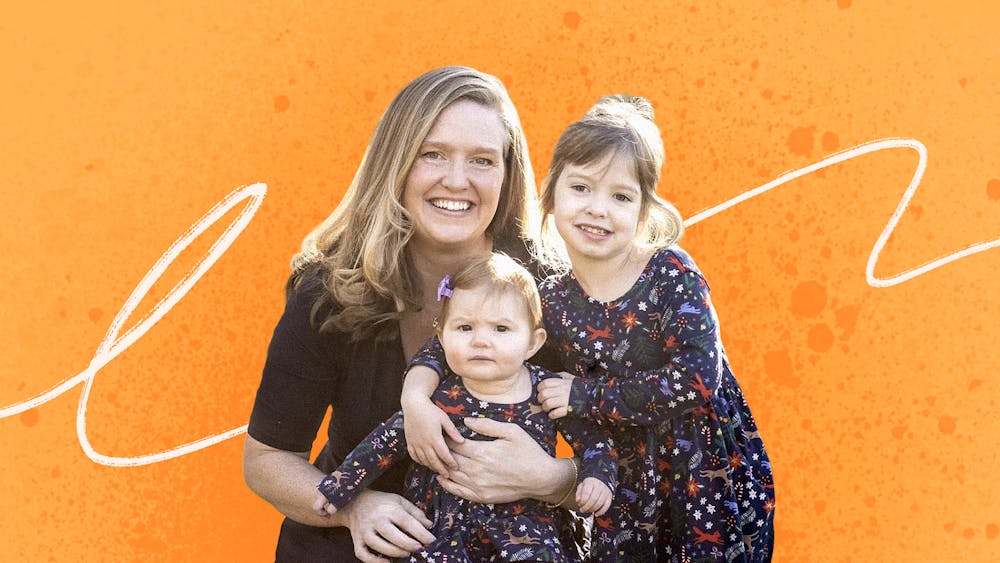
When I first met Dr. Katie Schuler, I immediately felt a sense of comfort. Her presence radiated genuine warmth and friendliness. I could easily imagine Schuler’s classroom being full of the same energy, creating a welcoming space where even intimidated or overwhelmed freshmen could feel at ease.
Schuler is an assistant professor in the Linguistics Department at Penn and also runs Penn's Child Language Lab. At the CLL, she researches how children acquire language rules and variations by looking into how children internalize complex language structures and patterns without any formal instruction.
Schuler’s fascination with linguistics and language acquisition began when she was spending time with her 18–month–old cousin. She vividly recalls playing a game where she hid a pacifier and the toddler wandered around the room searching for it. “Where is my passy?” the toddler repeated again and again. When Schuler began hiding two pacifiers, something unexpected happened: “My cousin, independently without me doing it first, said, ‘where are my passys?’” she recalls. Schuler was hooked—amazed that without anyone ever telling the toddler the rules of plural construction, she knew how to modify her speech to create a grammatically correct sentence. “I was so interested in the fact that this little toddler had somehow recovered this number–agreement rule. I didn’t know what it was called at the time, but she figured out that when something is plural, you add an ‘S’ at the end. How did she know that?”
As an undergrad at the University of Rochester, Schuler began taking linguistics courses to investigate how her cousin came to understand plurification. Yet she admits, “It took a long time for me to figure out that you could actually do that as a career. At the time, I didn’t know what research was,” noting that because neither of her parents went to college and she came from a really small town, it wasn’t a career path she grew up considering.
While her friends and family suggested careers paths such as pediatrics, preschool education, or social work, none of those quite captured her interests. Schuler was captivated by language, and craved a way to keep asking the questions that fascinated her. During a meeting with a faculty member at the University of Rochester, she voiced her concerns and interests. The professor listened, then told her that she sounded “just like a grad student,” explaining that being one entails having “a question you’re really interested in, and then you just ask it for the rest of your life, and it’s very fun.” For Schuler, this was the moment where everything clicked, when she knew that this was the path she wanted to take. She continued her studies at Georgetown University, where she got her Ph.D. in neuroscience and cognitive science.
For many students, research carries a certain mystique. Like it once did for Schuler, it often feels intriguing but not entirely clear, leaving students unsure of what it truly involves or how to get involved. Schuler wants students to walk away with one simple message: “It’s a really fun job where you have a question that you are curious about, and you get to ask those questions every day. You get to stand on the shoulders of people who came before you, who came up with all of these clever ideas to study the question you’re interested in,” she says, smiling at the opportunity to do exactly that every day.
Over the years, by sharing the same curiosity, interests, and passions for language with so many others, Schuler has found a vibrant community within her field. She strives to create that same sense of camaraderie within her own Child Language Lab, as well as in the courses she teaches, from “Neurolinguistics” to introductory classes like “Data Science for Studying Language & the Mind.” Schuler explains that she brings the motto “a rising tide lifts all boats” to life in hopes of building supportive and collaborative learning environments. “Another way of saying it is there’s room for everyone at the top,” she explains, emphasizing that in her lab, one person’s success never comes at someone else’s expense. “We can bring everyone along with us, and the more we help each other, and the more we share our knowledge, the more positive that comes our way as a group, as a class, or as a lab,” she says.
In Schuler’s lab, this spirit is absolutely clear. She created a Slack channel called “Lab Submissions,” where every abstract or a paper submitted by a lab member is shared. This way, new students working in the lab have a rich repository of materials to reference, models for how to structure their own work. Reflecting on her past academic experiences, which inspired her to cultivate practices that center on mutual support, Schuler expresses that “I was really fortunate to be part of universities that were really rigorous, but at the same time, had really strong communities and really shared with everybody and tried to bring everybody up with them.”
When it comes to building supportive learning environments, Schuler recognizes that these communities take shape not only within classrooms and labs, but also in the moments shared outside of them. She makes it a priority to get to know her students outside formal academic settings, though she insists this comes naturally. Schuler credits her own mentors, especially during her undergrad years, for modeling that ethos. “If you were interested in research, the faculty were excited to have you there, and there was no talking down to you. You just were folded in,” she explains. She recalls professors inviting students, including herself, to their houses and to other events. “It made for a really nice welcoming feeling,” she adds. “I just naturally do that, because I saw faculty doing that. It’s almost like I don’t know any other way to do it.”
Schuler aims to leave a positive impact on places she’s been, continuing to mentor her students and build community at Penn. As a first–generation college student herself, she’s involved in initiatives to advocate for other first–generation students and demystify key aspects of the college experience, often through ‘ask me anything’ style sessions. Recounting her experiences, Schuler says, “Lots of people have very different challenges, but for me, the financial side was really hard. There were so many things that I did not know or realize, such as that I could apply for grants to travel to conferences in other cities.” Hoping to alleviate the stress that this kind of uncertainty can create, Schuler now works to share the institutional knowledge she lacked when she first started college.
Outside of research and academics, Schuler continues to cherish time in her community. She loves spending her free time with her two young children and socializing with her friends and neighbors. She also has a small vegetable garden and enjoys cooking meals that incorporate the produce she’s been able to grow.
Schuler feels lucky to have had such inspiring mentors over the years, and finds daily fulfillment in mentoring passionate, curious Penn students. Reflecting on her lab, she says, “The most rewarding part is watching people find joy in their research, pursue it, and standing alongside them as they dive deeply into a question and design experiments to answer it.” In her teaching, her primary goal is to mentor students who may not see themselves as mathematical or computational thinkers, helping them realize that learning these skills isn't as daunting as it seems. “That’s one of the spaces where I feel most happy and feel like I’m making the biggest impact,” she says.
In many ways, Schuler embodies the rising tide she often speaks about—she uplifts her students and mentees, creates spaces where students feel supported, and shares knowledge with her wider community. And she has grown alongside her students by doing this as well: “When you help people who are brand new to something, show them how all the pieces fit together, and watch them take on challenges they would not have pursued before, it’s incredibly fulfilling,” she concludes.