
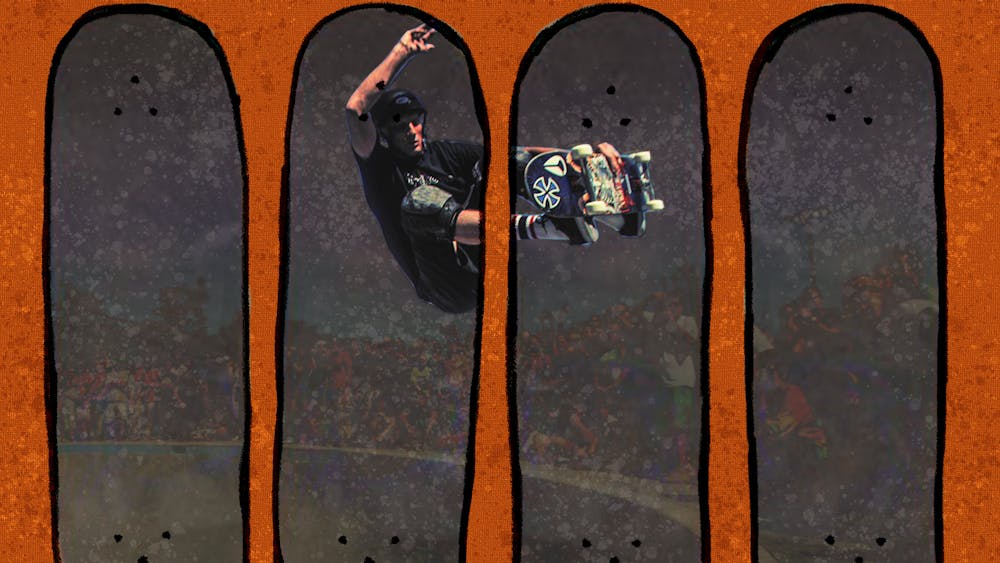
At the time of writing this piece, I will have played about 15 hours of the latest Tony Hawk Pro Skater installment. The first three of those were spent figuring out how to get out of the game’s very first level, The Foundry. The aggressively unforgiving nature of this game, for better or worse, is part of its appeal: in other words, gamers will need to “git gud.”
We’re at a strange time in the gaming calendar, with game awards right around the corner and the recent releases of heavy hitters like Kirby: Air Riders and Call of Duty: Black Ops 7. There have also been developments in the wider gaming industry, with the quality and style of games vying for a dominant spot. Such notable names as Pokémon: Legends Z–A, Clair Obscur: Expedition 33, and Battlefield 6 have all made their own mark amongst the year’s releases. Meanwhile, Tony Hawk Pro Skater 3+4, now out for a few months, has quietly gathered a niche group of players. For the veteran gamer, this game offers a blast to the past (with a few updates), and for the newly initiated, it offers rare experiential potential.
Tony Hawk’s line of games have been couch co–op staples since their inception, with their exaggerated, high octane movement intersecting with their gimmicks and quests to create a difficult, yet rewarding, test of skill. The music of the original versions became the soundtrack of a generation, and the mission to maintain previous games’ authenticity is particularly seen in the soundtrack, with a plethora of new artists and songs as well as some game–originals.
Atmosphere
On a first open, the game gives players a good idea of what they're in for, beginning with a two–minute video featuring the different skaters available to play as. The roster is diverse, and each skater has their own unique starting stats and an ultimate move that’s hinted at during the tutorial portion of the game. The game itself is highly dynamic, even beyond the actual gameplay. Small moving gears and icons throughout the menus and within the game itself further add to an underlying sense of kineticism. The music reacts to both your blunders and chained combos. The sound effects and vocals are never too intrusive, allowing the game to retain a sense of immersion.
For those who prefer a more forgiving experience, the game gives players access to a variety of cheats right out the gate, from half–speed to perfect balance during lip and grind tricks, allowing players to choose their level of difficulty for a deeper level of game customization. And a strong benefit to the game is its willingness to affirm players leaning into a more casual experience, encouraging things like button mashing and general exploration in order to really make the game one's own.
Gameplay
Though the game was reviewed on a PlayStation 5, I was blown away at how much it felt like playing on my PlayStation 2 again—the game’s handling translates almost exactly as it would on an older console. While this may be a benefit for both veterans and more intensive gamers, casual enjoyers wanting to play through the game as intended will have to adjust to a steep learning curve. The gameplay doesn’t leave you with much time between transitions and combos.
However, the combos are button–masher friendly, and the game encourages the utilization of button mashing and cheats to figure out new tricks and facilitate lengthier combos. This allows gamers to set up their games to their preferred style, though the cheats won’t compensate for tricks you’ll need to learn.
As for the combos themselves, the game will not reward repeated moves, so those looking to engage with the game’s career and single–session modes will have to pull from a variety of moves. The repeatable tutorial advises the player well enough by categorizing each style of trick, so those struggling for high scores would do well to make use of that resource. This will be of huge importance for those looking to engage with the online multiplayer mode.
Music
The music is definitely the most surprising element of the game. Like its predecessors, it still revolves around a hard rock sound, with driving guitars and blaring vocals accompanying the game’s rapid movement. But imagine my surprise when a Kendrick Lamar feature popped up—definitely a sore thumb among such names as AFI, Bodyjar, and Iron Maiden.
The playlist for the game, carefully curated by Tony Hawk himself, holds onto some of the original’s old faithfuls while simultaneously altering itself for a more modern audience. Unlike most games on the market, THPS gives you full music customization as a player, allowing you to turn whichever tracks you’d like on or off. This comes as a special benefit for those who enjoy the classics, as well as those like me who may prefer a more selective audio experience. And digital deluxe edition owners gain even more tracks from the DOOM OST as well as some game–originals.
Summary
Tony Hawk Pro Skater 3+4 brings a familiar, rambunctious energy to its niche audience, with charmingly janky movements and extensive potential for combos. The fact that the game is really two games in one alleviates the potential turn–off of the $50 price point, and gamers are sure to get their money’s worth if willing to engage with the in–game online community, or with their friends and family using couch co–op mode. And while veterans may be gutted at the exclusion of THPS 4’s free–roaming, NPC–interactive career mode, this edition more than makes up for it with a plethora of different challenges for platters to pursue: the classic S–K–A–T–E collection, Expert and Pro modes, and Solo Tour mode, only accessible when everything else has been completed. In Solo Tour mode, players can tackle each course as all the different skaters the game has to offer with skater–specific goals, making the platinum trophy a worthwhile challenge for completionists.
On one hand, the mechanics offer an experience unlike anything on the market, and the soundtrack will be sure to give players at least a few new songs for their playlists. On the other, the experience is demanding and difficult at the start, and the game loop may become repetitive for those looking for a variety of playstyles. The online mode is also a major draw, so those with unreliable or no internet access will lose out on a large part of the playing experience.
Given the era of gaming THPS is reviving through its current iteration, it's understandable to say that those primarily used to live–service and other genres of contemporary games may not find this game all that compelling. It does, after all, expect you to engage with the same game loop over and over again. But for those who feel even somewhat drawn to the game, there are many elements that may make the unconventional experience worthwhile. Completionists have a hefty job on their hands, hardcore grinders will have a blast mastering both the in–game and user–generated maps, socialites have multiple modes of online play, and casual skaters can adjust their sessions to suit their whims.