Young people are facing a loneliness epidemic. At this point, it’s a modern–day truism that feels both unshakeable and all–encompassing. Research shows that Gen Z is the loneliest generation thus far, facing rates of isolation that are higher than both those of millennials and Gen X. We don’t get out of the house enough; we don’t meet enough people; we spend too much time on that damn phone; and, as we have all for some reason been told ad nauseum, we don’t have enough sex!
This generation’s increased reliance on technology, coupled with their need for more human connections, would appear to make them most susceptible to the promise of dating apps. From Hinge to Bumble to Tinder, there are countless options to search for love digitally, and, according to a Forbes Health Survey, nearly half of Americans believe dating apps are the top spot to meet a match.
Despite this, recent years have found Gen Z flocking away from traditional dating apps, reporting fatigue and frustration towards mindless swiping and the inauthenticity fostered by platforms that once promised to make love simpler. College students report feeling the greatest disillusionment with dating apps compared to any group, a shift in opinion that raises questions about the future of what is currently a multi–billion dollar industry.
There’s one potential answer to this question: college–specific matchmaking platforms. Services such as Penn Date Drop and Penn Marriage Pact, which have gained traction on campus in recent years, offer an alternative to the swipe–based structures of traditional dating apps. In fact, they take swiping out of the equation entirely, using algorithms to directly pair university students. Although these platforms are still relatively new, they seem to have found a burgeoning niche within the college market. In the past several years, similar platforms have proliferated across college campuses, betting that students will prefer having fewer matches and some technologically savvy way to guarantee they are paired with a compatible partner. As dating apps slowly fall out of fashion with younger users, these alternative matchmaking platforms want to be the next big thing that helps Gen Z find love.
Marriage Pact was one of the first players on the scene. The company was founded at Stanford University in 2017 and reached Penn’s campus in 2020, where it has since thrived. This past fall, over 3,500 students signed up for the service—a third of the student body.
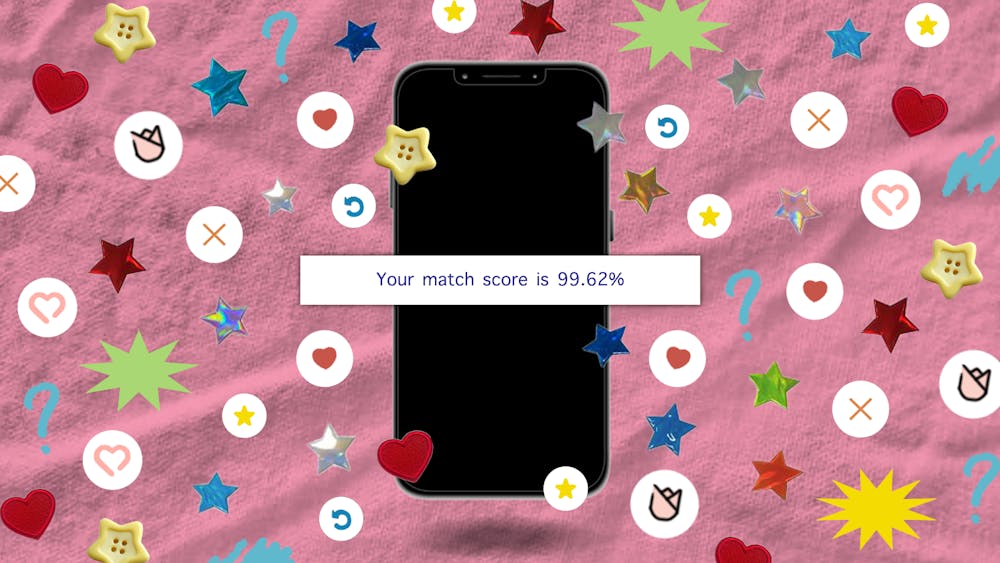
Marriage Pact is meant to be “your most optimal marriage backup plan,” says Manasi Gajjalapurna (E ’27), the launch project manager for this year’s Penn Marriage Pact. The platform—which boasts a presence at 109 schools and has garnered almost 630,000 signups nationwide—claims to pair college students with their “optimal match” through a modified version of the Nobel Prize–winning Gale–Shapley algorithm. Students fill out a lengthy questionnaire and, several days later, are given a name, email, and percentile number for their match, which seldom drops below 99.9—evidence that the algorithm has found that one–in–a–million (or at least a thousand) person for you. From there, you are free to reach out to your match and get to know them. “Do you really want to look up from your cubicle when you’re forty to find yourself alone?” the Marriage Pact website asks. “There’s no time to lose.”
The pitch for matchmaking services over traditional dating apps has serious merit, and college campuses seem to be the perfect grounds to test this new model out. According to Pinar Yildirim, associate professor of Marketing and Economics at the Wharton School, college campuses are “a good candidate” for matchmaking and dating platforms. “Dating is a much more youth–oriented activity,” she explains. And on dense, interconnected campuses like Penn, “You can get together fairly quickly” with your match.
These matchmakers offer less matches than would be possible on traditional dating apps like Hinge or Tinder—but that’s precisely what users want. When dating apps were still novel, and especially after COVID–19 froze in–person modes of connection, many were willing to forego the more intimate pre–screenings of traditional dating for convenience and novelty. It is undeniably fun to treat people like doomscrollable content—swiping left or right, choosing yes or no ad infinitum.
However, while dating apps can increase the size and diversity of our dating pools, they also make it wildly difficult to find and commit to a single individual. When a user has ten matches, and each of those matches have ten matches, it is almost impossible to give each match—or any match—enough attention to create a real connection. As Yildirim explains, users eventually develop a sense of “exhaustion” on traditional dating platforms, with younger people in particular leaving the apps in droves. “The Match Group, they need to come up with their next big thing,” Yildirim says, referring to the stagnating revenues of the dating app juggernaut behind Tinder, Bumble, and Hinge.
By contrast, college matchmaking platforms only give users one match at a time over daily, weekly, or even yearly timescales. This restriction of choice forces users to focus on one person with whom they are supposedly compatible, foreclosing what would otherwise be an “exponential number of explorations,” says Yildirim.
Investors seem to be taking this paradigm shift seriously. In 2022, Bain Capital Ventures tied the knot with Marriage Pact, leading the matchmaker’s $5 million seed round. The cash has helped Marriage Pact’s parent company, Matchbox, expand its operations beyond college campuses. Matchbox uses the same questionnaire and matching algorithm format of Marriage Pact to power events in major cities across America, pairing guests with one another following an extended mingling period. The website explains that, with Matchbox, you can match at events ranging from your next “cocktail hour, séance, book club, networking sesh,” or “sunday soirée.” This model could represent the final goal of matchmaking platforms—adoption by paying, post–graduate users that offer a larger market and a path towards monetization.
Students, however, might not be ready for a paradigm shift in online love. Devon Yau (C ’28), who participated in both Marriage Pact and Date Drop, did not reach out to any of the people he was matched with. To begin with, his choice to use the platforms stemmed from their campus virality, reflecting the way that school–specific matchmaking platforms can fuel a kind of campus buzz that traditional dating apps do not.
Devon explains, however, that these matchmakers only support an artificial and fast–paced form of dating. Students who match do so not because they choose the other person out of their own volition, but because an algorithm made that choice for them. In this model, the stakes are low—even lower than on traditional dating apps characterized by gamified swiping.
In fact, while matchmakers market themselves as an answer to Gen Z’s desire for greater authenticity, the pressure to commit to matches on such platforms might be even lower than on a traditional dating app. Matchmaking platforms “have the appeal that you don’t have to commit to them,” Devon explains. “With Hinge and Tinder, it feels like you have to own up to it more, because you’re putting all your information into it. There’s an expectation that you’ll reach out or connect. But with these sites, there isn’t even a face associated with the name.” Of the students that choose to use these matchmaking platforms, many seem to approach the experience with low expectations and no intention of genuinely finding love.
Manasi also describes the experience of participating in Marriage Pact as “lighthearted.” Most people aren’t actually banking on Marriage Pact to save them from a life of loneliness. “It’s not meant to be like, ‘Oh, you should go date that person now,’” Manasi says. Instead, she views it as a bonding opportunity. In previous years, Manasi and her friends would fill out the questionnaire together, and discuss where they agreed or disagreed. “You get to feel a little bit closer to other people on campus through it,” she says. Indeed, with its casual framing and once–per–year schedule, Marriage Pact seems impractical as a serious option to find dates.
Still, matchmaking platforms are betting that a stagnation of the dating app market, combined with a burgeoning faith in artificial intelligence ascendency, will turn students on to their model. In recent years, a motley crew of companies have seized on the college matchmaking space, their services spanning the technological range. Several of these come from Penn, including Pairfect, a more analog option which relies on a team of human matchmakers and began with a pilot program exclusive to Penn graduate students. Veil was another zany and short–lived platform that asked users to complete a personality profile and rate AI–generated faces based on their attractiveness.
A third Penn dating startup, Quickmeets, claims to understand users’ ideal type by analyzing an image of their celebrity crush with AI. Louis Chung, founder of Quickmeets, says that his team’s mission is to “solve the loneliness epidemic among Gen Z.” Chung believes that AI can provide a powerful solution that encourages human connection, providing both the convenience we are accustomed to and the compatibility we crave.
Across the board, these companies place a certain amount of faith in today’s technology to arrive at real insight about people, using those findings to pair them up with compatible partners. After all, we have AIs for everything these days—why not a robot that can find you love?
To Chung, Quickmeets’ AI software is “a means to hyperpersonalize your matches.” After a user uploads a single picture, Chung claims that Quickmeets’ AI can understand not just their physical type, but personal features like their extrovertedness or their sense of adventure. Upload a photo of your celebrity crush at a rave, for example, and you might get paired with an outgoing, party–animal type. Choose that same person reading a novel by the fireplace, and you might get a more wholesome, bookish personality.
At the very least, this new industry seems hot enough to fight over. Beginning this past fall, Date Drop launched in colleges across the nation. Like Marriage Pact, the platform originated at Stanford—and if you ask Marriage Pact founder Liam McGregor, that’s not the only thing the two matchmakers have in common.
This past November, McGregor filed a cease and desist order against Date Drop, alleging that its founder, recent Stanford graduate Henry Weng, had stolen Marriage Pact’s intellectual property. McGregor did not respond to requests for comment.
Date Drop operates on a near–identical model to Marriage Pact, asking users to fill out a deep, values–based questionnaire before feeding it through an algorithm to find the person’s ideal match. But unlike Marriage Pact, the platform delivers matches weekly, with users opting in or out before the deadline for that “drop”. In one of Date Drop’s introductory emails to the Penn student body, the subject line reads “like marriage pact but weekly.”
In the list of exhibits they put together, Marriage Pact notes that Weng opened his emails from the platform several times and that several of the marketing materials and several questionnaire elements were similar. Undeterred by the threat of legal action, Date Drop returned this semester to continue offering weekly pairings.
“Everyone in the college matchmaking space is aware of everyone else,” says Weng. “But I’d say Marriage Pact serves a different need [than Date Drop]: It’s a campus tradition, something fun you do once a year. We’re trying to build a more consistent way for people to meet others.”
Regardless of which matchmaking company has the best strategy, it’s clear they’re all abuzz about the budding market of campus romance. Their founders see in college matchmaking an opportunity to supplant traditional dating apps, and are betting that their way is best—whether that means changing the frequency of matches or using AI to find the most compatible pairs. Still, despite the rapid emergence of matchmaking sites within Penn’s dating scene, many students are skeptical of whether these platforms will provide the kinds of connections they promise, if any at all.
Devon believes that the high usage of matchmaking sites at Penn is an indicator of the “impersonal” culture that shapes many students’ approach to relationships. He specifically cites Penn Face—the masks of effortlessness and success that Penn students often curate for themselves—as a driver of this.
Penn Face makes the introduction of matchmaking sites to Penn double–edged. Although these platforms promise students more opportunities to forge human connection, their success also reflects a social trend towards detachment and feigned nonchalance. In a culture where many young people fear vulnerability, faceless matchmaking platforms offer high rewards at low stakes, allowing users to skirt around the openness that is often a prerequisite for pursuing romantic connection.
To Devon, matchmaking platforms are a vehicle for “trying to optimize the process of self selection that happens naturally” when dating. As technology, particularly the rise of AI, demands that we constantly make our lives more “efficient,” one has to wonder whether romantic relationships, so often marked by rawness and messiness, can be optimized as well. This question is made more pressing within Penn’s social scene, where ultra–competency is rewarded and vulnerability is largely shunned.
Given the plethora of research studies detailing Gen Z’s declining ability to connect, it’s uncertain whether matchmaking sites will truly satisfy college students’ cravings for romance, or if they will only exacerbate the loneliness epidemic they hope to fix. The venture capital firms and participants that have already invested in these sites show that matchmaking platforms are likely poised to continue integrating themselves into the Gen Z dating scene. But to students who are already tired of online dating, joining Marriage Pact, Date Drop, or Quickmeets is like trying to put out a fire by switching out the kindling. These platforms, on which you meet the technology first and the people second, hardly guarantee a love match—or even a good first date.
It’s more likely that our level of success in love will continue to depend on our own inclination to search for it. With the always–online, never–connected state of our generation and the average Penn student’s mortal fear of embarrassment, finding love at Penn seems bound to be a difficult process. For his part, Devon had a tough time figuring out how he could actually connect with the faceless names that these platforms fed him. “What are you supposed to do with a Date Drop?” he asks. “Go on a coffee chat?”