When I committed to Penn, I saw an opportunity to finally experiment with my style. No longer was I restrained by the identity I made for myself in high school. College was a clean slate, and I was ready to revolutionize my wardrobe and see my personal fashion sense develop. So naturally, I reached for my phone to see what was trending. Imagination often sprouts out of roots in imitation, and I needed a foundation to build off of.
After some time scrolling through Instagram, I found an advertisement for this jacket I had never seen before. It had this thick canvas material and was padded—perfect for the Philadelphia winter. Only, rather than a zipper or buttons to close it, it had these metal clasps. The creator had been preaching about how high–quality and inexpensive the jacket was, so I had saved the reel for later. However, that wouldn’t be the last I saw of those metal clasps. Not even close.
I’m not sure whether it comes from hidden superiority complexes or a certain trend–savviness that people interested in fashion tend to possess, but most would agree that getting onto something early feels amazing. The euphoria of knowing that you look good and, more importantly, different from everyone else, is a major motivator in why fashion–forward youth take care to dress nicely in the first place. The niche that you find yourself in is yours: You own not only its staple pieces, but also the niche’s clout and prestige among your peers. You own the figurative trademark of the look, and a huge amount of social credibility comes from that. And no one will be able to look at anyone else wearing your “thing” without thinking about how they’re committing copyright infringement.
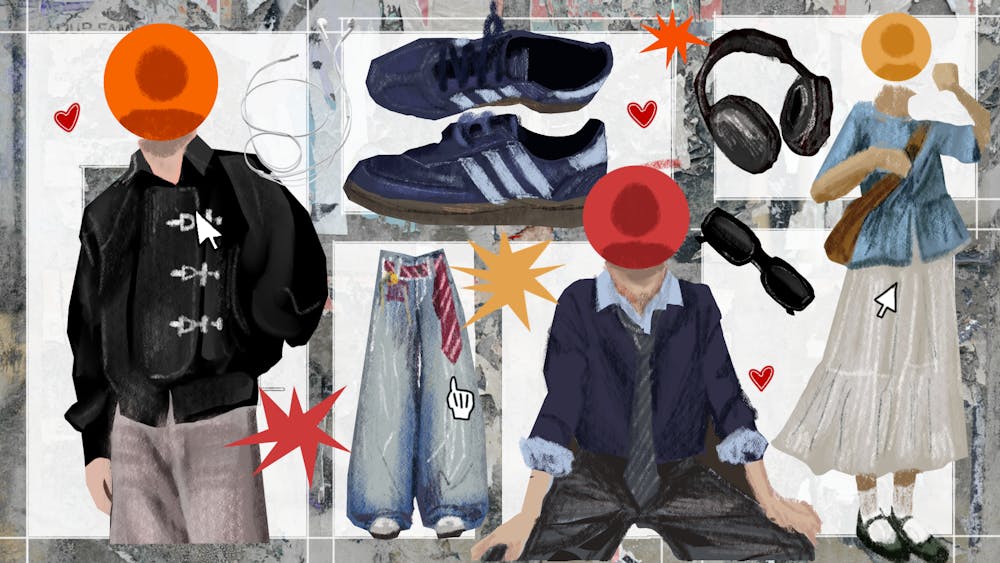
A recent “niche” to come out of social media is the fireman clasp jacket. This jacket features Y2K–style clasp fasteners on the front, purely for aesthetics, in tandem with a zipper. At a glance, this style seems like a great way to make your look a little extra unique. When walking to your 10:15, the extra silvery glint from the morning sun shining off the fasteners elevates an otherwise basic piece. It complements jewelry perfectly, matching the hardware on your hands, neck, and wrists. A find like this feels like a once–in–a–lifetime moment: When else will the chance arrive to pick up a piece that’s easy to wear, unique, and at least seems like it’s underground? But as with every novelty, the shine will fade. And in the case of microtrends, rather quickly as well.
It’s honestly stupid to assume that anything that comes across your for–you page isn’t on hundreds of other people’s as well. The fireman clasp jacket, now on your radar, is also on everyone else’s radar as well. And in a rush to be “trendy” or “ahead of the game,” so many people fall into the trap of the microtrend—the same pattern that led to you spending hundreds on Sonny Angels and Owalas. It’s difficult to go through a day without seeing another “fit–spiration” TikTok being posted, featuring those metal clasps.
The rapid spread of social media content surrounding this style of jacket has driven the fashion industry into a craze to cash in and pump out dupes, not even attempting to hide it behind a unique color or material. Fast fashion brands like Zara and Aelfric Eden now have several “styles” of practically the exact same jacket on their websites. Fashion brands have taken these microtrends and their minuscule life cycles to release lazy products that they know the coolest, most fashionable and keyed–in Penn students will eat right up and discard in a month for the next trending statement piece. And the worst part is that this has all happened in the span of a couple months.
Of course, the fireman clasp jacket is simply the most recent offender. Think back to just last year, when Labubus terrorized the fashion scene. JNCO jeans, the Realtree camo printed tops, and the infamous Brandy Melville American flag knit sweater are all fashion microtrends that spread exponentially in a matter of weeks, only to last just long enough to get a fit pic off and fade away.
One could argue that the fashion industry is just like that: cyclical and trend–driven. There’s no changing how the public reacts to trends, and it’s unreasonable to expect that people won’t buy what’s popular. Young adults in the midst of trying to find not only their style identity, but overall values as well, often take microtrends as an easy way to look good in the interim. Why should you have to develop your own style now? That takes a lot of energy and time that you don’t have. But when you actually stop to think about why you’re buying this jacket that you saw on Instagram Reels a couple days ago, stop and think: “Do I actually like this? Or am I desperate to be ‘publicly fashionable,’ ‘ niche,’ or as cool as the person flashing it is pretending to be?” Eventually it becomes disingenuous, especially at a point in your life where self–honesty is more important than ever.
The beauty of fashion is its ability to enable self–expression. I’m not immune to the not–so–subtle art of stealing a fit I saw on Instagram. But after putting all that time and effort into looking like someone else, I’ll look into a mirror before leaving my dorm and walking to DRL. And I can’t help but think that the pair of eyes looking back at me isn't even my own. You are a complete summation of all the choices you make. And no matter how small it seems, what you put on in the morning is indeed a choice. Mindlessly following microtrends appears to be a low–risk/high–reward ticket to being fashionable. But, at that point, we’ve lost the plot, and that choice has effectively been taken away. We’ve given the universal mode of self–expression to bankrolled influencers and fast fashion clothing companies. That’s not an expression of self—that’s a mindless echo.
Of course, when all is considered, fashion really isn’t that serious. And some people choose to participate in it much more vigorously than others. But when appreciation for all the great things a person can do with clothes turns into a walking advertisement, some reflection needs to be made on the industry and how we interact with it. There’s nothing more niche than a wardrobe that you built yourself piece–by–piece, and can proudly call your own.