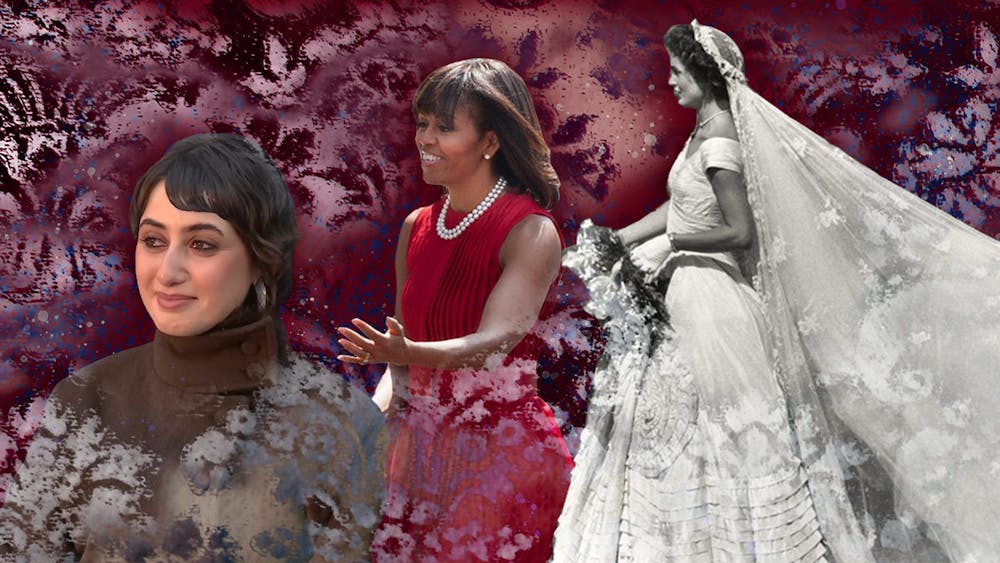
Sure, presidents, vice presidents, mayors, and other political figures may technically be the ones in office, but their spouses wield arguably just as much power and influence. For centuries, despite not being elected officials themselves, the spouses of high–ranking politicians have been thrust into the spotlight of the American public eye. There is no job description that specifies what exactly it means to be “first lady,” but women have been constantly reshaping the role with each new administration through new initiatives, programs, events, and above all, fashion.
From Michelle Obama’s all–maroon ensemble at Joe Biden’s inauguration to Rama Duwaji’s vintage Balenciaga coat at her husband Zohran Mamdani’s swearing–in ceremony, the style of the classic “politician’s wife” or “first lady” is experiencing a much needed modern renaissance. This time, it’s resonating with younger generations—both of these outfits made waves across social media. Their fashion extends far beyond merely clothing: These women are showcasing that first ladies aren’t merely accessories to compliment their powerful husbands, but style icons and prominent figures in their own right. Above all, in an America frustrated by rocky political landscapes, people are simply looking for politicians—and by extension, their spouses—who represent progressive, open–minded ideals and a sense of humanity and relatability that resonate not just in their campaigns and platforms, but through their clothing.
Of course, the notion of first lady fashion is not a new phenomenon. In fact, dating all the way back to the 1700s, the eyes of the American public have been naturally drawn to the personal and public–facing style of the wives of high–ranking politicians. From their very first public appearances on campaign trails to inaugural ceremonies, political spouses have virtually always found themselves pushed under the microscope as Americans hyperfixate on and dissect their curated fashion choices.
Martha Washington, wife of George Washington (who served as the first President of the United States from 1789–1797) is widely known for her strategically “matronly” style. Washington’s fashion choices carefully toed the line between sophistication and subtlety, so as to reinforce ideals of democracy and avoid haunting reminders of monarchy. Only wearing clothing “made in the US from US fabrics since before the Revolutionary War” to showcase her devoted patriotism according to BBC, she often donned chic, tailored gowns composed of laces and silks that were neutral and subtle in color. This would be accompanied by footwear and fine jewelry, typically garnet, that were considered highly fashionable at the time. Washington’s style was said to have aided her husband’s presidential career, putting forth the visual of a fashion–forward, supportive spouse. But even in the early days of the first lady, Washington was not exempt to criticism: “Although Martha seemed to achieve her goal abroad, she was criticized at home by those who disdained royal trappings, and some of this criticism appeared in the press,” the Miller Center at UVA writes.
With Washington setting the precedent, early first lady fashion was intended to support the platforms of political husbands and represent the nation. But even then, they were still met with heavy dissection from the American people. Mary Todd Lincoln, wife of Abraham Lincoln (president from 1861–1865), was known for her rather extravagant sense of style. Heavily inspired by European-style dresses, especially those of France, she often wore luxurious, low–cut dresses in bright, bold colors and patterns created by her own personal seamstress and dressmaker named Elizabeth Keckley, and took a liking to elaborate flower headpieces as her choice of accessory. Lincoln was heavily criticized for distinctive style, coupled with her widely–known spending habits, deemed too flashy and inappropriate given the nation’s grappling with the Civil War.
According to an article from Town & Country Magazine, Lincoln was well aware of the pressures of public perceptions that she faced, especially when it came to her fashion choices as first lady. But for her, fashion was a means of not just supporting her husband’s presidency, but the nation itself. Wearing lavish, exuberant clothing and accessories put forth an image of a confident, strong country in the midst of a tragic war, and Lincoln needed to look the part. She herself once said: “I must dress myself in costly materials. The people scrutinize every article that I wear with critical curiosity. The very fact of having grown up in the West subjects me to more searching observation. To keep up appearances, I must have money, more than Mr. Lincoln can spare for me.”
As administrations came and went, first lady fashion naturally evolved. But perhaps the biggest catalyst was Jacqueline Lee Kennedy Onassis (better known as Jackie Kennedy), who had arguably the most profound influence on not just political fashion, but women’s fashion at large. Married to John F. Kennedy (1961–1963 president), Jackie Kennedy became highly regarded for her classy, chic, and timeless style that solidified her as a fashion icon, even long following her time in office. From donning matching suit and skirt sets with pillbox hats inspired by Chanel to gowns topped off with pearl necklaces, Kennedy’s first lady style ushered in a new wave of dressing marked by sophistication and glamour. Her style became a fixation not just for the American public, but for global audiences—it was Kennedy style that turned the “first lady” into a cultural fashion force.
Since then, we’ve seen the likes of Pat Nixon’s early 1970s pantsuits against the backdrop of the feminist movement (her style was deemed by some critics as “bland”) and Hillary Clinton’s headband accessory choice that became iconic during Bill Clinton’s presidency (1993–2001). But today, the style of first wives has undergone a newfound revival, blurring the rigid lines that once governed women’s political fashion. Take Michelle Obama, who recently published her book, The Look. The book takes a deep dive into her fashion choices as first lady during Barack Obama’s presidency (2008–2016). While first ladies have always been critiqued for their style at public appearances, the scrutiny was especially compounded for Obama, the first (and only) Black first lady in the nation’s history. From her very first official photo as first lady, where she wore an elegant black sleeveless dress with a pearl necklace, Obama was heavily criticized. According to a 2009 article from ABC News, many were criticizing it as “too informal and out of season,” and “inappropriate” for a first lady due to its exposed arms. Obama notes that throughout her two terms as first lady, everything—from her clothing choices and footwear down to her natural hair—were hyper–analyzed and ripped apart by the media and general public.
Yet, Obama notes that she remained determined to use her platform as first lady to not only showcase her personal style to the American public, but to platform designers of all backgrounds to demonstrate the diversity woven into the nation’s fabric. “The designers that I chose—there were young designers; there were women designers; there were also immigrant American designers,” Obama said in an article from ABC News. Obama’s iconic 2008 inauguration outfit—a one–shoulder gown made of white silk chiffon and decked out in flowers—was designed by Jason Wu, a New York City based designer from Taiwan. Wu also designed her red chiffon halter–neck ball gown for Barack Obama’s second inauguration in 2013. From wearing designs by Nigerian–American designer Duro Olowu to Thai American fashion designer Thakoon Panichgul in 2008 for Obama’s presidential nomination speech, Michelle Obama always wore pieces created by immigrants and people of color throughout her time as first lady.
“I think that's one of the things we struggle with, but when we look around at truly who has built this country, who keeps it moving, you know, it’s all of us, and all of us is Black, brown, Puerto Rican, Mexican American, Italian, Irish, Haitian. That's the story of America, right? And it is the most true in fashion,” Obama said.
We’ve also seen the likes of Rama Duwaji. Her unique style has captured the minds and hearts of American audiences, especially younger members of Gen Z. Duwaji’s husband, democratic socialist Zohran Mamdani, was recently elected and appointed Mayor of New York City. Mamdani was on a generational run, from making appearances at clubs to bonding with New Yorkers of all backgrounds. Mamdani has resonated with the people, and so has his wife, especially when it comes to her sense of style.
Duwaji first rewrote the first lady fashion playbook at Mamdani’s mayoral victory party by making an appearance in a chic all–black ensemble: a laser-cut denim top made by Palestinian and Jordanian designer Zeid Hijazi, paired with a long velvet skirt from Sulla Johnson. An article from Vogue, which predicted early on that Duwaji would become “New York’s First Gen–Z First Lady,” noted her political fashion—as an artist and illustrator by trade, Duwaji’s looks are often reflective of her personal values while sending powerful political messages. More recently, Duwaji made fashion headlines after Mamdani’s swearing–in ceremony. Styled by Gabriella Karefa–Johnson, Duwaji wore a Balenciaga black wool coat paired with chic black wide–leg tailored shorts from The Frankie Shop and black boots from Miista, designed in London and handcrafted in Spain. Later on, at the public ceremony, she was seen wearing a “chocolate brown funnel neck, faux–fur trimmed coat from Renaissance Renaissance, designed by Palestinian–Lebanese label founder Cynthia Merhej—another personal, political statement,” Vogue notes.
Rather than fluffy gowns and pearl necklaces, Duwaji can be spotted on her Instagram wearing chic ensembles of black tank tops, wide–leg bermuda shorts, gold jewelry, and boots. Social media—especially those among younger generations—have been taking notice. “Finally, we get a cool girl to the tea,” one user reacted to Duwaji’s past looks in a TikTok video.
Starting from Martha Washington, first ladies have always been at the forefront of the American consciousness, especially when it comes to their fashion. The style of these political wives once served as a tool for merely aiding their husbands’ reputations as high–ranking government officials. But now, as the concept of the “first lady” has modernized, so too has the fashion that comes with it. From wearing chic black leather lace–up boots at inauguration to wearing pieces profiling diverse immigrant designers and designers of color, the style of political spouses has transformed into a powerful symbol of self–expression and political activism. Now, particularly for those in Gen Z, our modern first ladies such as Obama and Duwaji represent beacons of hope, where style can finally signify a sense of progression and, above all, relatability that many are desperately seeking.