It’s strange to say a project made by 30–somethings is reminiscent of their “late style.” But for I Used to Go to This Bar, the latest release from California pop–punk outfit Joyce Manor, that descriptor feels more than apt. In 2011, Joyce Manor came screaming on to the national scene with its self–titled debut album, a project whose short, aggressive rock anthems bubbled with teenage angst and paranoia. In 2014, the band’s third album, Never Hungover Again, channeled that same adolescent malaise to even greater acclaim.
With each successive release, however, Joyce Manor has found itself grappling with an all–too–familiar question for maturing musicians: What happens when you age out of the style that catapulted you to success? Though Joyce Manor’s most famous work is full of youthful rage, its later albums are all weighed down by a painful awareness that the sun has set on their era of reckless abandon. While some bands are able to make a transition to maturity with ease, Joyce Manor’s recent work has always felt torn between staying faithful to their old sound and charting a new course with their music. Unfortunately, This Bar reveals that four years of reflection haven’t led them to any greater insights. Though it shows flashes of inspiration, its latest album feels split between half–hearted revivals of its early–aughts style and ill–fated attempts to chart a new musical identity.
The album’s opener, “I Know Where Mark Chen Lives,” is marked by a refreshing fidelity to the band’s rebellious roots. Its shout–sung chorus (“Train coming down the track / And it almost gave me a heart attack”) lands with a familiar anger, while the pounding guitar line supports lead singer Barry Johnson’s vocals with appropriate vigor. But this is hardly a return to the heady 2010s, a fact betrayed most obviously by shifts in the album’s production style. Early Joyce Manor hits like “Catalina Fight Song” and “Heart Tattoo” were buoyed by a compressed, raw sound, each crack in Johnson’s voice giving the band’s music an air of immature authenticity. On This Bar, however, the band suddenly shifts to a hi–fi, roomy sound, intensified by the jarring smoothness of Chase Knobbe’s guitar tone and the seemingly conscious effort Johnson makes to “sing” instead of scream. While “Mark Chen” apes the rhetorical style of Joyce Manor’s earlier work, it lacks some of the bite that made their music so compelling to begin with.
As the album rolls on, it’s hard not to regard the shift in Joyce Manor’s lyrical themes with a kind of pity. The same issues that plagued the band in their youth—relationships, aimlessness, ennui—remain present on This Bar, but gain a new significance given the stage of life Joyce Manor is in. The girls Johnson used to sing about in the present tense are now rendered as figures of the past, lingering as ghosts that still haunt the mind of our mature narrator. The image we’re left with is that of a band stuck in a state of arrested development. All the joys of youth are gone, but the pain remains, compounded by the creeping feeling that the best years of one’s life have already passed. “I had a dream when I woke up this morning / I was a shadow of my former glory,” Johnson sings on “The Opossum,” which tackles the frustrations of post–teenage angst with appropriate weight.
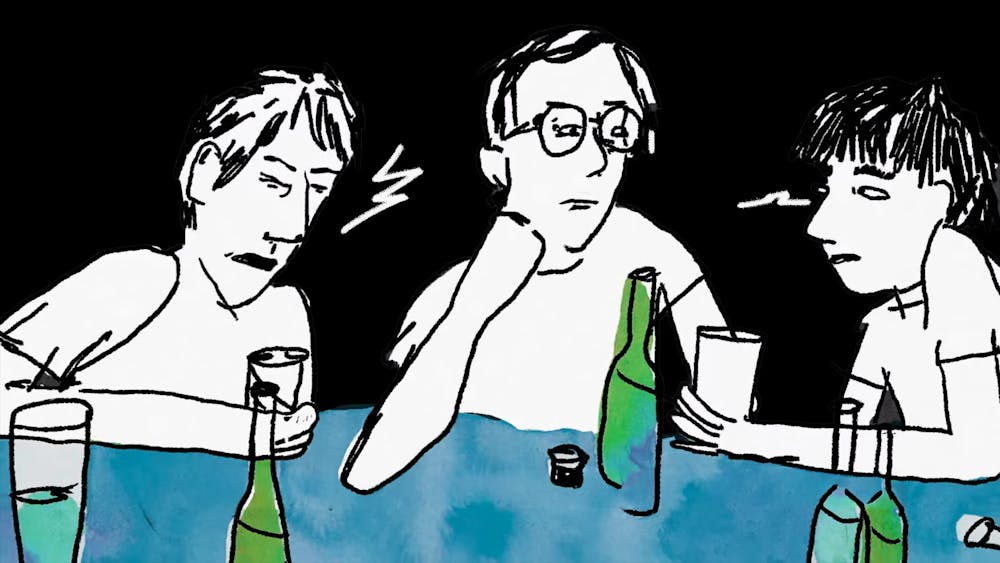
“All My Friends Are So Depressed” is emblematic of this shifting outlook—the band swaps out their usual rage for a kind of mellow fatalism as they meditate on alcoholism and the collapse of possibility. While Joyce Manor was never afraid to be miserable, that misery was always built on angst that still had some fight to it. Their songs were given weight by a kind of anticipatory nostalgia; the knowledge that one is living through a beautiful youth that is doomed to pass. “All My Friends are So Depressed,” however, captures Joyce Manor at a moment where the fight has drained from their bodies, a fact that must strike long–time listeners as disappointing, though likely inevitable.
These meditations of loss and aging could have been impactful were it not for the strange unreality that plagues most of this album. This Bar feels more zoomed out than ever before, with vaguely poetic expressions of misery eclipsing the concrete situations that gave those emotions power in the first place. Even standout tracks like “Mark Chen” or “The Opossum” have a kind of hypothetical quality to them, dwelling on scenes like a head–shop hold–up that simply aren’t as grounded as the basement party or the college dorm room. Joyce Manor’s songs were never autobiographies, of course, but their early work felt real in a way that the transparently fictional This Bar simply doesn’t.
This Bar’s stagnant lyricism is matched, unfortunately, by its stagnant sound. Shedding their fidelity to the joyous rage of poppier punk acts like Green Day and blink–182, the band shows a new appreciation for “soft” rock of the worst kind. The guitars are clean—the vocals are legible—the energy is gone. Genre–wise, most of this album can probably be characterized as “default rock,” mashing together the most palatable sounds of the ’90s, ’00s, and early ’10s to create an amalgamation of noise that’s sure to offend no one and impress even fewer. Every track is technically proficient, but ultimately vapid.
It’s an especially disappointing move when contrasted with Joyce Manor’s earlier work—“Christmas Card,” the opener of Never Hungover Again, begins with the shout–sung “Looking at your face in the dark / You don’t even look that smart.” The song’s choppy guitars only underscore the narrator’s frustration of missing out on a romantic connection. There’s an alignment here between the emotions evoked of the lyrics and the instrumental here that This Bar simply lacks. Every coat of polish Joyce Manor puts on This Bar flattens the album’s power further and further, with the final product lacking any distinct energy at all. In their search for a new sound and new purpose, Joyce Manor refuses to innovate, appearing simultaneously aimless and stuck at this critical juncture in their careers.
The album reaches a low on the abysmal “Well, Whatever It Was,” whose saccharine guitar lines and choral “oohs” crowd out any semblance of real emotion the song might have had. For a band that seems content with pivoting towards a more “mature” sound, the song represents a backslide into juvenile fecklessness of the worst kind. While the young Joyce Manor were irreverent, they were anything but passive—every song rattled with rage, with Johnson bearing a conviction that his personal problems were the only things of importance in an uncaring world. To replace that anger with a shallow flippancy feels like a betrayal of their own artistic identity. And the track is no better sonically than it is thematically: Inane lyrics about drinking and getting fired are backed up by equally mindless guitar riffs from Knobbe at a career low.
Musicians rarely age gracefully—the best most bands can hope for is a sort of managed decline, with their mature music serving as a sort of coda and reflection on a life lived in the spotlight. But that noble fate will not come to Joyce Manor, whose late work remains plagued by nigh–endless growing pains. Though not altogether meritless, I Used to Go to This Bar represents the worst of two worlds: a misguided fidelity to a long–gone past and a shallow attempt to grasp at a future that will never arrive.