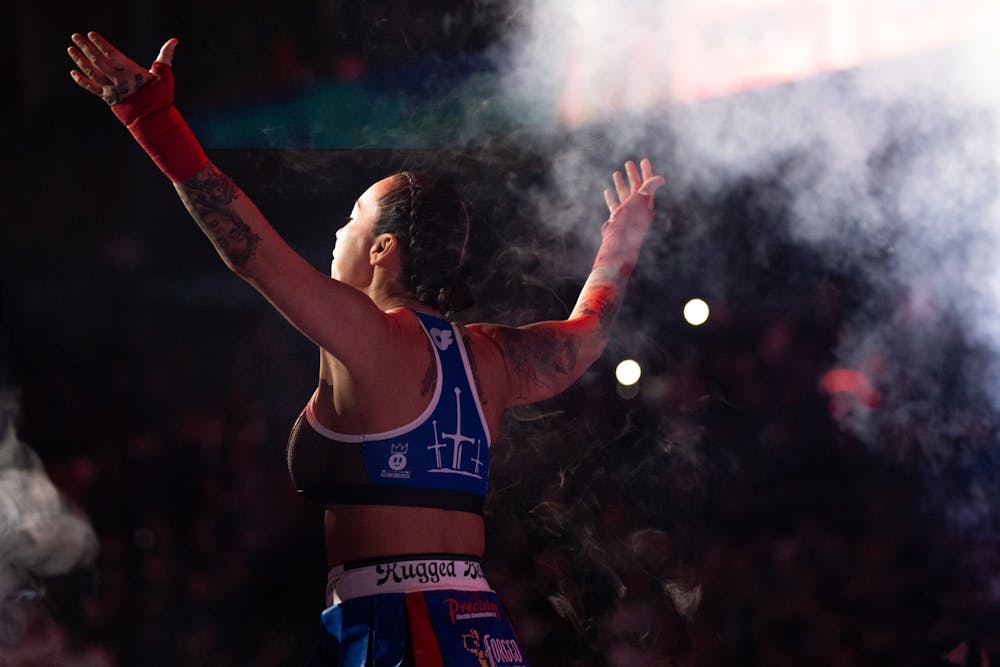
Bloodlust hangs in the air as Zedekiah Montanez begins his walk into the ring at XFinity Mobile Arena. It’s a homecoming of sorts for him. Last January, in his debut as a bare–knuckle fighter, Montanez squared off against fellow lightweight Brandon Meyer in a fight that would end sooner rather than later. Just 30 seconds into the second round, Montanez took a brutal left hook to the jaw that slammed him down to the canvas, ending the match. But fortune (and the higher–ups at the Bare Knuckle Fighting Championship) had smiled upon him, granting him a rematch with Meyer at Philadelphia’s KnuckleMania VI, the Super Bowl of the bare–knuckle world.
This time, he wouldn’t go down so easily.
Bare–knuckle fighting is something of a gray area between violence and theatre. From the beginning, the BKFC has built its brand around carnage. “We encourage dirty boxing, we love it here,” announcer Brian Soscia told the crowd before KnuckleMania kicked off in earnest. “You know what else we love? We love violence and bloodshed!” But while their fights are billed as exhibitions of raw, unfiltered savagery, equally as important are the dynamic theatrical personas that fighters construct for themselves. Fueled by its costumed combatants and frenzied announcers, bare–knuckle fighting can seem like a practice in contradiction with itself, blurring the lines between real violence and manufactured spectacle.
But in the midst of it all, one central figure disappears from the scene: the fighter themself. It can be hard to distinguish the warriors in the ring from the personas they carefully construct, and all too easy to forget that behind these masks are people with lives outside the squared circle. For many, fighting is a way of life—but what they’re fighting for is something greater than themselves.
Boxing is in Montanez’s blood. The Philadelphia native was born at Temple University’s Episcopal Hospital, just a few streets down from the house of boxing legend Rocky Balboa. From there, he spent much of his early life bouncing around the Philadelphia area, brawling everywhere he went. “Especially in school–elementary school, middle school—[I would] really get into a lot of fights,” he admits, “and I kinda used to get a rush from the crowd.” That drive to fight eventually led him to boxing, which he took up after he moved with his father to a small town in the Pocono Mountains, Pa. There, Montanez was the only Puerto Rican in a high school that was almost entirely “Caucasian,” a fact that made him feel like he “was kinda an oddball.” “I felt like I was in enemy territory, and I was in my fucking high school,” he says. At a tumultuous time in Montanez’s life, fighting taught him discipline and control, giving him a constructive outlet for his passions.
Montanez has grown a lot since his days fighting in the playground, a fact he attributes to the support system of coaches, friends, and families he’s built up over the years. “I was once someone that used to get bullied, then became the bully, and then became the one that told the bully to chill,” he says. “[I became] the one who gave a voice to the people that didn’t have a voice, because I was one of them as well.” Today, Montanez’s passion for fighting is combined with his passion to support and inspire his own children—to teach them that despite the adversity they may face, hard work can take you anywhere.
Only after years of traditional boxing and mixed martial arts did Montanez turn to bare knuckle fighting. “It’s a raw, dirty game,” he laughs. Montanez’s first BKFC experience was terrifying—feeling the gaze of more than 17,000 fans burning on his back, Montanez tried to drown it all out. But that was futile. “The more I tried not to listen to the crowd, the more I heard the crowd,” he explains. Trying to focus on both fighting and playing to the crowd left him unable to do either, and that first bout was quick and brutal. “I remember my son, after my first bare knuckle fight, he called me and was like ‘Dad, I don’t want you to do that ever again,’” Montanez says. But as he explained to his son, “Shit’s not always going to go your way, bro … this is what I chose.” Montanez had lived his life under punches, trading blows with the best fighters Philadelphia had to offer. One loss, he decided, would hardly push him out of combat sports for good.
It’s all led up to today, where Montanez faces off against the man who took him out a year and a half ago. This time, he embraces the furious energy of the room, letting it fuel him as he focuses not on putting on a performance, but putting on a clinic in clean, technical fighting.
The first round is quick and violent. For most of it, the two fighters struggle and bounce back back and forth, neither able to get a clear upper hand. Despite Meyer’s quick footwork, however, Montanez is able to knock him to the ground with a clean hit to the face. The violence briefly pauses before starting back up—no one is able to force a knockout before the round’s two minutes are up.
Before anyone can catch their breath, the second round begins. The two grapple and trade body hits. Montanez pummels Meyer with a series of hits to the stomach, forcing him down to his knees before he quickly gets back on his feet. But in the round’s final seconds, Montanez finally connects on a brutal uppercut to the jaw.
Meyer hits the ground hard—and stays there.
The violence at KnuckleMania was hardly restricted to the ring itself. At the press conference after the fight, a reporter claimed that a total of nine fights had broken out in the crowd throughout the night. Some of these brawls were visible from the press area, with violence even erupting on the floor section itself. Par for the course, with this crowd.
The total scope of BKFC’s violence is precisely the point. In the breaks between fights, the arena’s screens display clips of competitors trash–talking each other next to videos of the most violent KOs from past events. BKFC’s hype men do their job as well, playing to the audience with flattery, giveaways, and calls for cheers. Throughout the night, Soscia flails a merch bazooka around wildly, shouting into his mic at the formless mass of spectators. “Who wants violence? Who wants blood? Who wants a T–shirt?” This venue is a pressure cooker, the crowd coalescing into a single, white–hot ball of energy that embraces and amplifies the violence on display in the center of the arena.
The purpose of BKFC’s spectacle is, yes, to sustain the crowd’s energy, but equally (if not more) important is the need to expand BKFC’s market share. As a relatively new promotion in the professional fighting circuit, BKFC has been crafty in their attempts to get ahead. Their audience skews young, male, and vaguely conservative—the only moment of the night that silences the crowd is a saxophone rendition of the national anthem. KnuckleMania’s slate of sponsors is expertly tailored for the crowd present: hanging above the fighter’s heads on the arena’s Jumbotron are advertisements for Tucker Carlson’s new line of nicotine pouches; masculine skincare products for athletes; supplements, energy drinks, and alcohol side by side; even a bizarre sound therapy product that claims to “merge advanced scalar energy, plasma fields, and proprietary sound frequencies to support deep restoration and personal evolution.”
But at the center of it all is gambling. When fighters enter the ring, the Jumbotron displays their betting lines underneath their physical statistics. Audience members are constantly invited to scan QR codes and redeem their bonus bets. Having viewers put money on the line both helps BKFC grow through sportsbook partnerships and deepens viewers’ engagement with the sport. In the end, every punch feels all the more intense when it’s aimed at your wallet. “Betting is really the most important thing in any sport,” BKFC President David Feldman says at the post–fight press conference. For BKFC’s fighters, each battle is waged for honor, for glory, and for their people. The league as a whole, however, fights for something greater—their bottom line.
Economic pressures are no less present for the fighters themselves. At his lowest, Lex “The Grizzly Bear” Ludlow had $30 to his name and a wife and daughter to feed. It was fighting that left him there. After losing his first three professional bouts, Ludlow ruptured his ACL and tore his meniscus while training for his fourth, leaving him unable to work. He recalls thinking to himself, “I don’t ever want to struggle for money ever again … I don’t want to fight anymore. I want to just get a job and I want to do things the right way.” His love for the sport, however, ensured that he wouldn’t be out of the game for long.
Growing up, Ludlow dreamed of being a professional wrestler. After training at a local Brazilian Jiu Jitsu gym in Hatboro, however, he ended up turning towards the world of MMA. He lost his first fight to future UFC fighter Karl Roberson, who “dropped me five times in the first round,” Ludlow says. And although he won his next two matches, all he could think about was that first match, meditating on what he would do differently if he got the chance to square up with Robeson again. Ludlow lost that rematch by a tight 29–28 decision, but his drive to keep improving himself led him to dedicate his life to the art of combat.
After going pro, however, something changed. He grew burned out of the fighter’s life. His ACL rupture was the straw that broke the camel’s back, seemingly ending his combat sports career for good. He was just about ready to hang it all up when the sudden death of his grandfather, a key part of his early life, shook him to the core. His passing lit a spark in Ludlow, bringing back his passion to make something meaningful of his life. He made a promise to himself: “I don’t know what I'm going to do, but I’m going to change our lives somehow, or at least try.” After months of watching UFC and getting back into training, Ludlow made the choice to quit his job and re–enter fighting full time.
His re–entry wasn’t easy—he once drove out nearly eight and a half hours to a fight in West Virginia for just $1,000 in pay. But now, he says, “I’m doing pretty well for myself.” Ludlow is currently undefeated in BKFC, notching three wins under his belt and earning the title of “The Most Hated Man in Combat Sports” in the process. He talks plenty of trash before and after his fights, he says, “but when that music hits and I gotta make that walk, I’m there to work.”
While Ludlow loves to fight, his approach to violence is calm and professional. “I’m not there to wear a mask and play with the crowd at that point,” Ludlow explains. “My fights speak for themselves.” To him, each bout is like a level in a video game—finish one, on to the next. More than any passing rush of adrenaline, what motivates him to keep going is his family. He dreams of one day being a champion, gaining glory in the ring and financial security for his family outside of it. “I just want my kids, and their kids, and their kids, and their kids to be okay,” Ludlow says. “And I want them all to know who did it.”
At KnuckleMania VI, Ludlow faces off against Zach “Shark Attack” Calmus, who enters the ring in a menacing hockey mask and Boston Bruins jersey. Ludlow, by contrast, throws theatrics out the window. His quick walk–out is as stripped–down as can be, his focus trained on the fight ahead of him. The crowd hates the interloper Calmus from the jump, practically begging Ludlow to tear him limb for limb.
He delivers. Ludlow’s drive to bring chaos into the ring is palpable in the way he fights, his blows heavy and quick. His domination begins in the first round, where he draws blood early. The fight is more even in the second, but in the final round, Ludlow forces Calmus to the ground twice before cornering him with a flurry of hits to close out the match. As blood and sweat dribbles from Calmus’s face, the panel of judges announces their unanimous decision for Ludlow. It’s not a clean knockout, but it’s a victory nonetheless.
The roar of the crowd is deafening as the referee lifts Ludlow’s arm to the skies. But Ludlow doesn’t share in their jubilation. He’ll feel the rush later in the night, but as he stands there in the ring, his emotions are simple—“Emptiness. I have no nerves, I have no feelings.”
“I have nothing.”
The climax of the night features two old hands in the combat sports world, the Wisconsin–based Ben “Big Ben” Rothwell and the Belarusian Andrei “The Pitbull” Arlovski. The two first squared off 18 years ago, with Arlovski putting an end to Rothwell’s 13–fight long win streak. They’re older now—Rothwell is 44 and Arlovski is 47—and it shows. As the fight drags on through three long rounds, Rothwell begins to break. His footwork slows. His punches drag as if thrown through water. Blood streams across his face, its source unclear. Only when doctors stop the fight and wipe his head down is the extent of the damage laid bare—a massive gash runs from the top of Rothwell’s skull all the way down to his eye socket. Blood still cakes his face and torso as Arlovski is crowned BKFC’s newest heavyweight champion.
Bare–knuckle fighting is a brutal sport. Staring death in the face, fighters have to ask themselves: Are you ready to put your body on the line to do what you love? It’s a difficult choice to make. “Before, I used to be in there, and I used to be like, ‘Yo, I’d die for this shit,’ ” Montanez says. But now, with a wife and a family? “I don’t want to die for this shit … I want to be able to talk to my grandkids, to talk to my wife and for her to be able to understand me.”
“I got something to live for, bro.”