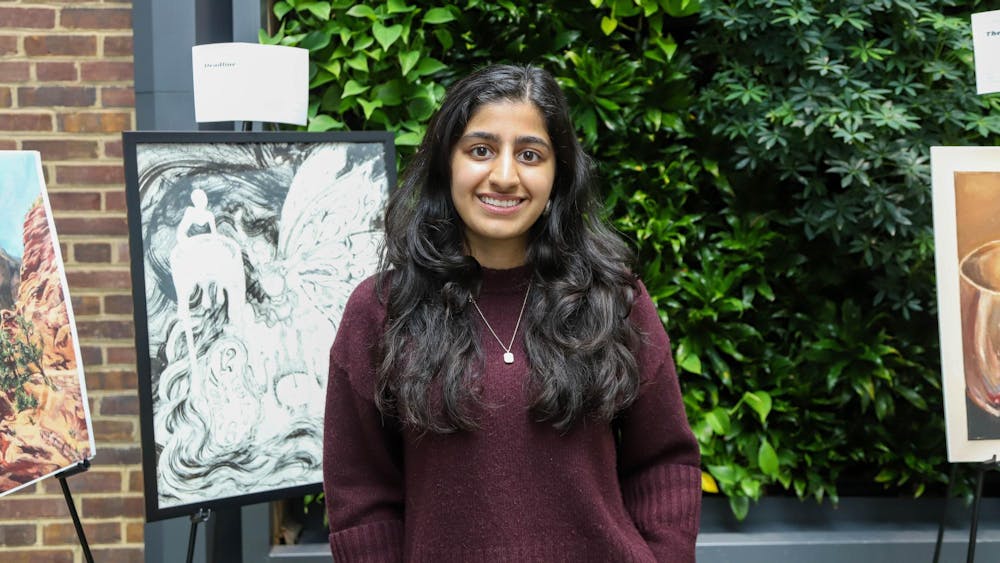
Writing this article feels like a betrayal, because everything that Duriya Rehan (W, E ’26) is cannot be contained in the assigned word limit. From the minute she sat down across the table, she spills her world, from side quests across Philly to celebrating a classmate’s birthday in Zimbabwe for a Penn Global Seminar. For a dual–degree student with no shortage of extracurricular responsibilities, she will always make space in her schedule for an interesting film class, at her dining table for her monthly supper club, and in her busy day to take you to the best Thai food in Philly. Coming from a place and school so different from Penn, she found home in her mentors, and strives to facilitate that relationship with others now. And, as anyone who has gotten to know her in her four years would say, she has undoubtedly succeeded.
Name: Duriya Rehan
Hometown: Karachi, Pakistan
Field(s) of Study: BS in Economics, Marketing and MSE in Computer Science
Activities: Wharton Wellness, Wharton Successful Transition and Empowerment Program (STEP), WH 1010 Teaching Assistant, APALI
Right off the bat, you mentioned a film ethnography course you’ve been taking. Can you talk more about your experience?
I’m taking ANTH 5467, which is an ABCS course. The class puts you into groups of two to three people, and each group is partnered with some sort of a social impact group in Philly. We make a documentary about the life of the person or the group, depending on the project. We’re working with a family—three siblings who work at a Montessori school in Germantown. Their dad actually started the school. They live in an apartment on top of the school, and have created this informal family around them. They’ve had the same magician come perform shows for 14 years, the same drummer, and people who went to the school 20 years ago come to teach there. I’ve taken film photography through the Fine Arts Department, so I know a little about photography, but I didn’t really have a background in video. I’m taking a video class through the department now, but that’s more about video as an art. But, I feel like a lot of the learning that I do in my video class applies to the archaeology class. I’ve learned a lot about anthropology and ethnography—how to really connect with the people you’re studying, because obviously there are personal moments where people get super vulnerable. These classes also allow you to connect with your fellow students. It’s a small 15–16 person class and a lot of the art people are creating, which is something that’s super personal to them. So you really get to learn more about people in a way where you wouldn’t get in a traditional computer science or Wharton class.
What prompted your interest in your fields of study and M&T?
Pakistani high schools use the British system, where you choose four or five areas you want to specialize in ninth grade. And then, in the last two years of high school, you pick four subjects you want to take. I took chemistry, computer science, math, and physics. That’s all I was studying. In my junior year of high school, I took part in this online entrepreneurship competition with a group of people that were based in the United States. The judges told us that they really liked the technical stuff, but our business model was just terrible. That made me realize that business is really important. In Pakistan, it’s common that you want to do science or business. My high school guidance counselor told me to look into the Jerome Fisher Program in Management and Technology, and I thought it was really interesting, but didn’t think I would get in because I had no business background. It’s interesting to learn that you can do both, because I feel like in Pakistan, it’s very much either this or that. But in the U.S., you can take a photography class, but you can also take an operating systems class.
How has your relationship with your family and your home changed since moving abroad?
It’s stayed pretty constant. I go home decently often. I was there for Eid, and I was there for the week after spring break. My brother is also freshman at USC, so I visit him often. My sister is a junior in high school, so I’ve been helping her with her applications for art school. I feel like the time difference actually makes it a little bit easier, because there’s only certain times in the day you can call, and that way it just becomes your routine. So I’ll call my parents in the morning because it’s nighttime for them and they’re having dinner, or sometimes I’ll call them at night because they’ve just woken up and are walking around. So, I feel like that actually makes it easier, because you don’t have to worry about when to call them.
I’m actually going to be working for a startup in Pakistan post–graduation. My mindset was always this: you learn something in the U.S., and you apply back home. I think it was always very important to me, since I’m from Pakistan, that whatever I learned here could be given back. Since they do e–commerce and really want to expand to the U.S. markets, I’m not sure if I’ll wind up doing that. But in the short term, I would like to stay in Pakistan.
You also run a supper club out of your apartment. What’s that like?
I started my own supper club in my apartment called the Stranger Supper Club. I send a form out to a bunch of groups I’m involved in. I then chose five people who don’t know each other at all, and bring them to dinner. It’s mostly based on availability, but I try to keep it across different grades and schools to make sure the people I invite don’t know each other. I draw people from all the groups I’m involved in. I also try to make them themed—the last one was a murder mystery, and everyone had an identity. I themed the menu and everything.
One of the reasons I do this is that in junior year, we’re required by Wharton to take MGMT 3010. It’s about organizational leadership. The professor talked a lot about the concept of brokering, which is essentially when you act as the link between people. I’m a broker if I know you, and you only know these ten other people because of me. We talked about how in life and business, it’s important to foster these connections. These dinners are an avenue for me to do that. My most recent one, people came at 8:00 p.m. and stayed until midnight, just talking.
What other ways do you bring people together?
Definitely through Wharton Wellness. It’s sponsored by the Wharton Undergraduate Division, so we get funding from them and collaborate directly with the administration and community. Some initiatives that we work on include one called Dolphin Tank, which is our version of Shark Tank. We have Wharton students come pitch wellness ideas, and they’re judged by a group of alumni. It’s this big event we do in the fall, and then we implement the ideas in the spring. We also just had another event called Fill Your Cup. We actually had it yesterday, and it’s a way to encourage students to talk to their advisors, especially around this time when their course selection is happening. So we pick a drink, and you can only get a drink if you write a message for the person who’s going to be getting the drink next. We also do this thing called Big Talk, which is the opposite of small talk. Essentially, we bring people together for dinner at restaurants around campus, and then we have a list of questions to guide the conversation. Instead of talking about where you’re working this summer, it’s more like, “What is one regret you have?” I met some really close friends through this program. I feel like a lot of the initiatives I work on through clubs involve connecting freshmen to upperclassmen mentors. Everything is about connecting people.
How do you manage your time?
I think prioritization is very important. Every week you have to decide whether to focus on your academics, your social life, or career stuff. I also think knowing what you want to do in certain areas helps a lot. For example, I have a list of all the classes I want to take. I make it a point to take at least one “fun” class every semester, like my anthropology class. I use Beli to make a list of all the restaurants I want to go to, and I have a bucket list of things to do before I graduate. I had some things around Philly, like visiting the biggest Wawa in the world, going to a Mask and Wig show, and visiting Linvilla Orchard. My friend and I are also attempting to go into every building on campus before we graduate. One of my friends just let us into the nursing building, which has a lot of murals. I still have some places to hit, like the ice skating rink. Doing this helps me keep track of what’s important to me, and I use it to fill my time.
How has mentorship defined your Penn experience?
Almost every community I’m a part of has involved mentorship in some capacity. For example, STEP is super cool, because while it starts off as a pre–orientation program, it goes through all four years. We introduce students to Wharton through that program, which focuses on adjusting to Wharton and finding your community and your space. Alumni come in and talk to them. You also get a mentor who stays with you until they graduate. It’s a very strong community. You also have social events. Some are mentorship events, but some are fun, like a Six Flags trip. I think it’s really nice to give back to the community, because I feel like it’s done so much for me. I was the only student from my school, or from Pakistan at large, when I came to Penn. My mentor back then was super helpful.
The same goes for Wharton 1010. It’s not really about the class itself or the content; it’s more about your mentor. As a teacher assistant, you do one–on–one meetings with students throughout the year. I had maybe 21–22 students, and I really got to know them very well. I have students from last year also reaching out to me for help with classes or anything else. It’s great for me, because it feels full circle—I feel like I'm giving back.
LIGHTNING ROUND:
Favorite Philly restaurant? Kalaya.
Best spot on campus? Second floor of Fisher Fine Arts Library, up the spiral staircase.
Class you would recommend? OIDD 0050: Grit Lab with Angela Duckworth
A risk you’re glad you took: Taking a Penn Global Seminar my freshman fall.
There are two types of people at Penn… People who say hi on Locust Walk and and people who don’t.
And you are… I always say hi.