Arrogant but brilliant doctors have occupied a timeless place in popular imagination. Gifted with a talent for medicine, characters like Marvel’s Dr. Strange and Grey's Anatomy surgeon Christina Yang spend every shift taking heat from their colleagues and patients alike for their lack of empathy, inflated egos, and pursuit of greatness—all at the expense of someone’s emotional well–being.
But what do you get when these strong personalities forget parts of who they are? Writer, director, and showrunner Hank Steinberg provides the answer in his latest hit series, Doc.
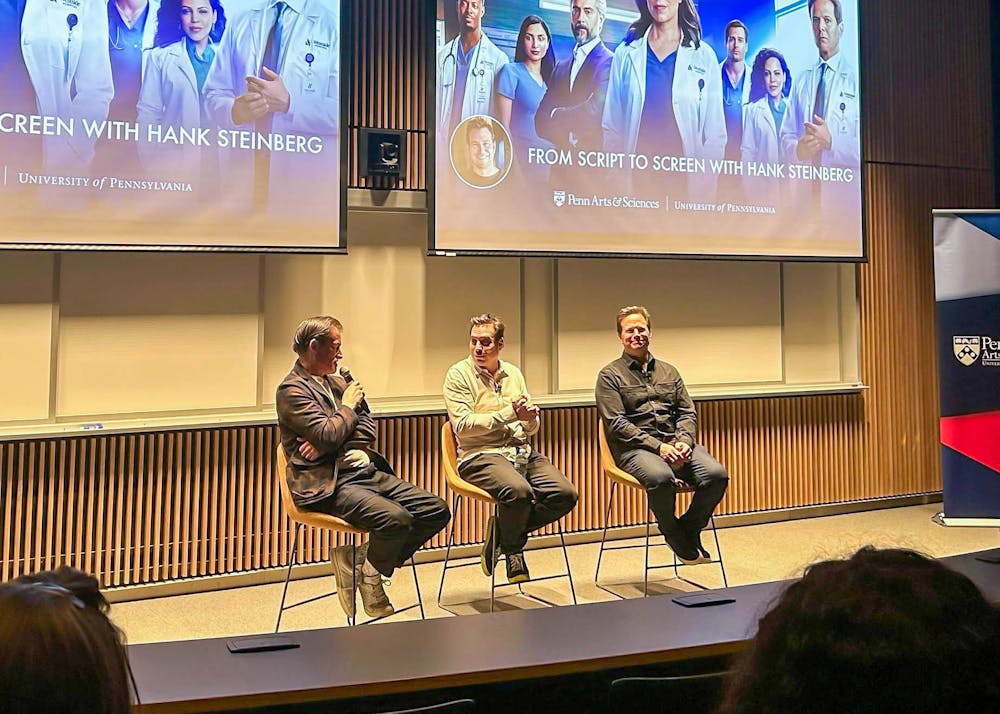
Premiered in early 2025 on FOX TV, Doc revolves around the brilliant but difficult Doctor Amy Larsen (Molly Parker) as she recovers from a car accident that erased eight years of her memory. I had the opportunity to attend a screening of the pilot, followed by a Q&A with Steinberg (C’91 and former DP Sports writer) and actor Scott Wolf, who plays Doctor Richard Miller on the show. The panel was moderated by Penn’s own Cinema & Media Studies lecturer and filmmaker Scott Burkhardt.
Based on the Italian medical drama, Doc: In Your Hands, Doc began after Steinberg was approached by Sony to adapt the series for an American audience. Doc: In Your Hands revolves around a male doctor pursuing an affair with a young nurse. His life is turned upside down when an angry patient shoots him in the head, erasing his memory of the last 12 years.
Sony gave Steinberg complete creative control, so he wanted to move beyond a straight–up adaptation. Namely, Steinberg felt that replicating the Italian version’s romance between a male doctor and young female nurse was overdone in the media. As a result, he switched to a strong, morally complex female protagonist who restlessly pursues excellence in her medical profession—and eventually uses it to escape her crippling grief after losing her young son, Danny (Taj Levey).
Working closely with producer and showrunner Barbie Kligman, Steinberg not only alters the show’s characters, but also its central plot. Instead of getting shot by an angry patient, Larsen causes her own accident after accessing a patient file on her phone while driving. Steinberg felt the show would be more grounded if Larsen’s own tragic flaws caused her life–altering accident.
The pilot episode immediately establishes Larsen’s difficult nature prior to the accident. Her abrasive personality gives her a poor bedside manner, while her constant tendency to demean her colleagues leaves many frustrated and reluctant to obey her orders. She divorced her husband, Doctor Michael Hamda (Omar Metwally)—now serving as the department’s director—and is involved in a new relationship with another colleague, Doctor Jake Heller (Jon–Michael Ecker). Her relationship with her daughter, Katie (Charlotte Fountain–Jardim) is strained and almost nonexistent. And deep down, she still hasn’t moved on from the death of her young son after his heart failure. Compared to what it once was, Larsen’s life now feels hollow—but she seems to accept it.
That is until she gets into her accident. Larsen’s memories over the last eight years are erased—including memories of what led to her divorce and the death of her son. Instead, all she can recall are blissful, sun–kissed flashbacks of her and Hamda raising their two kids. She wakes up still believing that she and Hamda are together, and that their son is alive. As Hamda breaks the news to her, it becomes clear that Larsen will have to contend with this new, incomplete version of herself as she struggles to right wrongs she has no memory of and navigate a world where she no longer has control. A world where every life she has touched holds her memory—and thus her identity—hostage.
What makes Doc so compelling are the dynamics at play between the characters. Steinberg and Wolf discuss the joys of creating nuanced characters, particularly Doctor Miller, or as the two refer to him, the show’s “accidental antagonist.” After Larsen’s crash, Miller is promoted to chief medical officer, and sees this as a great personal victory, despite the tragic circumstances. As Larsen fights to restore her memories, we will come to understand how she and Miller went from being friends to turning into enemies.
Steinberg and Wolf emphasize that the show’s hospital setting only heightens these complicated character dynamics. They both underline the importance of using what is left unsaid between characters to build true emotional tension. Many scenes involve characters subtly arguing with one another while in a room with a patient. This added layer forces compartmentalization; Steinberg loves subjecting his characters to situational constraints that push them so far that they are eventually forced to admit their deepest truths and feelings.
In addition to probing deeper into Steinberg’s technique for building on–screen tension, audience members ask for advice about breaking into the entertainment industry. Steinberg recalls that once he moved from Penn to LA, he spent too much time “chasing the market,” trying to write scripts that would sell, so he wrote a script he was truly passionate about. That is the script that landed him his agent and got picked up by a studio—and though it never got made in the end, it started Steinberg’s career and set him up to work on projects he was genuinely excited about.
Between his meticulous attention to medical accuracy and his dedication to building nuanced characters, Steinberg’s passion for Doc is clear. As the industry struggles between guaranteeing financial returns and creating content that audiences will love, Steinberg and Wolf are a testament to why original storytelling—when executed well—can do both.