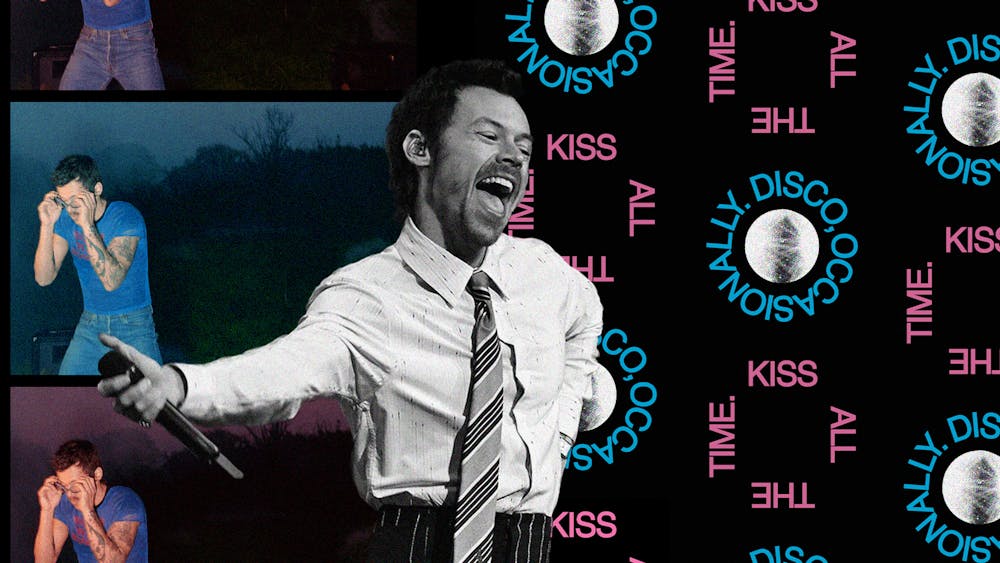
In an interview with Apple Music, Harry Styles described his newest record, Kiss all the time. Disco, Occasionally. as a search for music that makes being on stage feel like being in the middle of the dance floor. As it turns out, Styles’ time on Europe’s dance floors in between Harry’s House and Kissco was more contemplative than sweaty—the carefully placed “Occasionally” in his new album’s title should have let us know that it wouldn’t be a full–out dance record. The album is a sobering check–in with Styles, seeing him take inspiration from electronic artists like LCD Soundsystem and Floating Points. But instead of chasing the ecstatic highs of his disco and techno influences, Styles wields them in his simultaneous questioning of and indulgence in self–mythological nostalgia. Though he attempts to interrogate the emotional bankruptcy involved in being a teen girl heartthrob ever since One Direction, Styles seems out of place and unconvincing in his new meditative persona.
The album’s lead single, “Aperture,” seems like a remnant of a different psychedelic dance record, which is not what we got. The track gathers heat as it goes, layering synths and bass lines to lengthen the infinity between a lulling dance floor and the beat drop—and that space gives Styles plenty of room to reflect. The music video follows a wild—very wild—goose chase wherein the man delivering food to Styles’ hotel room aggressively chases him down to the backrooms of the hotel. But don’t worry—they eventually do the iconic Dirty Dancing lift and make up through impromptu choreography. Between shots, the deliveryman transforms into a second version of Styles, making it clear that he has spent years dancing, fighting, and eventually running away from his own mistakes. Speaking to a stranger he met on the dance floor, Styles admits in his wispy delivery that there are some things about him that they are better off not knowing. In the aforementioned interview, Styles describes the piece as the entry point for his album’s thesis: an exploration of how he’s changed and danced through it all.
But “Aperture” betrays the increasing incongruity between Styles’ voice and the production he forces himself into—this problem quickly weighs the rest of the album down. Ostensibly, a dizzying dance floor is the perfect place for Styles’ traditional songwriting approach of quickly switching from ultra–specific vignettes to ambiguity. “Aperture” works in its first half, where Styles’ voice gets lost in the groove. However, it seems he can’t help but make a song the masses can scream along to. The repeated “we belong together” at the end of the track sounds fine when you sing along to it, but otherwise feels too lonely and melancholic for the song it’s placed in—it’s like when a house remix of “Love Story” by Taylor Swift comes on at the club.
The rest of the album, which retreats even further from the sonic experimentation of the lead single, catalogues Styles’ step away from the stage as he contemplates his role in the music industry and the entanglement of his romantic connections with his artistry. As hinted at by the dissipation at the end of “Aperture,” the album tries to build a wistful atmosphere that floats from one song to the next, ditching hit–single potential and any sort of explosive ending.
“The Waiting Game” puts Styles in the second person, criticizing him for mining relationships for emotionally vulnerable songwriting material in a pattern that “all adds up to nothing.” While the song is more straightforward than past Styles tracks, he still finds himself back at his guitar. The track’s interspersed electronic glitches also seem added for album cohesion rather than depth. Ironically, the preceding song, “Taste Back,” details a reignited affair with misty intentions in small scenes and rhetorical questions—there’s nothing more Styles than that.
Styles can and should accept contradictions in his music. This choice of song order mimics the swing of a pendulum, with Styles both embracing and feeling trapped by his niche in the music industry. Tracks like “Paint By Numbers” and “Are You Listening Yet?” also lament that his public persona seems increasingly at odds with his ever–complicated personal life. “Are You Listening Yet?” succeeds by capturing the numbness that comes with tour–life overwhelm, rendering the experience emotionally vacant. It’s fresh but challenging territory for Styles, as his voice clumsily treads the line between corny and well–humored while setting the scene that his therapist is “well–fed.”
“Paint By Numbers,” meanwhile, places Styles in familiar languid territory, with the older “From the Dining Table” serving as a comparable, if more emotionally moving, use of the tone. “Season 2 Weight Loss” is Styles’ most effective reflection on his artistic persona, seeing his traditional songwriting style and emotionally charged voice converge with catchy techno rhythms. Here, he’s believably anxious about growing out of the kind of Styles we’d write fanfics about—it’s a rare moment where his presence in this space of instrumentation feels effortless.
Kissco, as the internet has decided to abbreviate the album, also celebrates Styles’ newfound approach to romantic relationships. While the “Sign of the Times” Styles would liken a doomed relationship to armed combat, the more mature “Coming Up Roses” Styles accepts the little moments that might or might not end a relationship. Today’s Styles is communicative and undramatic about romantic problems—and, most importantly, he revels in the beauty that emerges from a relationship that may only last one more night. But this newfound maturity occasionally slides into something less compelling. On the much sexier “Ready, Steady, Go!” Styles falls into clichés in describing a brief intimacy that is infidelic, perhaps? It’s left unclear. The track is so mired in its own persistent racing metaphor that it plays like a synthy Ferrari advertisement. Worse, Styles’ flattened, head–voiced interruptions break up any tension before it becomes too unmarketable—or too fun.
The album’s more radio–friendly tracks often leave a bitter taste in the mouth: Styles is much too demure for the locale of “Dance No More,” and it’s unclear whether he has the authority to tell us to respect our mothers. “Pop” follows the narrow footsteps of “Watermelon Sugar,” but loses the carefree quality of that track’s sexy innuendos. The track only makes sense on a part–time basis.
Ultimately, Kissco is an utterly “listenable” album that will serve as a pleasurable backdrop to endless bittersweet One Direction fancams. Still, the album is not nuanced enough to portray Styles’ occasional indulgence in lukewarm nostalgia, as is intentional in a record about his evolution. When he circles new themes and styles, Styles sometimes sticks the landing—but more often than not, he overpromises. Maybe Styles needs more time to un–become himself; or maybe he just didn’t disco hard enough.