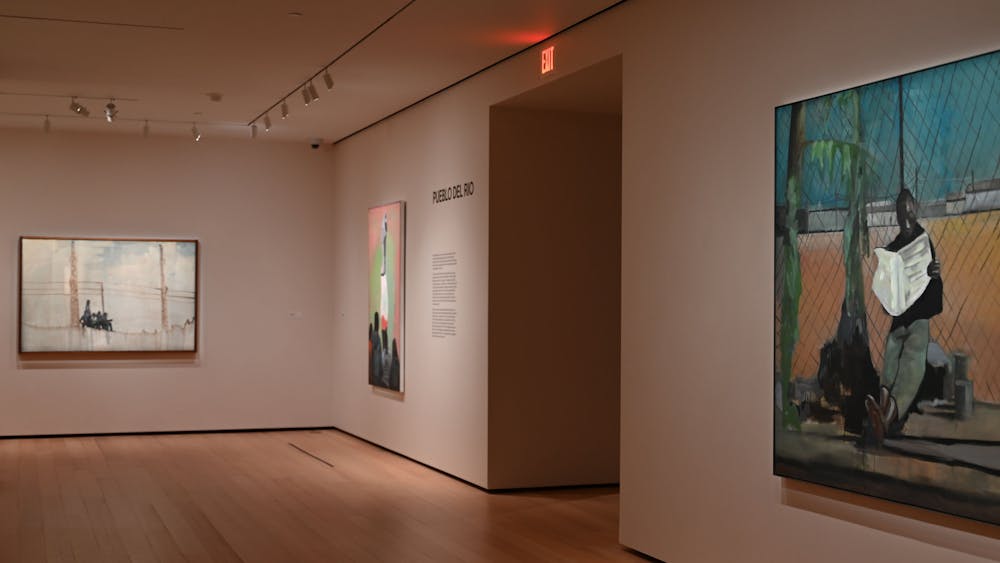
The exhibition at the Philadelphia Museum of Art is the first museum retrospective of Noah Davis’ work, and the only North American stop. The paintings are arranged in an open, expansive space, so both the artwork and the viewers are able to breathe in the legacy and grief that weighs heavily in the art. Davis’ works, while steeped in unspent tears, do not wallow in pity but instead contemplate the underbelly of America’s past, and the collective suffering of the human experience through the backdrop of loss. The paintings work as stages of healing and belay the conviction that progress will be made. The exhibition reveals Davis’ enduring commitment to translating the felt world and textures of life into a language only paint can speak.
The overarching narrative of the exhibition tracks along Elisabeth Kübler–Ross’ five stages of grief. Davis’ take on this psychological concept is stained with an undercurrent of melancholia and hope, from his perspective as a Black artist, his lifelong pursuit of beauty, and untimely death. Art is Davis’ strongest conviction, his purpose, and what connects him to his history and community. Consuming his work is like being swept away by the ocean, leaving the viewer almost tearful after working through the grief alongside the artist.
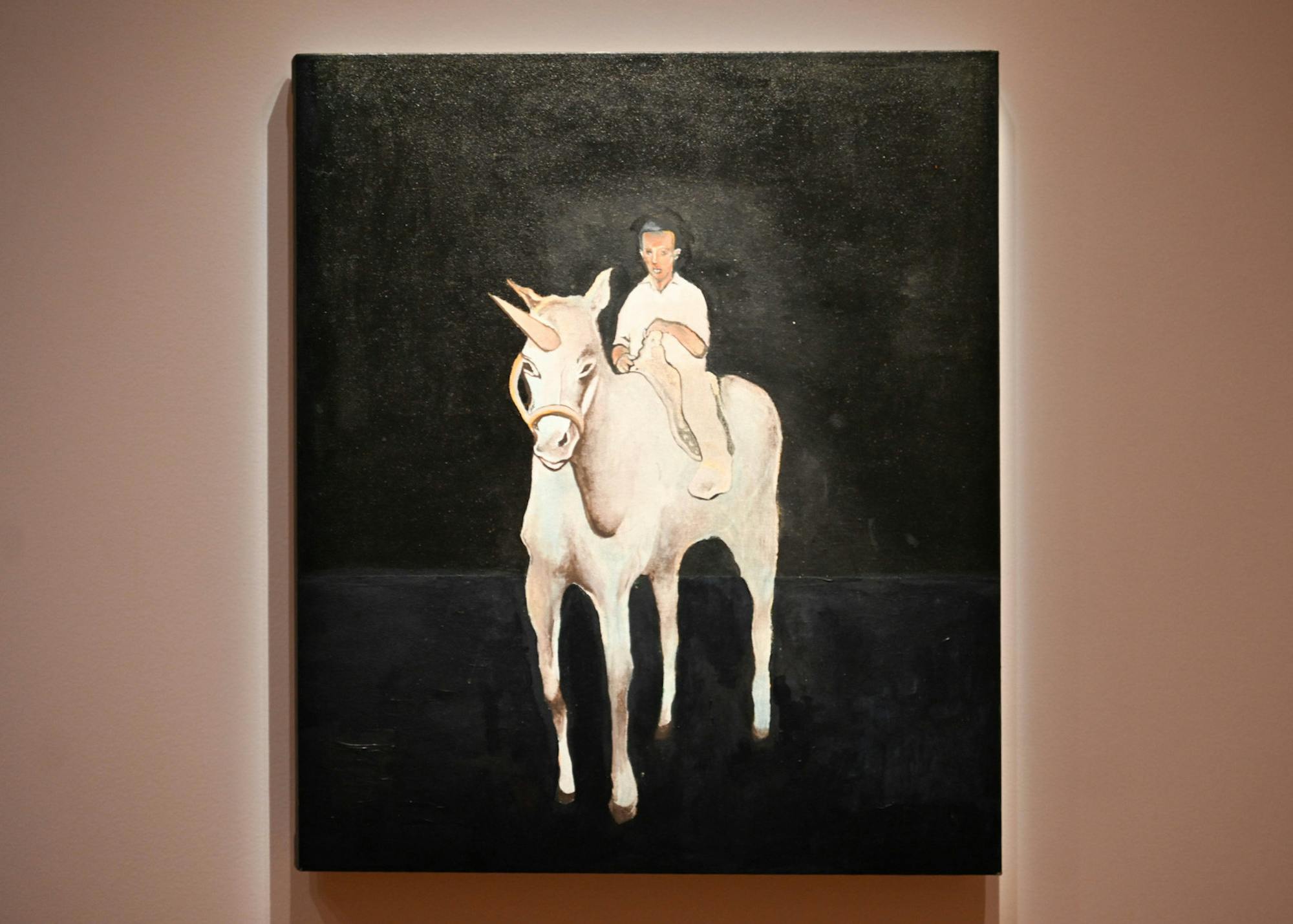
Denial: 40 Acres and a Unicorn
Davis alludes to the 13th Amendment through his use of the fantastical unicorn—here, he contrasts the shattered hopes and dreams of the formerly enslaved families who were set to own the land that they had expended their involuntary labor on. The work alleviates the smeared aspirations and cold reality of life by contrasting the injustices faced with an enchanting unicorn. Surrounded by a world consisting only of darkness and shadows—“yet free of violent city noise,” as Davis’ words on the wall of the exhibit suggest—the only light illuminating his pairing of a lone Black man and a pale unicorn is their own luminosity. It emanates from within and emits outward, a symbol of encouragement toward eventual peace.
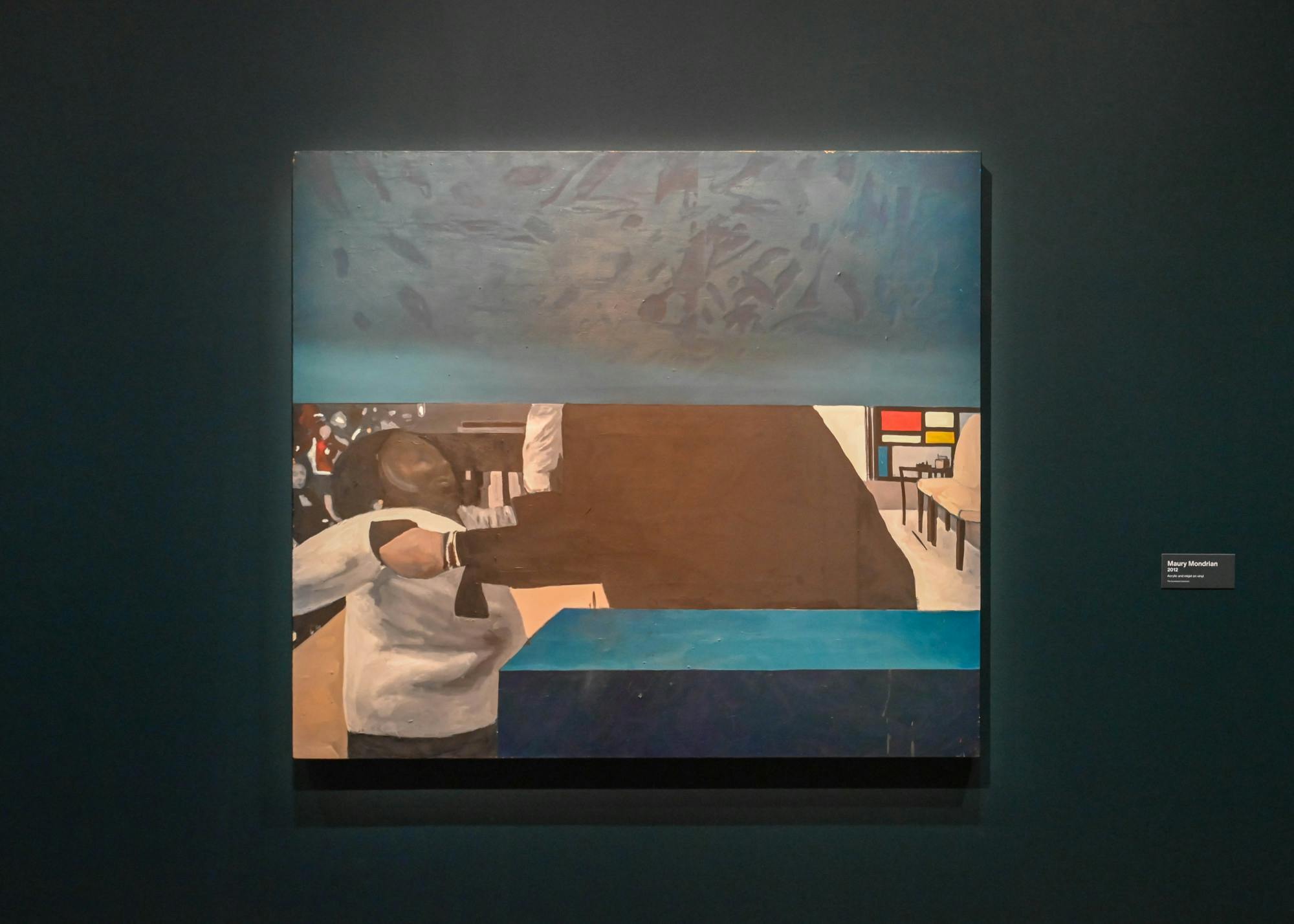
Anger: Maury Mondrian
A partially hidden white man grips the shirt of a lowered, Black figure; through a gap in the foreground we see a rowdy audience, roused to their feet. Popular TV shows like the Jerry Springer Show and Maury often incorporated negative representations of lower–income people of color in contrived, exaggerated contexts. These stereotypical caricatures propel a false narrative that has historically dehumanized the Black community. Davis confronts this societal blight in Maury Mondrian as he explores the absurdity of public media and showtime television. Anger is central to these shows—from the indignant audience to the fury of the victims to the pointed fingers at the shocked perpetrator, rage requires a target or outlet. Davis exposes the slants presented in the media and its influence on public opinion by using his art to turn the tables back around on shows like Maury.
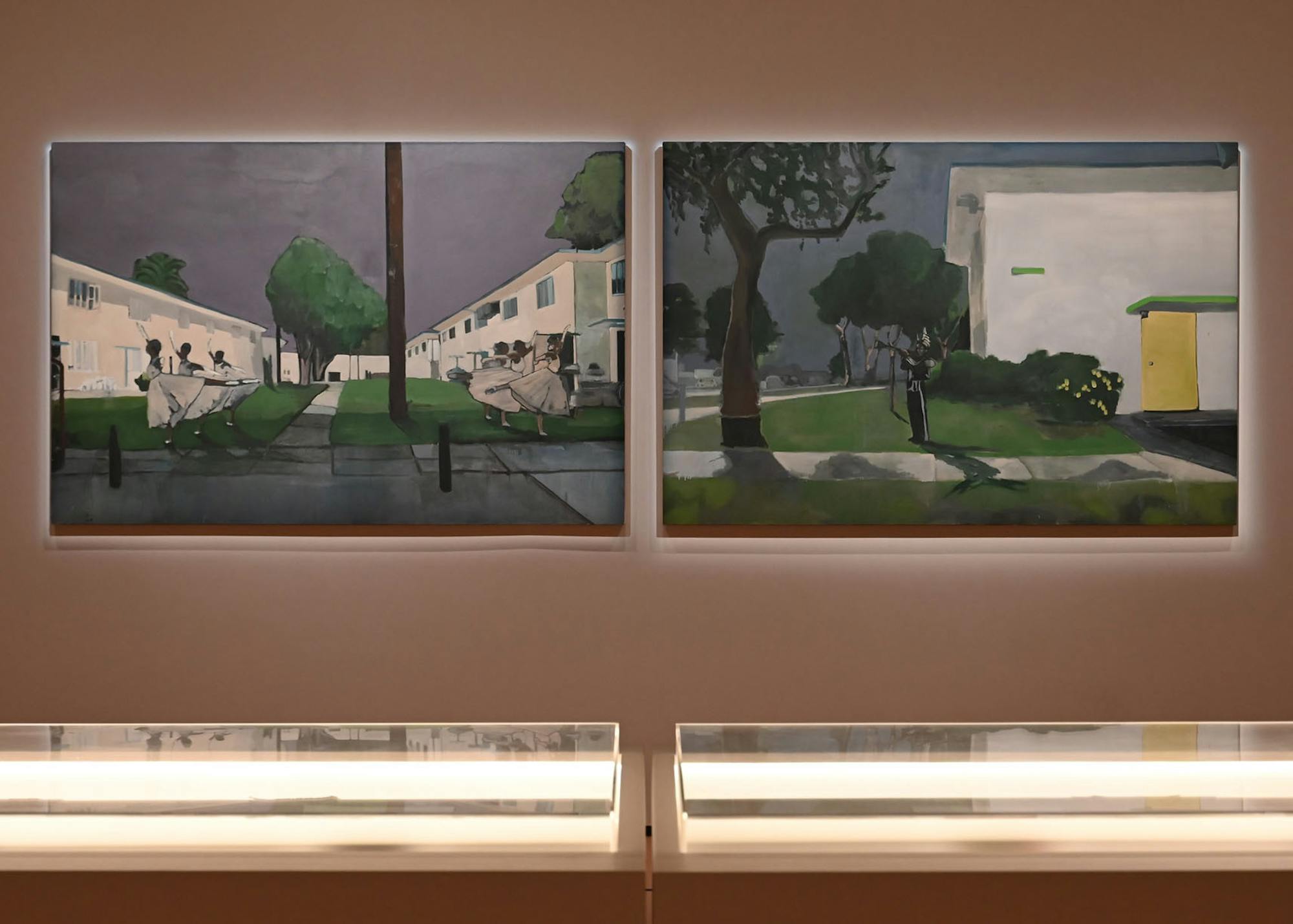
Bargaining: Pueblo del Rio: Arabesque
Davis fabricates a fantastical garden city as Pueblo Del Rio—a Los Angeles housing project built for Black defense workers that atrophied into systemic poverty. Grey skies overlook lush, verdant manicured lawns and fully grown trees, while beautiful, white–garmented Black ballerinas freeze, craned like swans in mid–dance. Ivory apartment buildings are placed like chess pieces on a board of grass and uncracked, unblemished sidewalks. The painting juxtaposes the pure innocence of the ballerinas with the dour sky and blunt architecture. Heaven isn’t a place on earth—certainly not Pueblo del Rio—but Davis bargains between elements of fantasy and reality to strive for a future where a repeat of Pueblo Del Rio doesn’t occur. The political issue of affordable housing is inextricably linked to communities of color. Crucially, Davis is not unable to face this reality of historical oppression; instead, his optimistic self–possession guides his refusal to accept it as a blanket truth.
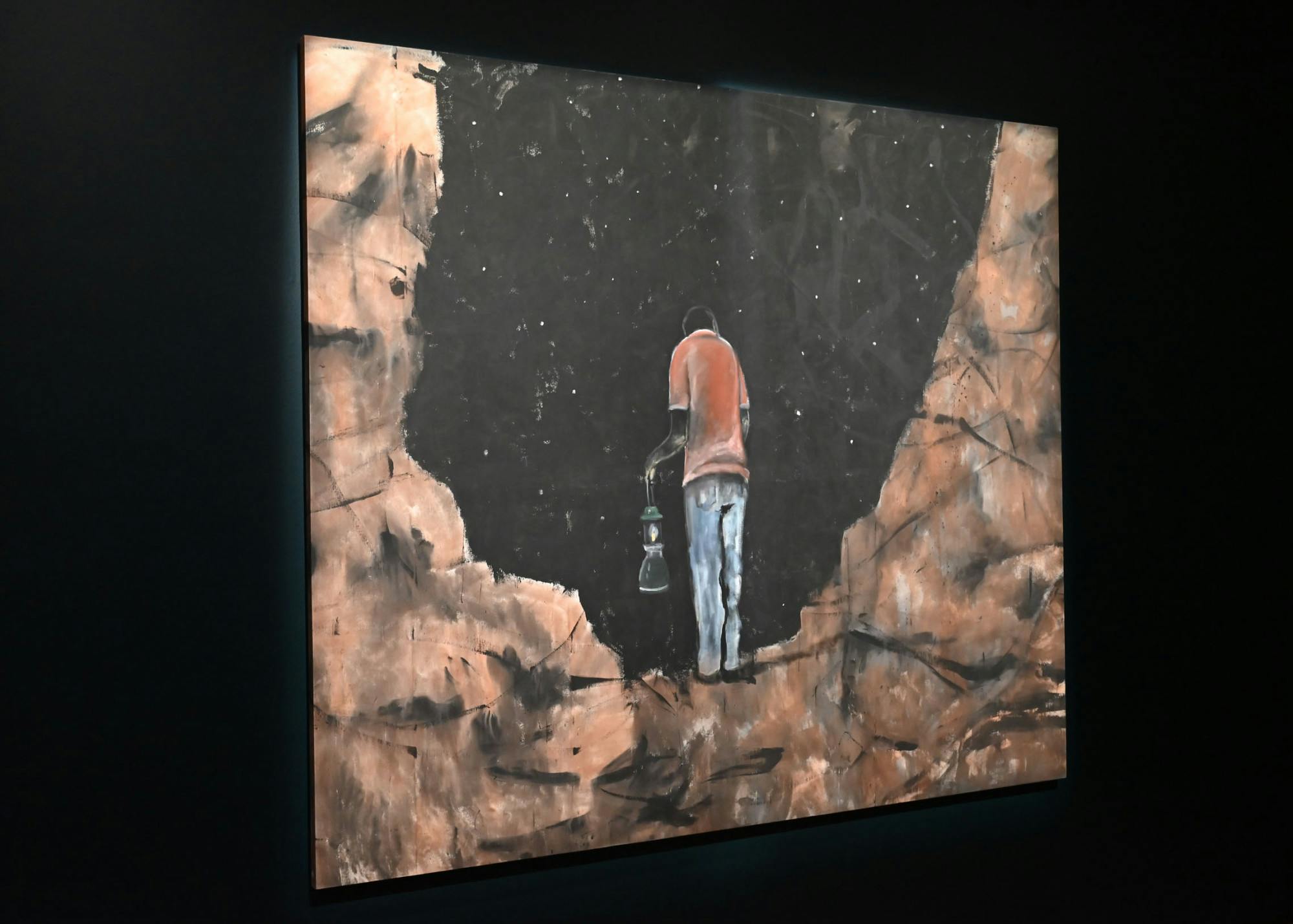
Depression: Painting for My Dad
This painting takes up its own wall in the gallery. A figure stares out into the abyss, holding a lit lantern while incandescent rocks circle the frame of the painted canvas. The darkness beyond is not entirely bleak—ashen streaks run through it, and a multitude of stars encompasses it. The glimpses of possible bliss, of hopes, dreams, and wishes written across the black sky, are as striking as the unspoken message of love and light that prevails beyond the unknown. Davis reveals hope as a sentiment of good faith in somber, grief–stricken times. The figure contemplates loss just as Davis did while painting this piece—his father was diagnosed with terminal cancer shortly after Davis became a father to his own son, Moses Davis. Grief is not just the moment of loss; it can be as expansive as an onyx night and mourns what’s left behind even as it lessens to make way for new beginnings.
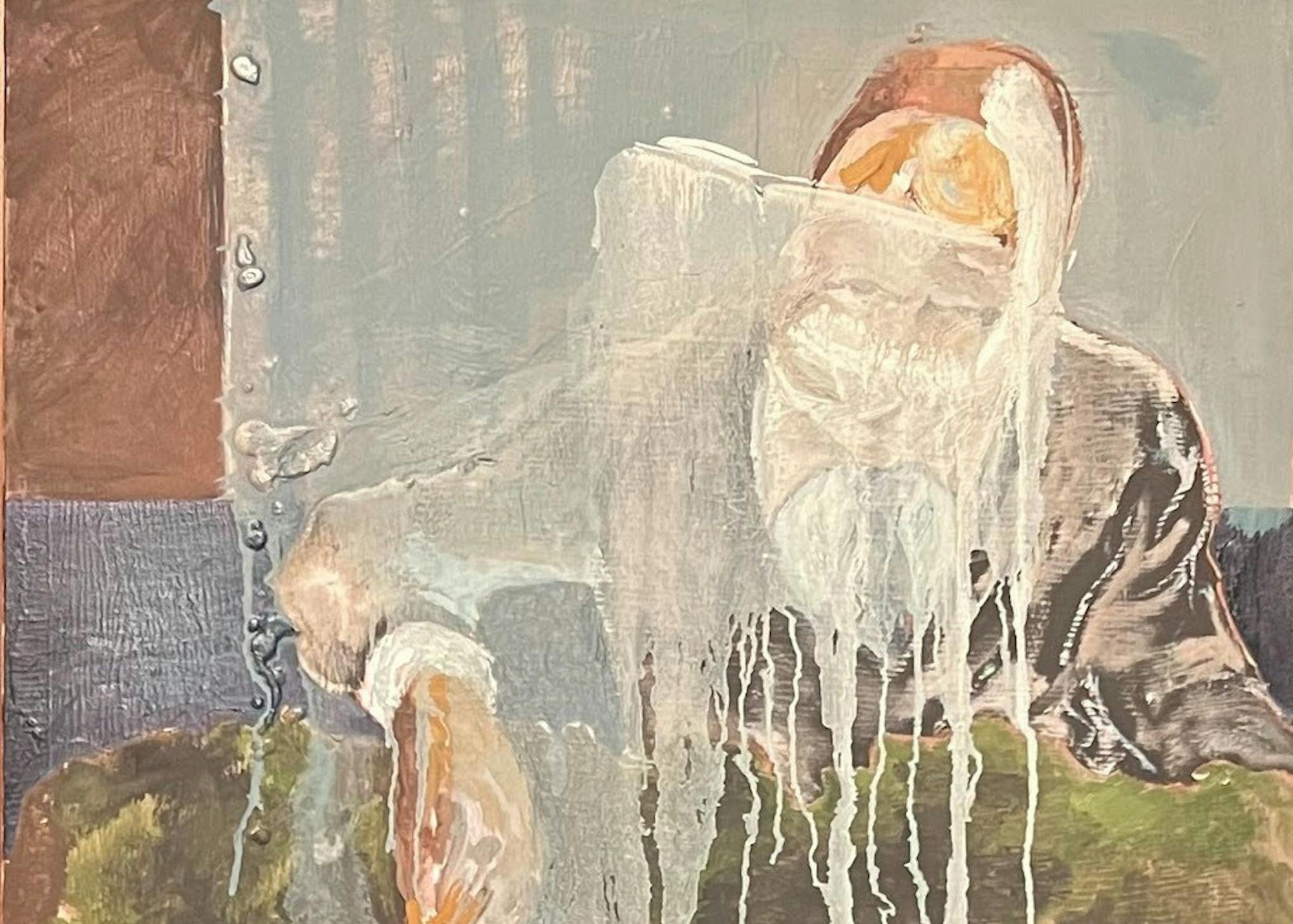
Acceptance: The Architect
Paul Revere Williams is featured behind a wash of white paint that obscures his face. Williams’ body of work notably belonged to the White–dominated architect world of Los Angeles, where he built over three thousand buildings when it was still segregated. Blocked panels of muted browns, dark blues, and pale blues envelop Williams as an arm stretches out to place a piece of a building into its larger framework. Williams is faceless in an intended non–portrait, and even in art, he can’t escape the white veil that hangs over him. Davis accepts the possibility and permanency of loss over time and history, but does not allow it to stop him from immortalizing Williams’s accomplishments, career, and entire architectural legacy so that they’re not diminished to facts in obscure books, or, if lucky, down a marginally more visible Wikipedia rabbit hole.
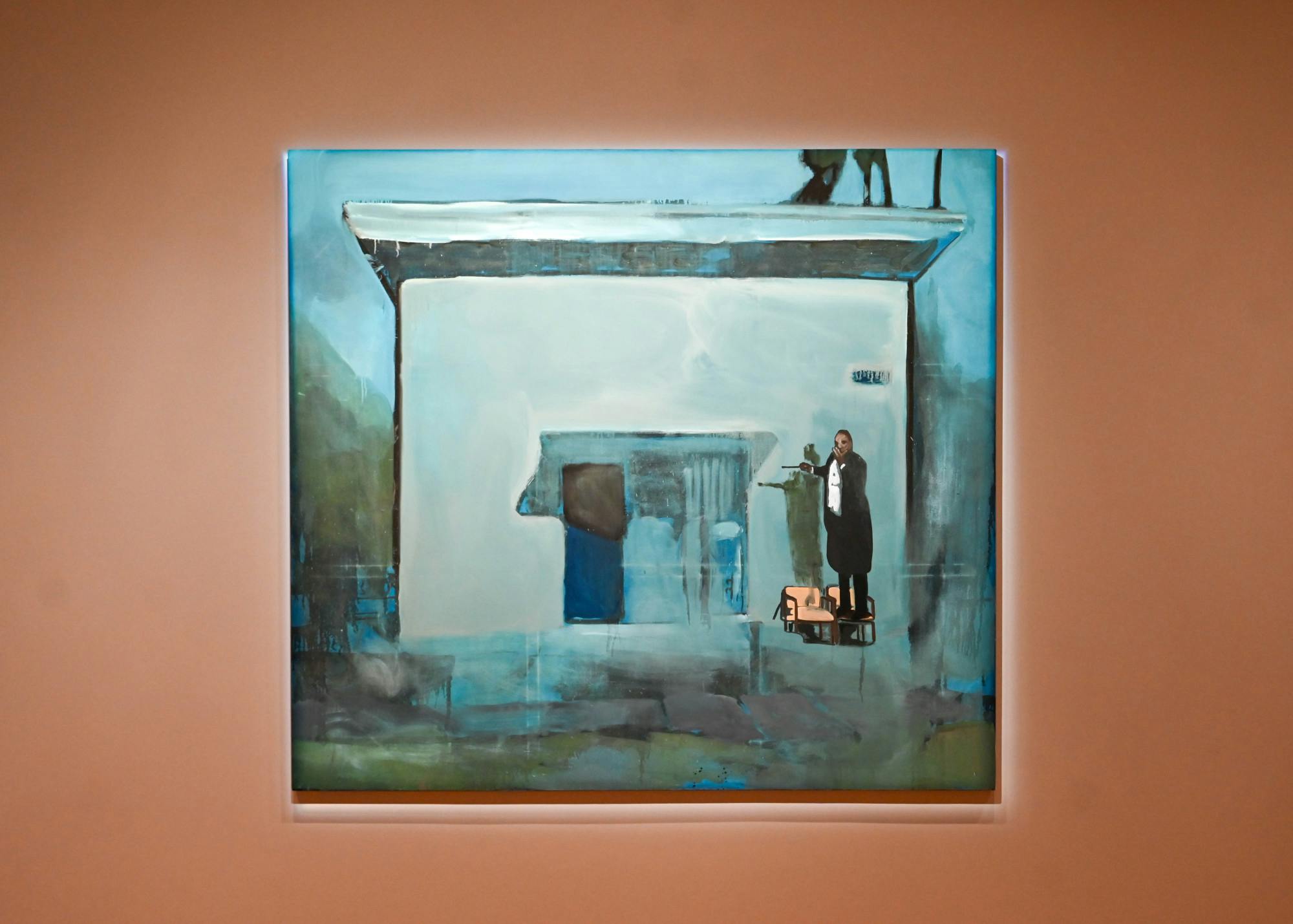
Meaning: The Conductor
The figurative body of the Black conductor stands on a chair, his shadow imprinted into the blueish building. An illusion of cyanosis drains the oxygen from the painting, leaving an atmosphere of blue hues—an homage to Maggie Nelson’s Bluets. The painting acts as a culmination of all the stages of grief and what happens after. The blues encompass the “contradictory sensations of lived experience”—a swirl of nostalgia and bittersweetness that foster deeper introspection, empathy, and the ability to navigate the hardships and realities of life without losing oneself in escapist fantasy.
The brightest stars burn the fastest, but not without leaving light for others. The messages of Davis’s artwork soar in a blend of figurative and abstract brushstrokes that can only be entirely understood, as Davis argues, in person. The physicality of artwork is what allows it to prosper as the PMA celebrates its 150th birthday anniversary—an astonishing achievement in the digital age. Davis offers an audience the opportunity to contemplate a collective history that reverberates across specific identities and generations, and to start to heal from it by experiencing the world through his own lens through his art. The retrospective illuminates his understanding that life always moves forward, and the importance of maintaining a lived memory as we work towards a glorious ideal of progress.