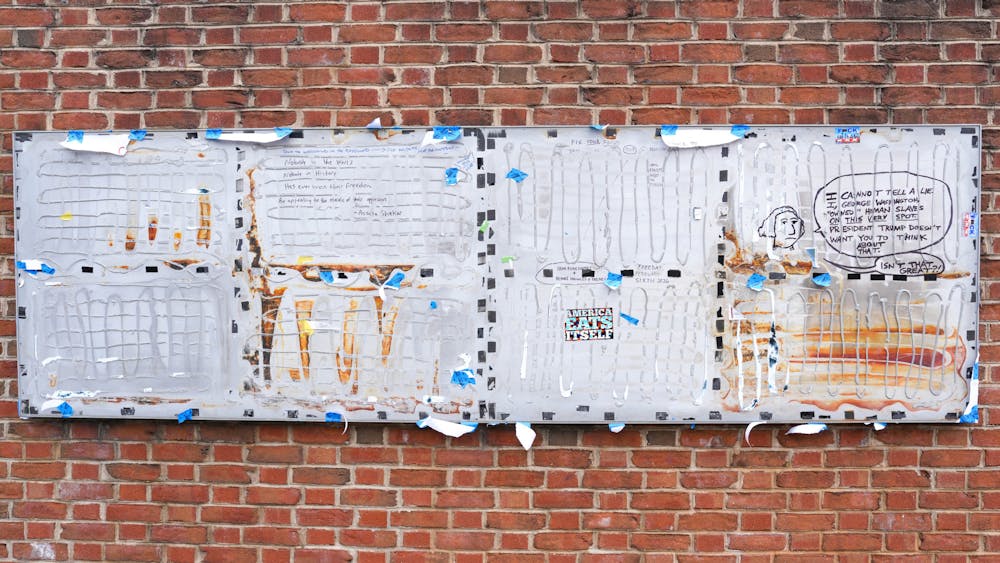
It's January 22, just another quiet Thursday afternoon at the Philadelphia Independence Mall, when a clattering sound fills the air. This isn’t the ordinary clamor of Philadelphia construction or the rumble of traffic: it’s the sound of federal agents prying a monument off the side of the President’s House.
The exhibit, erected in 2010, consists of several plaques that recognize the lives of the nine enslaved people who lived and worked at George Washington’s executive mansion. One plaque, titled “The House and the People Who Worked and Lived in it,” names those nine. Another describes slavery in America during Washington’s Presidency, while others present illustrations of those enslaved working and living in Washington’s Philadelphia home.
“When the site was uncovered during a renovation of that space, activists mobilized to ensure that the full history was preserved and shared. It's been an important opportunity to discuss what freedom and liberty meant during the nation’s earliest days, and what those words mean today. This was the intent of the exhibit, to not look past the fact that the home of the nation’s first President also housed human beings who were denied their human rights,” says Dr. Brian Peterson, Penn professor of Africana Studies, and director of Makuu: The Black Cultural Center.
The removal follows President Trump’s recent order for the National Park Service to flag signs and monuments that “disparage” America. Passed on March 27, 2025, the Executive Order, “Restoring Truth and Sanity to American History,” states that it seeks to rewrite historical messaging that “replac[es] objective facts with a distorted narrative driven by ideology rather than truth.” It goes on to say that, through such “historical revision,” the legacy of the United States is “reconstructed as inherently racist, sexist, oppressive, or otherwise irredeemably flawed.”
Philadelphia immediately took action against the removal of the Old City exhibit, filing a lawsuit against the Trump administration that names the National Park Service, Interior Secretary Doug Burgum, and the acting National Park Service Director Jessica Bowron.
The city held a hearing regarding the lawsuit the following Friday, where Philadelphia sought a preliminary injunction that would stop the park service from removing the panels any further and advocated for the removed panels to be restored. Federal attorneys argued that the removal of the exhibit was within the federal government’s realm of control, while District Court Judge Cynthia M. Rufe labeled such actions as “dangerous.” While Rufe could not provide a statement, as the case is ongoing, she ruled to have the plaques returned to their original place.
Nearly a month after their removal, workers began reinstalling the exhibit panels on February 19. The Trump administration has appealed the decision, which is now pending in the U.S. Court of Appeals.
The exhibit’s removal and reinstallment has sparked national conversation about how history is remembered, who controls public narratives, and how we deal with the uncomfortable truths of America’s early establishment. For many, it raises questions about the role of the federal government in determining the messaging of nationally recognized parks and monuments.
This attempt is part of a broader national trend that aims to sanitize history at the expense of education. In New York City, the pride flag was removed from the Stonewall National Monument. Several national parks have lost sites commemorating native and minority populations who were harmed and displaced on the land. Notably, a 2021 addition to the Muir Woods Exhibit in California, which recognized the roles of women and indigenous people in creating the National Monument park, was removed in 2025. President Trump has also attempted to remove the slavery exhibit at the Smithsonian Institution because it focuses too much on “how bad slavery was.”
“Taking down an exhibit doesn’t erase the historical facts, conditions, or consequences. It does contribute to ignorance, however, which is never a good state of affairs in a democracy, in which we count on an educated electorate to guide our government,” says Dr. Kathleen Brown, a Penn professor of history who focuses on race and the history of slavery.
Dialogue about the removal of historical exhibits, such as the one as Old City, often drifts back to the removal of monuments of problematic figures, such as confederate soldiers. In recent years, hundreds of Confederate monuments have been dismantled across the U.S. The question arises for the right, if political monuments can be taken down, why can’t exhibits on American history be?
“This argument about hypocrisy, I think, is really unfair … the difference between taking down a monument and taking down those historical plaques is that these plaques are meant to teach, but a monument with somebody sitting on a horse, elevated in a city square is meant to honor that individual. It doesn’t really tell us a whole lot about who that person was,” says Dr. William Sturkey, a professor of history at Penn.
Ultimately, we must be able to distinguish between honoring a figure from educating Americans about a historical figure’s legacy. Education serves a different purpose entirely than reverence. “This conversation about removing statues is a fundamentally different thing,” Dr. Sturkey says.
Sturkey also addresses the question: who might the audience of these plaques be? He asserts that this history can and should be taught to all Americans. “I really struggle with this argument that something is not for kids, because so many kids experience that racial oppression in real time,” explains Sturkey. “I teach a class on the civil rights movement, and I showed a documentary about Emmett Till, and when you pull up the documentary, you have to click a button to say I’m over 18, which I just thought was really ironic, considering the fact that Emmett Till wouldn’t be old enough when he was murdered to watch a documentary about his own murder. He was 14 when he was killed.”
The concerns over the “appropriateness” of the plaques is concerning, especially considering, as Sturkey explains, “five year olds knew they were enslaved. … We’re susceptible to racialized violence at very young ages, and so I think it’s perfectly acceptable for us to teach young people today about what young people of the past went through.” Young Americans today live with the cultural scars of slavery in America. This is a history that does not subvert the American experience but rather in fact, for many, explains it.
Furthermore, referring to these plagues as inappropriate raises the question of what is appropriate. The plaques themselves present a notably toned–down version of the story of slavery in the Washington house. “They’re pretty sterile, honestly, just to acknowledge the fact that George Washington owned enslaved people,” says Dr. Strukey. They don’t mention the true horrors that occurred in the life of an enslaved person. They don’t mention that Washington removed the teeth of enslaved people to make his own dentures. If these signs, which already leave out elements of the story, are now viewed as unacceptable, we must wonder, how “sterile” must our slavery education become to abide by these standards?
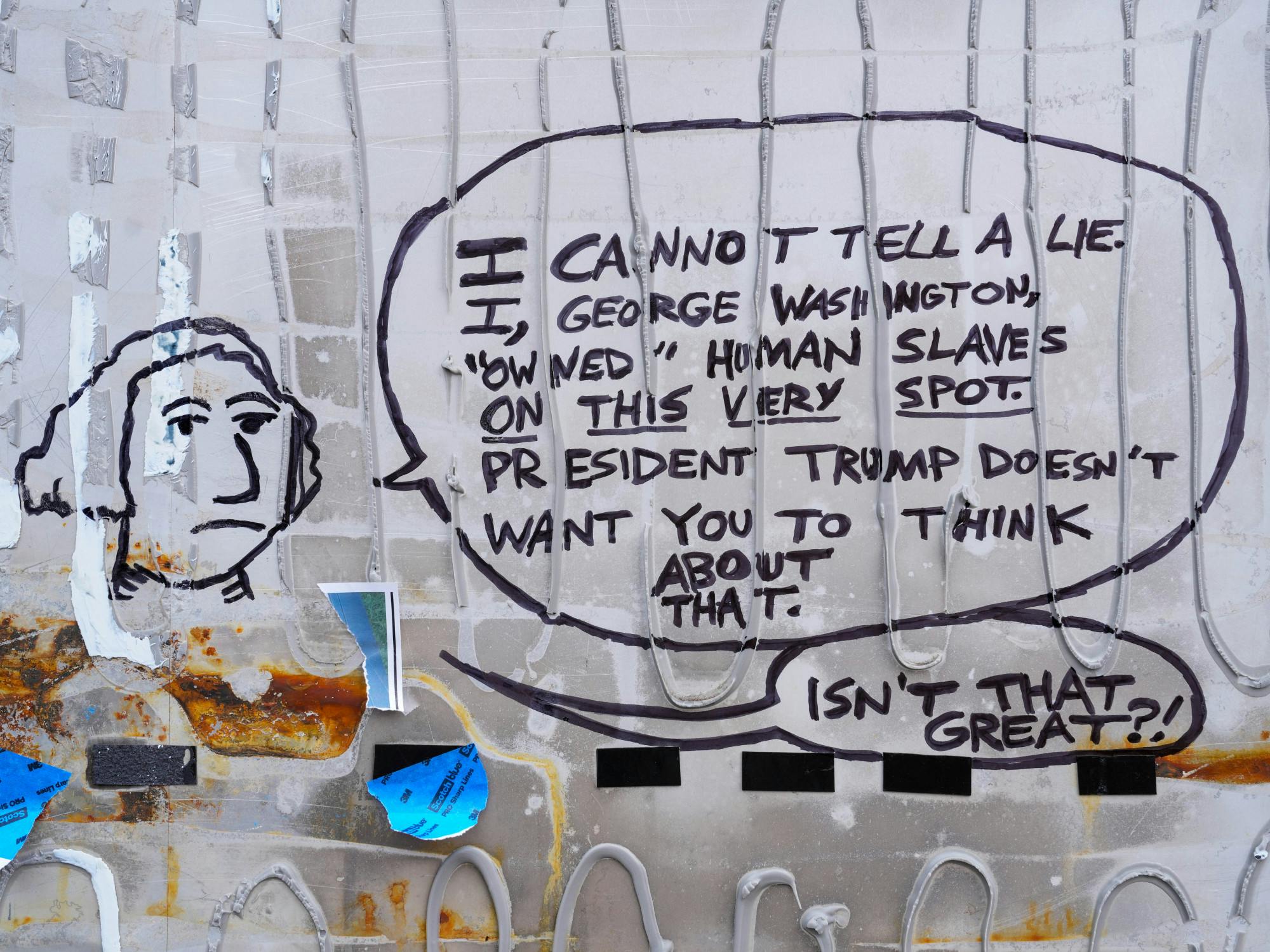
The turmoil around the exhibit in Old City speaks to a broader social tension around race history education. Schools and libraries are banning books about racism, and classroom content is being questioned for teaching the history of slavery. But censoring American history doesn’t erase its effects on the present. Sturkey reflects on the ways in which art and social media can keep conversations about racism alive in the face of federal restrictions on classrooms and public spaces: “At the same time, there’s so much technology and that people can access; podcasts, YouTube videos, and different sorts of information outside of school, which isn’t always as rigorous as what we learn in the classroom, but at least an eighth grader in South Carolina can listen to a podcast about something that would be illegal to teach in their school because the government tells them they’re not allowed to know that.”
As Philadelphia’s lawsuit against the Trump administration develops, the country is faced with an important question: what happens when our history is stripped of its cultural complexity, and how can we protect Americans from that damage?