“Commenting to stay on penn tok.” Without context, you’d assume these words come from the mind of a hopeful high schooler, replying to one of the many videos on Penn Undergraduate Admissions’ TikTok account. But they’re replying to Jack Rogers’ (C ’26) TikTok feed, finding the desire for this life hard to resist.
In one of his videos, Jack and other Penn students, decked in all–white outfits, embark on what the caption deems a “study break.” But the destination isn’t the Biopond or College Green—it’s a field where a hot air balloon, vintage cars, and croquet sticks paint the scene of an upper-class Ivy League gathering. One of the TikTok’s comments reads “this is so old money;” many others remark on the video’s resemblance to the secret society from Season 5 of Gilmore Girls. Not all the comments are so laudatory—one particularly negative post reads “I covered my drink and I’m not even there.”
Seeing the lavish lives many influencers lead makes content creation seem like a perfect career to those looking to make it big—and for some, it is.
Influencer culture and social media may look like nothing more than a distraction from the “real world.” But the so–called “creator economy” is a force more powerful than it first appears. A 2023 report by Goldman Sachs projects this economy to gross almost $480 billion in revenue by 2027, while the pool of 50 million global content creators is projected to grow by 10–20%.
Why do millions gamble their lives for a spot in this creator economy, and where do Pennfluencers fit within it? On the whole, Penn’s influencer culture is both a part of and distinct from the larger creator economy, with content creators using the broader market’s trends to build their own unique brands.
Lindsey Cameron, assistant professor of management at the Wharton School, describes much of influencer culture as a facade. “You look at a ten–minute video, and you don't know that it took ten hours to shoot that video, and you see people with the trappings of a luxury lifestyle,” she explains. Cameron researches organizational behavior, especially as it relates to social media platforms. In an article she co–authored on the topic last year, she explored “why people stay engaged in a form of work that … often is not in their best self–interest to continue doing.”
The reason lies in what she coined the “platform paradox”: depictions of wealth and comfort from content creators online lead other aspiring influencers to believe they will gain success despite the odds—which are slim. Only 4% of content creators earn a six–figure salary—Goldman Sachs’ standard to be deemed a “professional” in the field. Because of this, Cameron emphasizes that content creation and platform work are by no means guarantors of upward mobility or high economic success.
Whether they buy into the promise or not, Penn’s campus teems with influencers of all stripes. They buzz about on Locust or prop up their phones in Pottruck Health and Fitness Center, ready to record “days in the life” for thousands of doting middle– and high–school viewers. One would think they’d fall into the same unfortunate paradox—but Penn’s unique environment leads many influencers to pivot and explore social media differently.
Influencers often take the potential monetary gains of content creation very seriously. For many at Penn, however, content creation is a hobby rather than a career path. Jack, for example, recognizes the potential of his content creation as a tool for upward mobility and a means for profit, but he also sees it as excessive when brand collaborations take over a creator’s feed. He believes that doing so forgoes the debonair image he tries to build on his platform.
“I feel like the way that I've always seen social media is that it's very personal and obviously very curated,” Jack explains. “And so when you start putting brands and stuff in there, you can kind of lose that, which is why I rarely do sponsorships. But if I do, I make sure it's something I actually like.” So far, he’s only accepted a sponsorship from one brand: TruFru, one of his favorite snacks.
Jack established his digital footprint long before Penn and TruFru. In seventh grade, before his main platform, TikTok, entered the picture, he got his start posting videos of himself decorating cakes, a practice he has continued while at Penn.
But underneath his cake videos, Jack aimed for fame in middle and high school. In the beginning, “I just wanted to be super famous,” he says, “and at 16, because I was in my house for so long due to COVID, I wanted to go out and see the world.”
Today, he’s at least gained micro–celebrity status. His most recent videos on TikTok—where he has amassed over 25,000 followers and 5 million likes—share moments from his final semester at Penn.
These moments from Jack’s “days in my life”—whether you find him strolling through campus or walking along the shores of Malta—showcase the image of an idealized college lifestyle, eliciting reactions full of awe and wonder. For this reason, most of Jack’s audience—as is reflected in his “study break” TikTok—aren’t Penn students themselves, but those romanticizing “Penn life.” Jack’s casual trips to the Hamptons and hot air balloon rides paint a picture of what Ivy League life is supposed to entail—status, wealth and personal success.
Now, with summer on the horizon, Jack plans to pivot his content and document his everyday life after undergrad, when he will study architecture at Columbia University. He makes it clear that his feed is a mirror of his growth socially rather than financially; it’s a diary, he says, with the goal being to “meet other people that I wouldn't necessarily meet.”
Elaine Peng (C ’28), meanwhile, has certainly flirted with the idea of pursuing content creation full–time. Today, she has over 4,000 TikTok followers, and has amassed over 800,000 likes on the platform. “I have thought about what happens if I put my all into it,” she says, and ultimately decided that she would “never do something like that.”
“But then brand deals started coming in.”
After she’d gained a footing on TikTok, supplement company Bloom Nutrition reached out with a brand deal—it was one of the largest sponsorship offers Elaine had received. But despite the promise of monetary gain, she turned down the offer. Like Jack, she was wary of letting outside incentives shape her content. “I didn’t feel like it was me being the most authentic to myself,” she says. Elaine maintains a strict rule—keeping content creation a hobby she pursues for its own sake, similar to how she explores her artistic side with a Fine Arts minor.
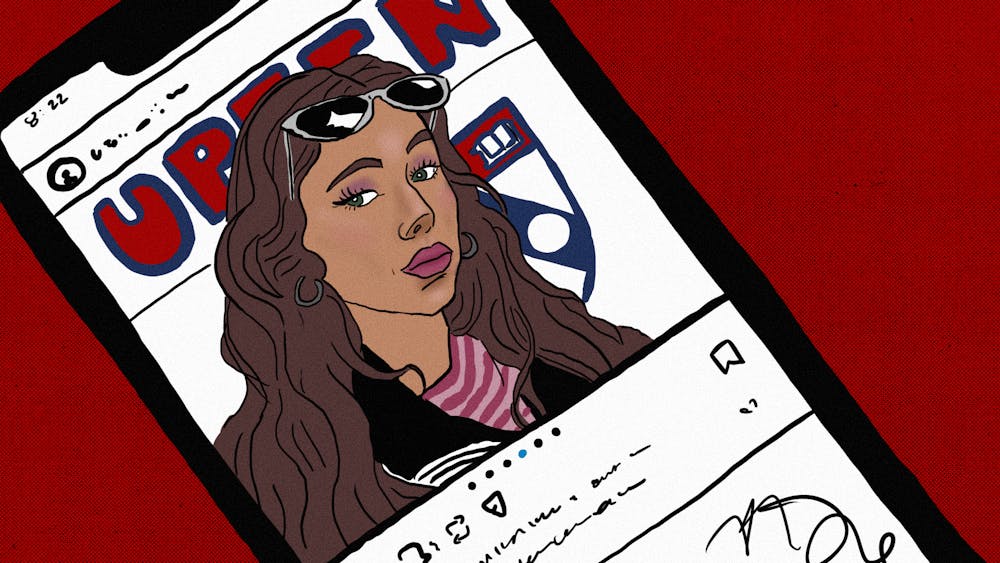
In Elaine’s freshman year, her content leaned on her identity as a Penn student. Her most viral TikToks document her ranting about Penn dining while eating yogurt at Commons, or offer a look into her freshman year dorm in Hill College House. Both videos’ covers showcase the words “UPenn” or “Ivy League” in big, floating letters, placing an emphasis on her days at an elite university like Penn that would attract aspiring high schoolers.
Her most recent videos, however, reflect a shift in her content—she now aims to deviate from her Penn persona and document herself with university life in the background. It’s this artsy style that now characterizes Elaine’s “digital diary,” as her TikTok bio reads. Today, instead of finding her talking to her phone, recording videos about student life, you’re more likely to catch her on Locust in the furry jackets and plaid skirts she captures in her fit checks.
Elaine admits that she’s only dipped her toes into the pool of the creator economy. She stresses the importance of income stability to her lifestyle—something social media, she says, can never ensure. That instability is another reason why she shies away from brand deals. “I think I am speaking with privilege [when I] say I can turn down that sum of money, because this is purely a hobby for me. And I'm not relying on it as a source of income,” she clarifies.
Elaine’s reasoning likely stems from her position as a student at Penn. Similar to how they enter, 23% of graduates earn a spot in the top 1% of income earners, and 69% land in the top 20%—both are among the highest rates in both the Ivy League and peer institutions. With a mobility rate of 66% for Penn graduates, many students have the resources to earn a high, steady income with just the name on their degree. Because of the stability a Penn education can offer, the woes of the platform paradox hardly enter a Penn content creator’s consciousness.
It’s this stability that allows students like Elaine to stay separate from the millions gambling in the creator economy. As an economics major and aspiring consultant, Elaine places her bets elsewhere.
For Ava Infante (C ’28), content creation is a goal in itself—earning an income from it is only an added benefit. “When I was about 14 during COVID, I used to make days of my life vlogs. But then, because middle school [and] high school [students were] very judgy, I stopped. I was like, ‘I'm just not gonna [pursue content creation] when I’m in college,’” Ava recalls. But experiencing student life at Penn changed her mindset. “I realized it's obviously a new space,” she says. “No one really cares what you do because the population is so big, and everyone's just trying to get a job or do their own thing. So I just started again.”
Since rebuilding her platform during her freshman fall, Ava—who was also Elaine’s freshman year roommate—has accumulated almost 9,000 subscribers on YouTube, focusing on lifestyle content through the lens of a student at an Ivy League university. She explains that her videos, which range from tours of her high–rise dorm to college advice, are best suited for YouTube. “I feel like YouTube is the most stable [platform], and you can also build a loyal, broader audience, versus the other ones,” like TikTok and Instagram, “which are more based on video–to–video,” she says.
Though many YouTubers have made a career out of content creation, Ava claims that she “didn't go into social media with the intent of making money.” But eventually, the opportunity presented itself—so she took it. Now, brand deals have become her primary source of income and, in her content, Ava has kept monetization and audience growth at the front of her mind. “My marketing brain,” Ava laughs, “asks, ‘What points would help attract my key audience?’” Topics like college lifestyle, academics, and social life are her bread and butter, and she often displays the term “IVY LEAGUE” in all caps within the titles of her YouTube Shorts to attract audiences like high schoolers aspiring for a life at a school like Penn.
While Ava is perhaps too prudent to go all in on her own brand, she does hope to carve a career out of her content creation. Ava views social media work through a professional lens—she’s currently working a social media job for the beauty brand Good Molecules and aspires to work in high–end retail marketing.
Because of this aspiration, she accepts her place within the creator economy while recognizing the financial pitfalls of the platform paradox. By doing so, she accepts brand deals and monetization but doesn’t allow herself to go all in. “You have to be mindful about what’s going to make you money,” she warns. For her, independent content creation isn’t the means to achieve this end.
The financial instability that comes with content creation is why many Pennfluencers take Elaine’s path. Dressed in a chic business casual outfit as I spoke to her over dinner, she planned on later attending a recruiting panel and networking session with McKinsey & Company for the Wharton Undergraduate Consulting Club.
By graduation, most Penn content creators trade in ring lights for business cards and high follower counts for even larger salaries. Penn students aren’t willing to put their stability on the line—and by nature of being at a school like Penn, they have the privilege to find stability elsewhere. The rules of the broader creator economy, then, don’t typically apply to those protected by an Ivy League–manufactured safety net. Instead, they use Penn as the backdrop for their next viral video, glamorizing student life to the hopeful eyes of their striving audiences.