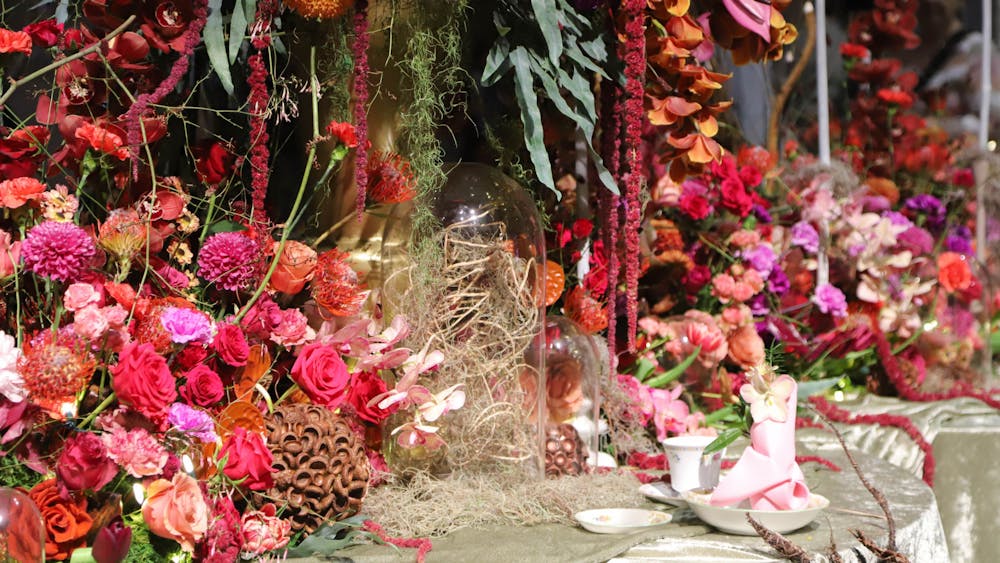
The air inside the Pennsylvania Convention Center is warm in a way that feels suspicious for late winter. Street Photo Editor Connie Zhao and I spill out from SEPTA platforms alongside tens of thousands of other flower enthusiasts, all surging towards the flower show. We step into the constructed spring, and, as I hear Indila’s “Love Story” playing, I feel like I’ve wandered into the secret garden.
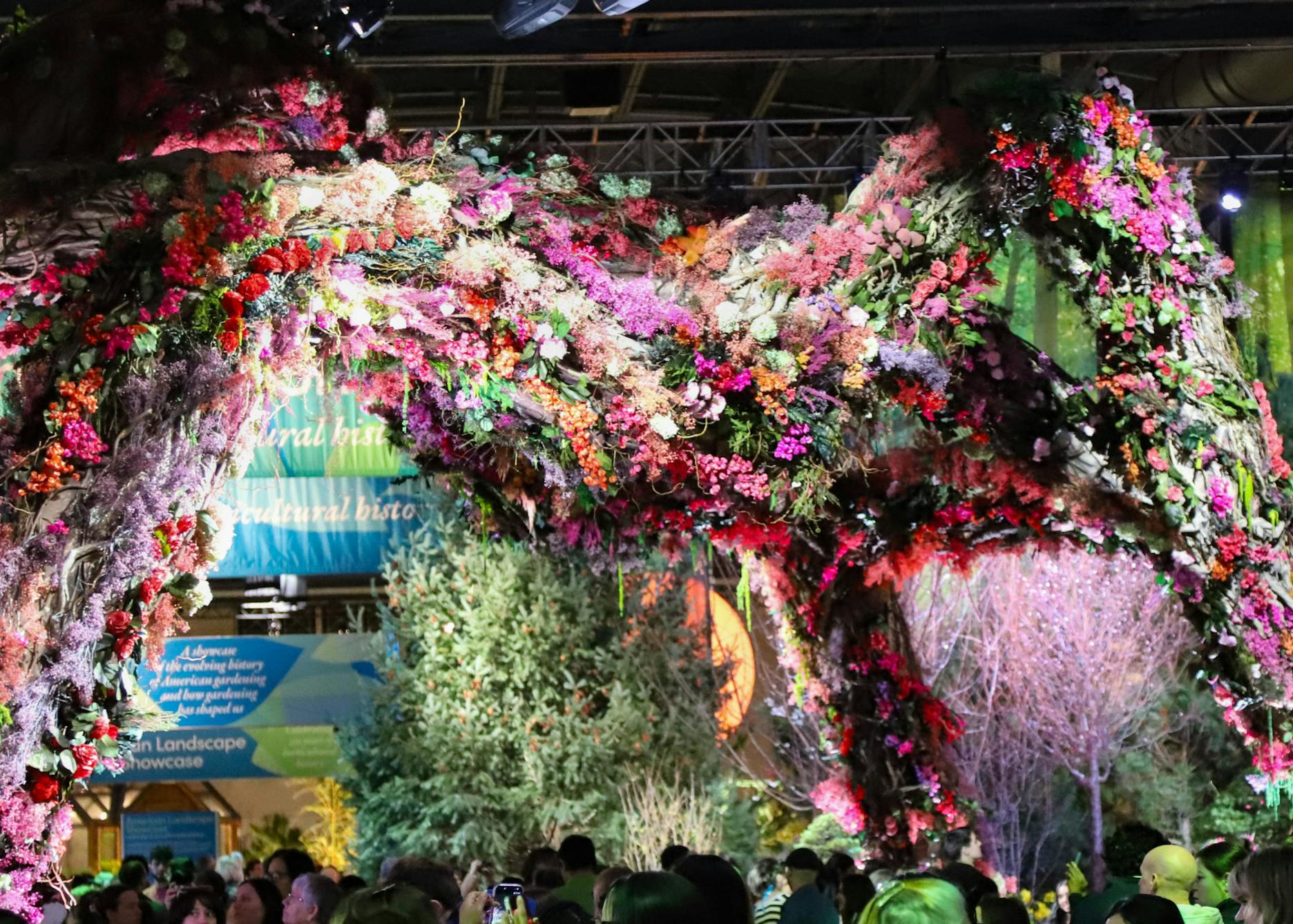
Immediately, a cathedral of blooms forms overhead. Gasps ripple through the crowd, and a low chorus of audible awe floats around me. It’s easy to see why generations of visitors have been drawn here.
The Philadelphia Flower Show has been operating for over a century. The Pennsylvania Horticultural Society, founded in 1827, staged its first exhibition two years later at Masonic Hall on Chestnut Street as a competitive display of fruits, flowers, and greenhouse specimens. Since its 1829 debut, it has grown from a small horticultural gathering of local enthusiasts to the nation’s largest indoor flower show, drawing over 250,000 visitors from across the world each year.
In its earliest years, PFS primarily functioned as a formal judging event, awarding premiums for the best camellias, dahlias, and other specimens that reflected 19th century America’s fascination with botanical collecting and global plant exchange. As the show expanded in the late 19th century, it moved to larger venues including Horticultural Hall in Fairmount Park, built for the 1876 Centennial Exposition. The transition allowed for increasingly elaborate floral tableaux and landscape installations rather than single–specimen competitions.
By the mid–20th century, exhibitors were constructing immersive themed gardens indoors, complete with fountains and complex architectural elements. When PFS relocated to the Pennsylvania Convention Center in 1996, it expanded again, transforming into the massive, multi–day spectacle it is today. In recent decades, themes have foregrounded water conservation, urban greening, pollinator habits, and native planting—all efforts aligned with the show’s broader mission to fund community gardens and healthy food initiatives across Philadelphia.
“This year’s Flower Show theme is ‘Rooted: Origins of American gardening,’” says Matt Rader, president and CEO of PHS. “All of the origin stories, all of the cultural traditions, all of the personal experiences, all of the plants from all over the world that have somehow shaped the American garden and landscape that we all experience today.”
Rader emphasizes that the theme is intentionally expansive, allowing each gardener to tell their story. He says a gardener’s beauty reflects their personal experiences.
“What makes a garden beautiful—what plants you treasure, how you learn to cultivate and grow—is really a reflection of you. It’s parents, it’s your lived experiences, it’s grandparents, it’s cultural traditions, it’s geographies that have been part of your family’s life, and that all culminates in some sense of how you think about gardens and landscape,” Rader says. “The first question you should ask yourself is: How did this get made?”
The answer begins far before opening day. Each Flower Show operates on a three–year cycle. Planning begins years in advance with the selection of a theme meant to inspire innovation. Exhibitors are recruited globally, secured roughly a year ahead, and required to finalize designs by late summer. By Labor Day, plants are already being forced into bloom. They are moved through artificial dormancy and growth cycles so they flower on cue. Two weeks before opening, the Convention Center transforms during an intense “creative–thon.”
Today, judging at the show is conducted by expert panels who evaluate exhibits on design, horticultural quality, craftsmanship, educational value, and overall impact. Entries can earn gold, silver, or bronze medals, and there are also special awards for Best in Show, innovation, or sustainability. Judges score exhibits against established standards rather than each other. At the end of the week, the entire installation is dismantled in just three days, with sustainability guiding reuse efforts.
Joseph Brooks, an landscape design intern at Land Collective, spent the week prior to opening installing a display featuring Land Collective’s Founding Principal David Rubin’s tool collection.
Brooks noted that David’s display included a set of cast iron garden furniture—a bench, chair, and table—from a U.K. foundry. He described the installation as sleek and modern, especially for a flower show.
He also described the artistry that went into each piece:
“Really looking into the minutia of the arrangements and the plants themselves, I think that the way that individual leaves speak to each other, and the fact that no stem of a plant is like another stem, even within the same species, makes every detail unique,” says Brooks. “The flower show is one of those experiences where you have a bunch of people who are into the same thing and know each other but don’t typically see each other. There’s a real feeling of unity there. It’s palpable, you can feel it in the air, and it’s incredibly powerful.”
Silver medals from 19th–century gardening glint under fluorescent lights; relics that link today’s displays to the craft and competitions of the past. Of course, the magic isn’t just in the hands that build the installations but also in the visitors carrying their own stories and memories into the show.
Andrew Dordal (E ‘83) first attended the show as a senior with his wife, Ann. Decades later, he’s here with his daughter Nancy.
“I met my dear wife, Ann, as a senior. We came to the flower show senior year of college just to go see it,” Dordal says. “After college, we went a couple more times. We joined the Peace Corps, traveled around the world, came back to [the] New Jersey area and lived and worked a little bit, [and] came to the flower show different times … Sadly, Ann died of breast cancer three years ago, so I’m here with my daughter, Nancy, just to reminisce and think about mom.”
Nancy lingers near the tulip display, flowers that reflect her grandmother’s Dutch heritage and remind her of her mom. Andrew’s visits, spanning decades and family generations, reflects how PFS functions as a rite of spring for countless Philadelphia families.
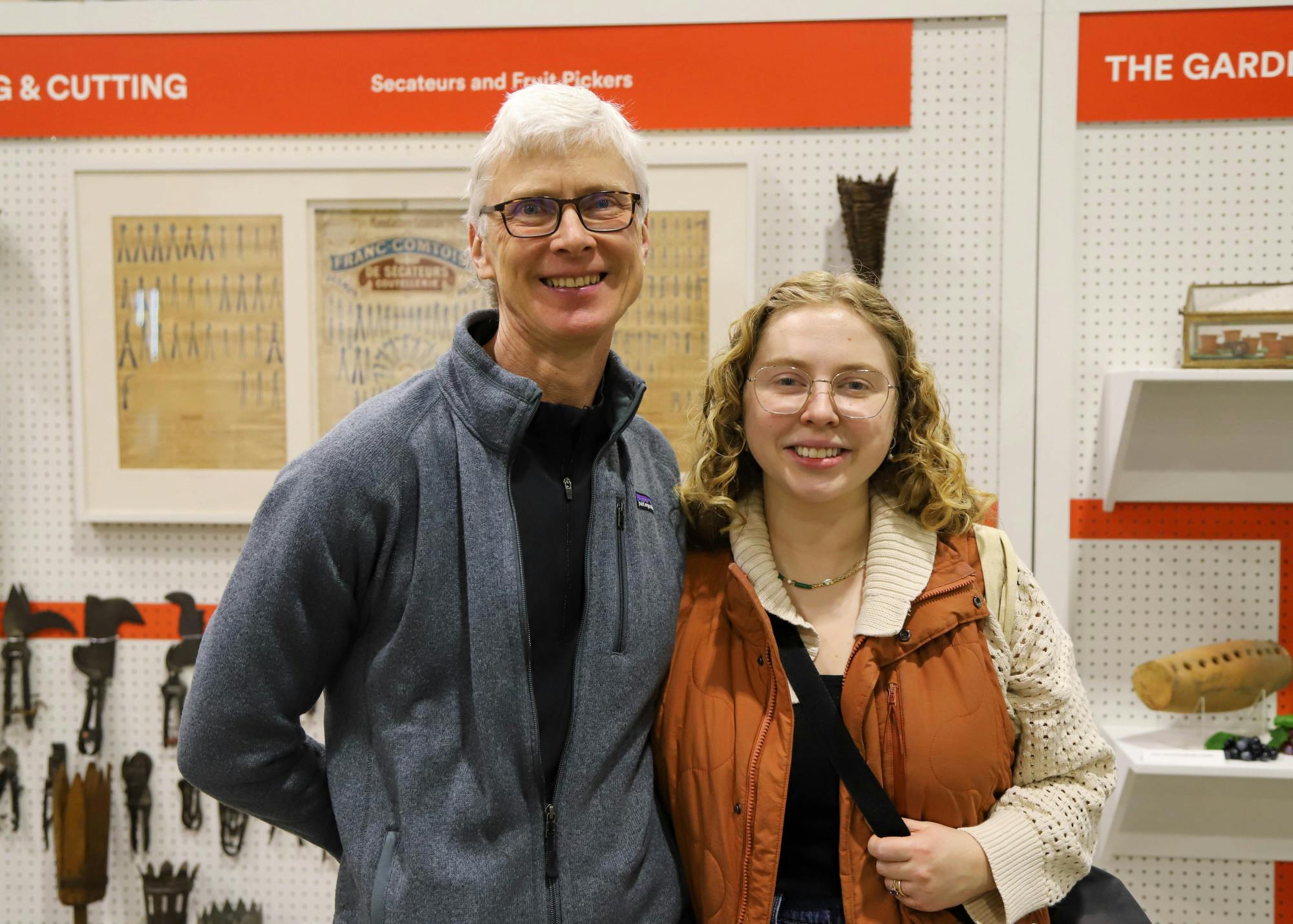
For others, the show serves as inspiration and instruction. Melissa Rose, a master gardener from Maryland, attended with two fellow gardeners, studying the native landscapes featured throughout the exhibition.
“This is a beautiful installation, and we’re happy to be here,” Rose says. “They’ve brought in a lot of American plants and landscapes that are native, and that’s been what has drawn our attention the most, looking at how they did that.”
“Rooted: Origins of American Gardening” features exhibits that specifically highlight native plants and landscapes. The displays include species like ostrich fern (Matteuccia struthiopteris) and oakleaf hydrangea (Hydrangea quercifolia), which are native to regions of the United States, alongside education signage about their uses in gardens. Exhibitors are also showcasing native grasses and woodland plantings, demonstrating how indigenous species can be placed into design landscapes.
The vision is embodied through individual installations offering diverse interpretations of the theme. Bloom Bold Co.’s “Garden of Reflection” layers mirrored panels with structured arrangements of orange, coral, and green plants to represent how beliefs and lived experiences take root over time. The Shipley School Sprouts’ Class 175 doorway, “The Lavender Scare,” uses a Washington stoop framed with fragrant herbs and archival newspapers to reference the mid–20th century campaign to purge suspected homosexual people from the federal government.
In the balcony category, “California Dreaming” by Abby Deussing and Roberta Kramer draws on David Hockney’s Southern California palette, using bright, sunlit plant groupings to evoke terrace living by the Pacific. Others focused on emphasizing the theme’s cultural pertinence. While the W.B. Saul High School of Agricultural Sciences’ exhibition honors the Lenni Lenape land stewardship, the Philadelphia Society of Botanical illustrators traces 250 years of native plants and fungi in “Rooted in Time.”
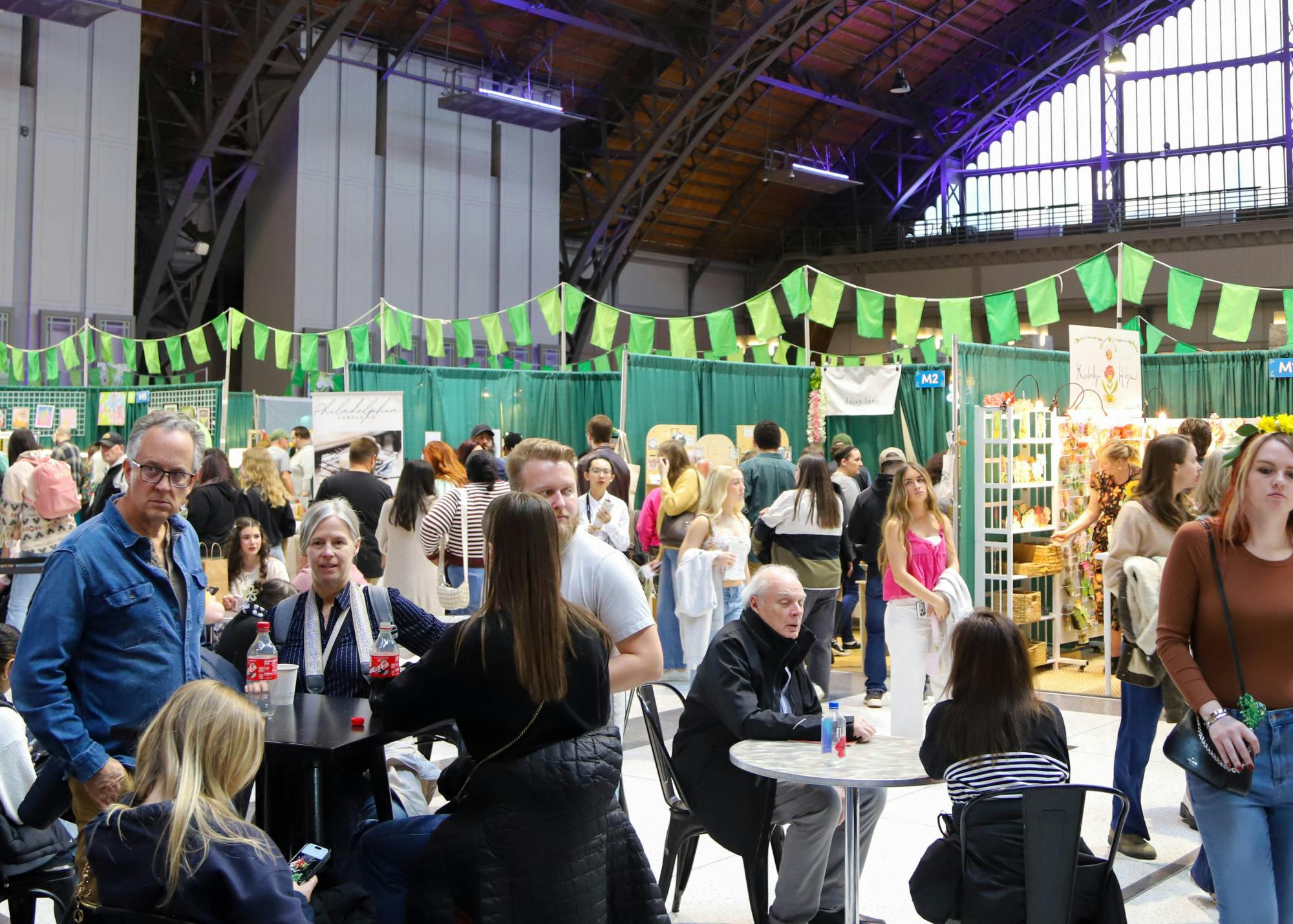
Beyond the large–scale installations, visitors can interact more directly with the show in Artisan Row, a space introduced by PHS to offer hands–on craft experiences. Guests can paint floral–inspired handbags, create bouquets, build terrariums, blend custom herbal teas, craft dried floral wreaths, and make pressed–flower jewelry.
This year, Artisan Row has grown to include almost 40 vendors and craftspeople who all work with visitors to provide the materials and guidance needed for each individualized experience. Just a few steps away, the Makers Market features a similarly sized batch of regional artisans selling handmade jewelry, decor, clothing, and artwork that complements the show’s larger installations.
In a space traditionally dominated by visual spectacle, these two areas are a nice counterpart. As families, couples, and first–time visitors drift beneath the blooms, the show feels less like a seasonal exhibition and more like a living tradition: nearly two centuries of horticultural history unfolding each spring.