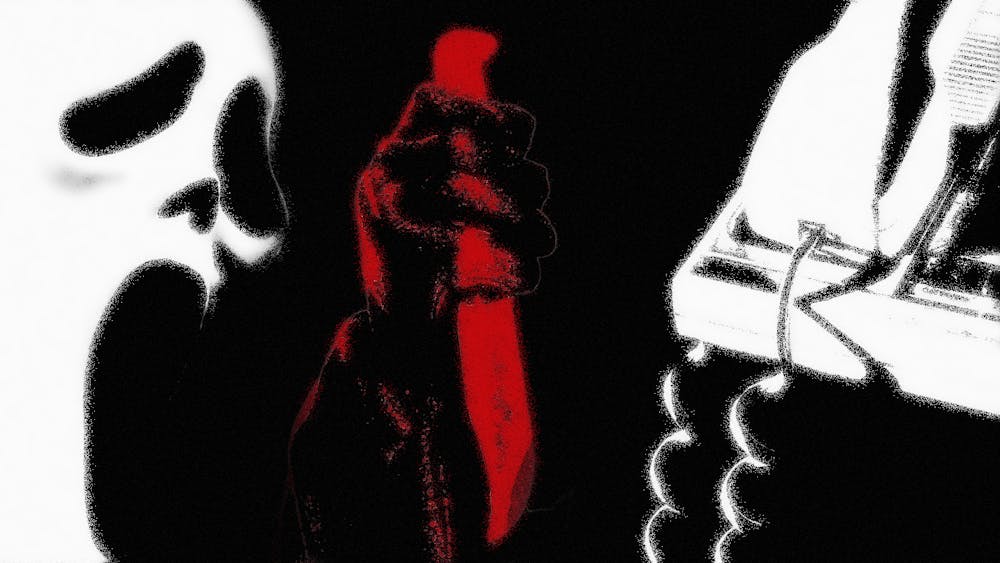
Thirty years ago, in December, a young Casey (Drew Barrymore) burnt popcorn so badly that it caught fire and one of the most iconic film franchises of all time was born. As Scream 7 releases this year, it pays to take a second and reminisce on the series’ journey to this point. The original Scream (1996) is a near–perfect movie, combining the traditional elements of slashers like Halloween and Friday the 13th with a healthy dose of pithy, self–referential humor. Although the magic of the first film will never be replicated—due to a severe lack of Stu Macher (Matthew Lillard)—Sidney Prescott (Neve Campbell) and a continuously evolving cast of characters have, in one way or another, fought constant iterations of Ghostface longer than most people at Penn have been alive. In that time, Sidney has grown up, but not away, from her past, which continues to haunt her. The last couple of installments of the Scream franchise have been directed by Matt Bettinelli–Olpin and Tyler Gillett—who abandoned their work on hit film Cocaine Bear in favor of directing Scream (2022)—and breathed new life into the franchise that was caught in dire straits after Scream 4 (2011) and the (deserved) downfall of Harvey Weinstein.
Scream 7, however, picks up in a completely different place creatively than where the franchise was left off in Scream VI (2023). Not only is this due to the exit of Bettinelli–Olpin and Gillett and return of original screenwriter (now director) Kevin Williamson, but the cast has shifted significantly. Melissa Barrera, the lead of both Scream 5 and Scream VI, was controversially dropped from her lead role in Scream 7 for comments she made on the war in Gaza, with Jenna Ortega leaving the film shortly after in solidarity. With the newest entry missing its main characters, the writers instead chose to refocus on poor Sidney, this time with her daughter, Tatum (Isabel May), under attack. With this major shift in focus, it was unclear whether Scream’s renaissance would continue or fizzle.
After seeing the film, I believe the latter. As per usual, the film opens with an absolute bloodbath. This time, a horror fan and his girlfriend are brutally stabbed to death in Stu’s home, which has been turned into a horror–themed Airbnb. This scene sets the tone for the rest of the movie, which constantly harbors the (incorrect) fantasy that references to the past will make up for a lack of plot. The film plays out like a collection of scary sequences with shallow attempts at emotional substance rather than a cohesive, integrated story. As the movie progresses, we are constantly met with nostalgia bait, references to past movies and characters, and even cameos from the Scream 1, Scream 2, Scream 3, and Scream 4 killers. Although these references can be appreciated (to an extent), there comes a point where it feels less like small threads to follow for “those who know” and more like a desperate attempt to stay relevant. Sidney is, once again, entirely protected by too much plot armor, whereas virtually every other character is almost immediately killed by the three (yes, three) Ghostfaces.
But it wasn’t all bad. The series’s special effects have undoubtedly evolved since the 90s, and Jessica Bowden’s (Anna Camp) death, although gory, was particularly fantastic. It was also nice to see the return—in some capacity—of Stu, as he is an absolutely unhinged delight; Lillard does a great job of playing up the slight insanity that makes Stu so much fun. However, his implementation in the film, with the killers using him as a deepfake, reads more like a desperate attempt to infuse modern technology and less like a clever plot twist. One of the fantastic things about the original Scream was its ability to make use of new technology (cell phones) as a plot device without making it seem gimmicky. This use of deepfakes in the same vein feels much less authentic and creative. Some of the more subtle legacy references were great, like the repetition of the so–called “rules” of horror movies (a major plot point in the first film). They also did a great job of drawing parallels between Tatum’s boyfriend, Ben Brown (Sam Rechner), and Sidney’s boyfriend from the original film, Billy Loomis (Skeet Ulrich). The film’s horror sequences were also very well done, especially the opening (as previously mentioned), which cleverly fakes the viewer out many times before Ghostface actually attacks.
This film’s fatal flaw isn’t that it doesn’t pay enough attention to the franchise; it fundamentally doesn’t understand what made the first Scream so great. The beauty of the original does not come from the action sequences or mystery of the killer’s identity, but its ability to give every character a purpose and not take itself too seriously. By missing the mark in those aspects, Scream 7 loses the magic of the franchise and proves, time and time again, the old adage that less is more.