In a world where the climate crisis competes with everything else for your 30–second attention span, one artist decided to stop fighting the noise and start drawing it.
“Scientists now say injecting light–reflecting particles into the sky might help cool the planet—but also might make marine clouds weirdly shiny. ‘What could go wrong?’ asked no one sober.”
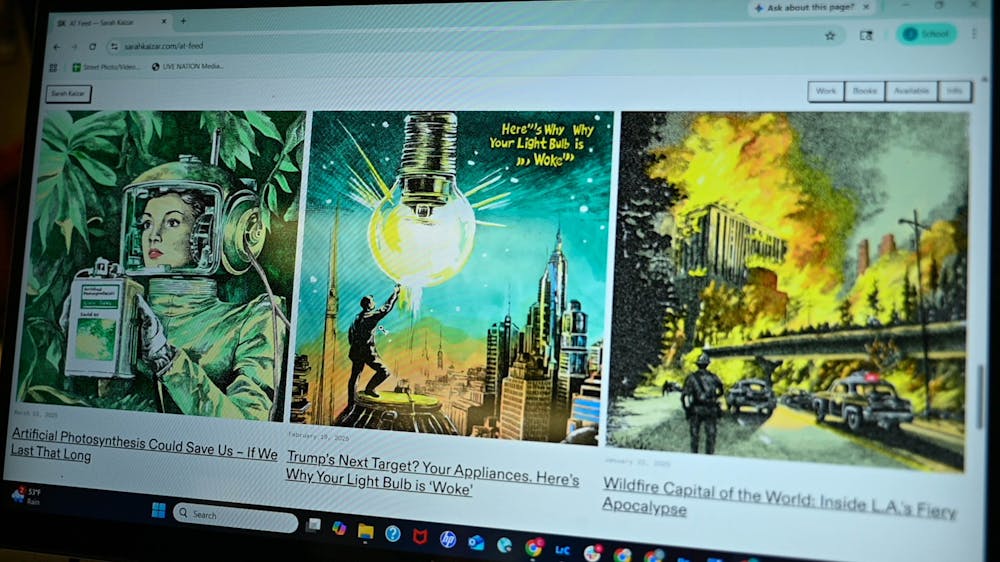
Web artist Sarah Kaizar calls her work the “most crunchy granola” thing she has ever done in her career: a hybrid art and technology project that transforms the overwhelming flood of climate news into surreal stories and hand–drawn artwork. Kaizar feeds headlines from major outlets into ChatGPT, asks it to generate an article and accompanying image prompt, and then interprets that output through meticulous pen–and–ink drawings.
The marrying of algorithmic absurdity with human craft is the genesis of The AT Feed. The moniker AT comes from the word anemotropism and derives from the way organisms orient themselves in response to air currents, similar to how our understanding of climate is molded by whatever is in the air. “It kind of makes sense, and it kind of doesn’t,” says Sarah about the evolving archive that humorously exposes the distortions and narrates the unease of the planet’s future.
But where did it begin?
In 2023, Kaizar authored Rare Air, a book about an environmental study on North American bird conservation. Compiling silos of information to substantiate her work culminated in a stark realization that was impossible to ignore. Climate coverage is shifting in tone and vocabulary. Gone are the days of steady, measured language that shows our incremental progress and optimism. Now, some outlets frame it as science, others as a crisis, and many bury urgent stories beneath faster, louder news in the churn of the daily news cycle. She began to question what gets amplified, and what never enters the conversation at all. Kaizar saw gaps between sources and their priorities, between reporting and public understanding, and increasingly between verified fact and fabricated news.
The onset of AI complicated this equation even more, and with ChatGPT came more existential anxieties about climate change and artificial intelligence. Her quest to reconcile the moral confusion in the collective consciousness over AI and the environment was the impetus behind creating a space of productive unease.
There is a bit of “pessimism” there, according to Kaizar … and how could there not be? We are seeing the continuous removal of climate politics from our news cycles in order to obfuscate the true gravity of our planet’s conditions from the public. It is permeating the structures of the country in a literal sense as well. Earlier this year, Kaizar worked at an architecture firm that received a top–down directive to remove the words “climate” and “green” from all of their projects. This institutional decision went unquestioned and worked to “[erase] the priority from everyone’s minds.”
The attack on environmental protections and mass deregulation is hindering any progress against the imminent countdown towards an irreversible crisis. It is a truth that becomes hard to wrestle with after every strike against our future. Every AT article newsbite evokes a sardonic chuckle, such as: “A peanut–shaped asteroid just whizzed past Earth, SpaceX spiraled blue lights into the night sky, and scientists found their ‘strongest evidence yet’ of alien life—just in time for humanity to destroy its only habitat.”
Maybe if this were an article about a fictional galaxy far, far away, it would be fine, comical even. But for many, the sobering moment is being confronted by the gravity of its reality, and, knowing that, the satire isn’t quite so satirical. Want to do your small part for the climate? Tough luck. Because, according to the AT Feed, “Earth 2025 is a flaming, drowning, gasping rollercoaster hurtling toward oblivion—but at least it’s entertaining.”
When asked what her goal was with the project, Kaizar imagined it to be a time capsule—a historical artifact from the first wave of AI that we can someday look back on. The question becomes whether this era is just the beginning of our devolution, which we might retroactively say was inevitable. Or, on a more hopeful strand of thought, it will become a time we look back and remark at how strange it was when the world was burning and we were still debating whether it was real.
Regardless, as it stands right now, it becomes a situation where you take from it what you will. These truths derived from every article on the feed can be taken in two ways, either resorting to abject hopelessness or using it to confront the worst of our maladies.
At Penn, we are trained to become the architects of what comes next. This could be the policymakers, engineers, and designers who will either confront this crisis or drown out the noise. The AT Feed is a mirror held up to the information landscape we are inheriting. When climate stories get buried under louder news, when institutions strip “green” from their vocabulary, then the absurd starts to feel routine. This normalization happens in the everyday decisions of the industries that students are entering, and it will be up to them to decide what gets prioritized, funded, or set aside.
Kaizar’s project is a refusal to look away, and it asks the same of its audience. That is not a small ask in 2026, when despair and detachment are equally available exits. But the AT Feed suggests a third option: sardonic clarity. Look straight into the chaos directly and refuse to let it become background noise. For a generation that will spend its careers managing the consequences of decisions already made, that capacity to stare down an absurd reality unflinchingly may be the most important skill we can build.