
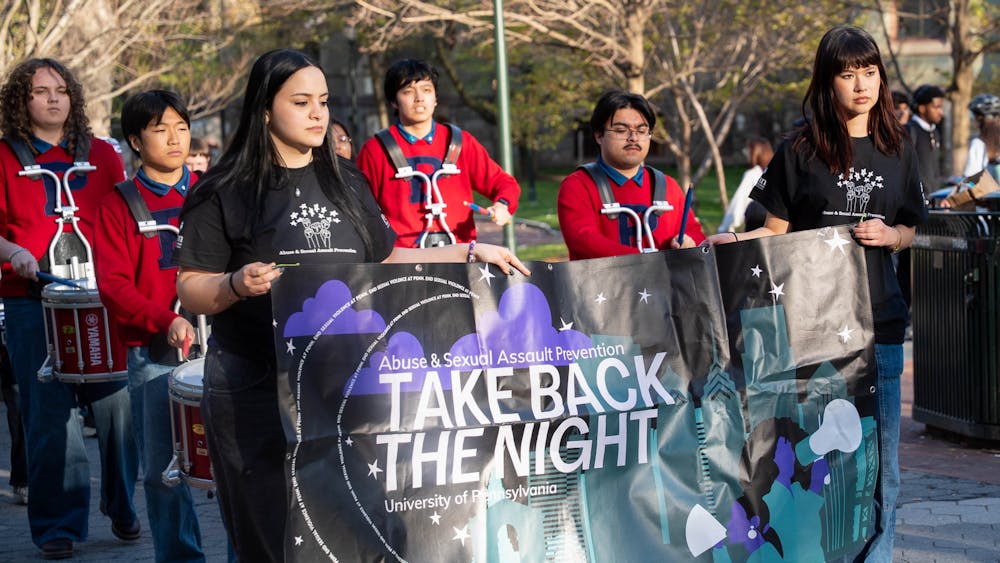
It has been over three decades since the Penn held its first organized Take Back the Night rally, and students and faculty have since upheld the annual tradition. This past April 9, the rally took over Locust Walk with signs and slogans, expressing the continual need for action against sexual and relationship violence perpetrated on university campuses.
The Rape, Abuse, and Incest National Network’s website says that sexual violence is experienced by 26.4% of females, 21% of gender non–conforming individuals, and 6.8% of males on university campuses. These statistics incur rage alongside a need for unity within our campus community as we take the ongoing perpetration of sexual violence as a call to action. We must continue pushing to be better aware, better informed, and better equipped with the resources to direct our colleagues to systems of support, as well as inform our community on matters of consent education and the behaviors that constitute assault.
Especially as sexual assault culture continues to be enabled both politically and socially, campus events such as Take Back the Night and the Clothesline Project are essential for giving survivors the public platform to grieve, heal, and voice noncompliance with their own experiences. On a broader scale, these events exercise noncompliance with a culture that has continuously enabled the silence of survivors. Expressing dissatisfaction with the way our culture has dealt with perpetration is essential to reestablishing expectations for aggressor accountability, affirming the need for diverse support systems for survivors, and highlighting the need to continue these conversations past Sexual Assault Awareness Month in order to uphold the standard of consent education and bystander intervention.
Since no experience is the same—nor do we grieve, heal from, and process trauma the same—students and staff should stay up to date on information regarding the various different routes survivors can explore to receive support, join communities, or make reports on campus. Street spoke with survivor support groups such as Penn Abuse and Sexual Assault Prevention and other University offices during the Take Back the Night resource fair to accumulate a collection of resources, questions, and answers to offer some insight when navigating options on and off campus.
What kind of support is typically accessible/available for survivors on campus?
While sexual assault is a crime that happens across all demographics, young adults and particularly university students make up a large portion of those affected.
No person processes, grieves, or heals from a traumatic event like sexual assault in the same way, so resource offices stress that there is no predetermined path of support offered to survivors. Rather, Penn support systems strive to lay out every option available and allow a space where survivors can explore their full autonomy on how they want to proceed following an act of sexual violence.
The first resource a survivor chooses will usually depend on their individual experience and their primary concern. If their initial need is safety, Penn has 24/7 emergency resources and support available. Students can call Penn Police at 215–573–3333 or 511 from a campus phone, or contact Student Health and Counseling at 215–746–9355.
If a survivor wants to have a conversation with someone who can provide emotional support and information about resources and process options, they can contact one of Penn’s confidential resource offices, including trained advocates available through Special Services. With permission from the survivor, these confidential resource offices can connect the survivor with other campus resource offices, such as Student Intervention Services and the Associate Vice President for Equity and Title IX Officer, to address the survivor’s individual needs and concerns. To protect the parties and witnesses, survivors can explore various interim measures such as housing, academic accommodations, schedule changes, and no–contact orders.
How about when an assault occurs during campus breaks or travel abroad?
While support systems are available throughout the year, many students have also expressed concern about resources available during off–campus seasons and travel abroad. Navigating foreign environments, unfamiliar areas, or off–campus reporting systems are huge concerns of students who are unsure how to proceed without a walkable resource. To ensure that students are seeking support regardless of mediating factors such as time or location, Penn’s support and resources have remained open during campus breaks with any adjusted hours communicated through their websites or social media. If someone has an experience while they are traveling abroad, they can still reach out to the AVP and Title IX Officer for support, resources, and process options and engage with other support services such as Special Services, who can help them navigate local resources.
What role can a bystander play if hearing about or witnessing an assault on campus?
One of the best ways we can continue to support our Penn community even if we are not survivors ourselves is both by being active and compassionate listeners and by being informed on Penn’s diverse network of campus resources.
Students, staff, and faculty should learn about the support and resources available to survivors and share this information with them. Bystanders can always reach out to the AVP and Title IX Officer for consultation or to submit a third–party report about something they may have witnessed. Penn Violence Prevention is also a great resource for consent education and to discuss bystander intervention strategies.
Does reporting an assault pose any risk for undocumented immigrants or visa holders?
A strong deterrence factor for many students—especially in our current political climate—is distrust in law enforcement. Our campus community is rich with students and staff from all walks of life, with many students being children of undocumented immigrants. A present worry is that students may be deterred from seeking support out of fear of jeopardizing their visa status or the livelihoods of anybody involved who may not be a United States citizen.
To debunk this fear, and to continue encouraging students to seek support regardless of circumstance, we can confirm that the AVP and Title IX Officer does not ask for a party’s status when receiving reports of sexual misconduct, nor will there be any involvement of U.S. immigration and customs enforcement in any step of the reporting process.
Should a student have a concern about their immigration status, the AVP and Title IX Officer would refer them to International Student and Scholar Services or to an external supportive resource.
What measures are taken to ensure a survivor's comfort when reporting an assault?
Reporting an assault is difficult. While many choose the path of seeking legal action, there is an element of talking about the act of sexual violence that could be potentially re–traumatizing for the survivor; thus, campus support offices have strived to make survivor comfort a priority.
All officers are trauma informed and support the survivor’s agency in deciding their best course of action. Additionally, any time a student meets with the AVP and Title IX Officer, they can have a support advisor or friend of their choosing with them for support. The AVP and Title IX Officer can also connect students with one of their volunteer support advisors as they navigate the process.
What kind of resources are recommended to a survivor who simply wants to find community?
Many students are uncomfortable with traditional routes of support such as talk therapy or reporting; thus, we want to highlight some of the student–led support groups on campus that concentrate efforts on community rather than the individual instances in which harm has been inflicted.
The Sexual Trauma Treatment Outreach and Prevention (STTOP) Team through wellness, for instance, offers group therapy to those seeking to reach connection and understanding with fellow survivors on campus. The confidential resource offices and cultural resource centers at Penn also often host programming for students and can support them in finding community. The offices will regularly post their events on social media, their website, or in their newsletters.
ASAP president Ashley Kim went on to cite additional resources.
“Community can be found in PVP, the LGBT Center, and Penn’s Women’s Center—which is open to all students regardless of gender—and ASAP, which is particularly close-knit,” she says.
Through campus wide events like Take Back the Night, students can also be leaders and help spearhead the effort with offices such as ASAP and PVP. Even if a survivor chooses not to march on the frontlines, they can participate in preceding events to support the effort, such as with the Take Back the Night poster making sessions held in the beginning of April.
Though events like Take Back the Night and the Clothesline Project are best platformed during the month of April, we want to remind the campus community that these resources are always available, as students and staff work diligently to continue providing and publicizing a diverse network of resources for journeys of grieving, healing, or finding community.