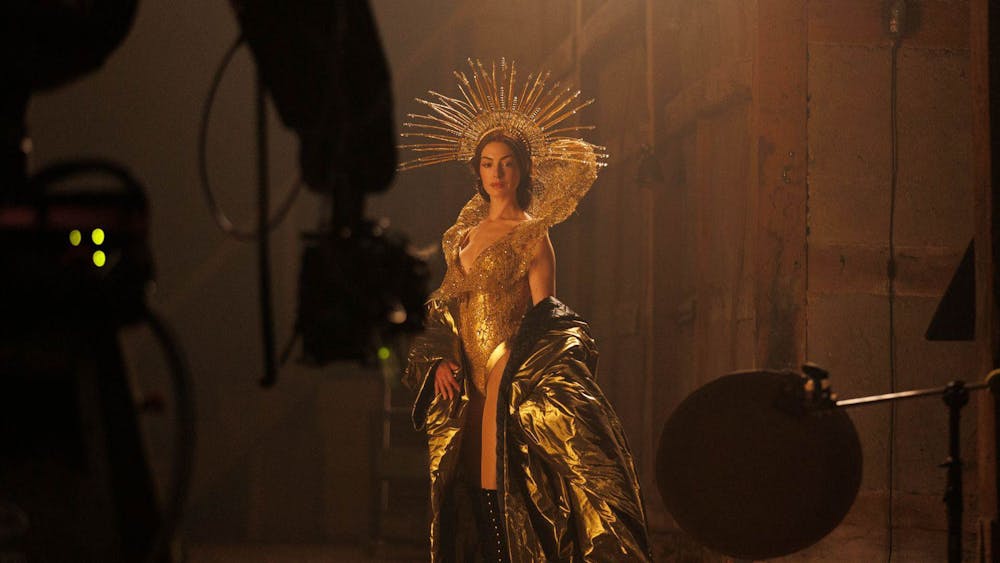
If you thought a film titled Mother Mary would be a religious retelling of Christ’s passion through the Virgin’s eyes, you’d be sorely mistaken. Instead, Mother Mary is David Lowery's attempt at a modern artistic film, which stars Anne Hathaway as a glitzy pop star. The most religious the film gets is a shot of a halo made of nails, which functions more as a tiara than any sacred symbol. Some viewers have even labeled the film blasphemous—not because of its theology, but because it uses religious imagery to tell a story about the emotional cost of collaboration in the entertainment industry.
At its core, the film is about two former collaborators trying—and failing—to move past their shared history. The film follows Mother Mary (Hathaway), a pop sensation who reconnects with her former friend and current famous designer, Sam Anselm (Michaela Coel), to create a dress for her comeback performance. But the dress is just a red herring. What the film is really interested in is the unresolved tension between them—a tension sustained by betrayal, resentment, and creative dependence.
That tension is where the film introduces its central metaphor. Most of the film takes place in the present, inside a dimly lit barn where Mary and Sam reunite to design the dress. The story of their fallout, however, unfolds through the flashbacks they share with each other. Produced by A24 and helmed by Lowery (of The Green Knight), the film leans into the supernatural. Here, it takes the shape of a ghost story—or, more accurately, a possession.
Through these flashbacks, we learn that after Mary abandoned Sam when she rose to fame, both women began experiencing the same strange presence in separate moments of their lives. The red spirit first appears to Sam, then later manifests during one of Mary’s performances, where it overtakes her body and causes her to fall from a high platform.
Back in the present timeline, the two try to make sense of what happened—and eventually decide to confront it directly. Together, they perform a ritual to remove the entity from Mary’s body, and in one of the film’s most bizarre images, it is pulled from her chest as a strip of red fabric. That fabric then becomes the dress for Mary’s comeback performance, closing the loop between their past conflict and present collaboration, literally turning their shared trauma into the thing that brings them back together.
The idea is clear, even if the execution isn’t: turning emotional damage into something literal, something wearable. The themes of the film are worthwhile, touching on healing fractured relationships and pushing against the singular focus of the entertainment industry, but the bizarre way that the film accomplishes this is more distracting than effective.
In places, Mother Mary is innovative and artistically beautiful, but in other areas, it comes off as reaching for meaning it never quite earns. Exhibit A is Hathaway as a pop princess in a sparkly Sabrina Carpenter–esque bodysuit. Don’t get me wrong, she is a mesmerizing actress and a stunning individual. She was phenomenal as a young actress in whimsical films like The Princess Diaries and The Devil Wears Prada (whose sequel is set to release this week), and her transition to roles in more serious films like Interstellar and Les Miserables was seamless. She has been fantastic throughout her career, but no one could have foreseen this direction, and it proves difficult to fully buy into. The flashy bravado of her as an international popstar often feels phony.
However, the film briefly works when it abandons that spectacle. Hathaway is strongest in the scenes where the two principal characters air out their grievances in the barn, overcoming pain and pushing boundaries through dialogue. In one scene, Mother Mary performs a crazed dance filled with violent full–body motions in front of her former best friend—and the only sound audible is her breathing, stomping, and grunting as Sam refuses to listen to the song. It feels violent and painful, a direct reflection of their relationship. There, the dynamic is clear, impactful, and overall believable.
But that clarity disappears the moment the film returns to the stage. The glitzy style and hyper–sexualized stage outfits feel not just unwonted, but unwanted. And the soundtrack, largely written by pop artist Charli XCX, is undeniably catchy, but Hathaway is the wrong person to sing it. Her Broadway–trained vocals don’t mesh with the techno beats of the pop hits. Even small details—like her slightly inconsistent accent—add to the sense that something isn’t quite working. All of it creates a disconnect between what the film is trying to say and how it chooses to present it. The unbelievable aspects of this film make it difficult for audiences to take it seriously, as evidenced by laughter and occasional choruses of “this is ridiculous” in the theater.
In contrast, Coel is phenomenal as Sam Anselm. Her mystical presence and the indirect manifestations of her pain (refusing to listen to any of her former friend’s songs, for example) effectively convey her character’s hurt. Her big eyes and coy smile immediately win over the audience, while also hinting at something more complicated underneath. Her character has good intentions, but Mary’s betrayal runs deep, and that tension drives the story forward. The dynamic between the leads is electric. The actresses play so well off of each other that you can feel their chemistry in the tension (both sexual and psychological). I was surprised by the lack of overt lesbian action, but from the start you can tell that there is a tumultuous history between them.
Visually, the film continues this same pattern: strong ideas, uneven payoff. Most of the film is spent in a barn-like structure, which doubles as Sam’s designer studio, with frequent flashbacks to past performances and ghost sightings. Every time the camera leaves the barn to show a memory, it delves into an artistic fever dream. Some of the creative choices in the abstract presentation of their memories are commendable. The scene where Mother Mary relentlessly climbs stage stairs and collapses on the other side only to be pushed onward by her team is particularly effective, capturing her exhaustion and loss of control. The cinematography of these scenes—and the whole film really—is artistically melancholy, matching the morose tone of the film. Dark blues and blacks are offset by an occasional streak of red or flash of glittering white.
But once again, the film struggles to connect these images back to its core idea. Beyond aesthetics, the purpose of certain scenes, especially ones in which Mother Mary performs, often feels unclear and disconnected from the film’s core ideas.
With valuable themes, beautiful visuals, and first–rate acting, Mother Mary has potential; however, there’s something lacking in its reception. The absurdity of the story undermines its own ambitions and leaves audiences asking why it even happened. It’s an interesting watch and certainly entertaining, but in terms of great films, A24’s Mother Mary falls short of its potential.