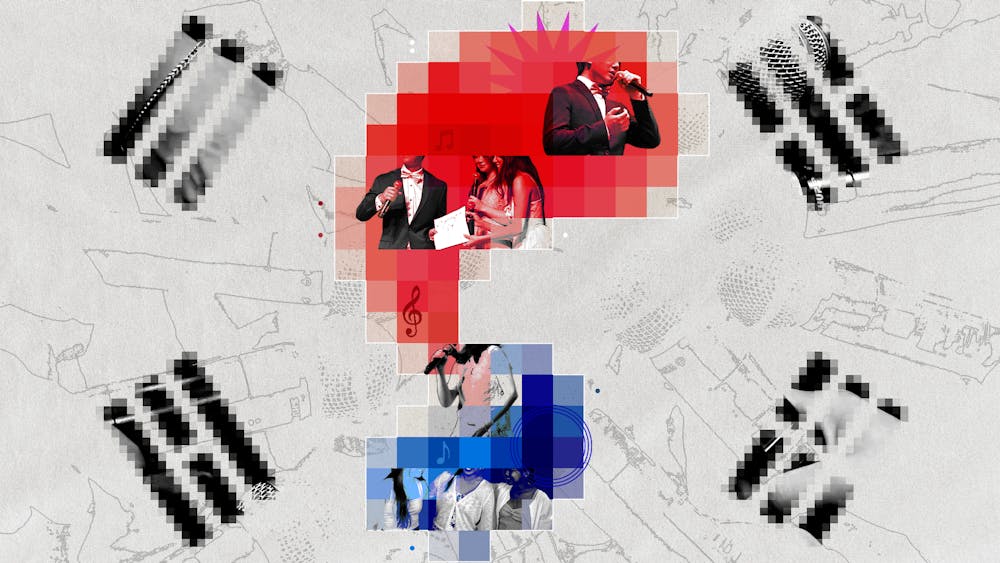
At some point during rehearsal, language stalls. The music director pauses mid–sentence, searches for a word, then switches to Korean. “There’s just no word for it in English,” says Jaein Han (C’ 26), co–music director, finishing her note to the singer. It might seem like a small moment, but it’s exactly how PennSori operates—not through clean translation, but through the imperfect, ongoing, and productive attempt.
PennSori calls itself a "cultural bridge," but the phrase undersells it. Bridges assume two fixed endpoints. PennSori works in the middle of many endpoints, in between Korean and English, performance and social life, familiarity and unfamiliarity. As Luke Jun (C’ 29), assistant music director, puts it, Korean and English songs are mashed up together to be something “greater than the sum of its parts.” So, the point isn’t to connect the two completely; something new gets made up in the overlap. PennSori takes different cultural layers and turns them into a practice of making–in–between, and that practice holds the group together.
Nowhere is this method clearer than in music. In the setlist for the upcoming show, Jaein recognized songs that she heard “in the car with [her] parents.” On stage, that personal song flows back through the voices of other people. The result of such a performance ends up reaching the audience that may not share her memory at all. Listening to Jaein, I wonder what it means to make art for people with a different relationship to the culture the song is made of.
Jaein recalls performing “I Will Show You” by Ailee for her non–Korean roommate, who later raved that it was “incredible” and could even work in ICCA, a competitive a cappella set. To a Korean audience like myself, the song arrives pre–loaded with memories of the 2010s. For someone else, that context may be absent. Their rendition of Chappell Roan’s “The Subway” similarly lands differently for an American pop–savvy versus my Viet international friend hearing it for the first time. Still, as shown by her roommate’s reaction, their show unmistakably works.
The arranging process may help explain why. Luke, in his first semester as an arranger, spent weeks finding a second song that matched the first both musically and thematically. Then, he built transitions that let each remain independent while producing something neither could alone. At the same time, Jaein has found that her “most PennSori” arrangements happen when she lets the music be “whimsical.” Whether the audience shares in the song’s cultural significance, they receive what the group has made from the song, memory, and perhaps distance between the performer and the audience. PennSori allows different points of entry to exist at once, held collectively by the arrangement and the voices willing to carry it forward.
This kind of logic also shows up in how members interact with each other. By accounts of the vice president, Hemosoo Woo (E’ 27), not everyone arrives with the same relationship to Korean: some are Korean internationals, some grew up speaking it at home, and others are learning it alongside the music. At the same time, he stresses that PennSori works through them. English memes are translated into Korean and altered in the process, which then end up as something specific to PennSori and as something that couldn’t have existed anywhere else. Even before auditions, each member draws a duck for the “Penn–ori” board—pun on Pennsori and “ori,” the Korean word for duck—then asks nervous auditionees to participate in the joke by voting on their favorite. Understanding this “ori” pun is one experience, but coming to it without fluency in the language is another. Clearly, PennSori makes room for both.
Rehearsals, according to Hemosoo, feel like any other a cappella rehearsal until they don’t. Korean phrases burst out here and there. The latest Singles Inferno episode turns into a 20–minute detour. Someone's favorite K–pop idol group becomes everyone's problem. What Luke didn't expect when he joined PennSori was how fast it stopped feeling like a performing arts group. Within weeks, it became just people he’d simply always known who convene for Stommons lock–ins, spontaneous dinners, and even more. Hemosoo, who came in having never sung, found that rehearsals became the most protect time of his week. He still gets post–concert depression after every single show.
These moments accumulate into its own continuity. Jaein remembers PennSori being different when she was a freshman—people showed up to learn music and then left. By the time she was a senior, PennSori had transformed into a friend group that also happened to perform. Jaein explains that once that kind of community is built, it doesn't normally go away. The most unambiguous evidence of what she’s describing is that some members have ended up sharing off–campus housing. As a soon–to–be–alumna, she wants that part to continue most of all: the friendships, the social events, the being together in ways beyond the music.
At Penn, where much of student life runs on outcomes, that distinction matters. As several members unanimously put it, PennSori is a “labor of love.” It is not a means to achieve something else, but a place that exists on its own terms. Between languages, between people, between the group it was and the group it is becoming, PennSori keeps making something together in the middle. Which is, as it turns out, spectacularly enough.
PennSori's Spring 2026 show, Soritopia, runs April 3 and 4—tickets are available now.