
War Machine arrives on Netflix with the kind of blunt–force appeal its title promises: heavy artillery, heavier stakes, and a lead performance built like a tank. Starring Alan Ritchson as an unnamed sergeant, the film begins as a familiar entry in the modern military action canon before swerving—sometimes effectively, sometimes clumsily—into something stranger. It’s a movie that both wants to be a boots–on–the–ground war story and a high concept, sci–fi survival thriller. For long stretches, that ambition works. But in the end, War Machine becomes another example of a film that can’t quite resist setting up the next installment instead of fully delivering on its own.
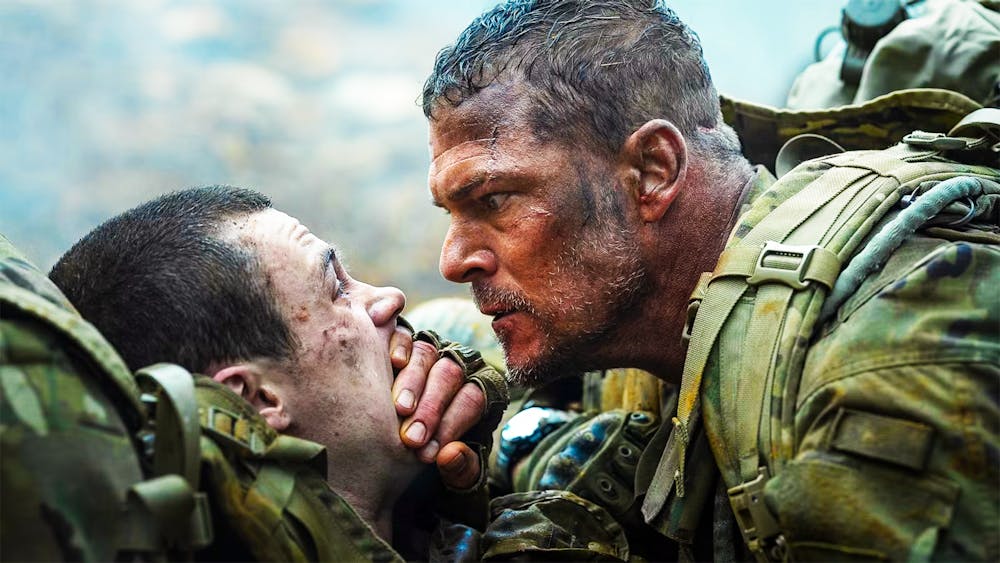
The film follows a group of elite U.S. Army recruits who set out on what should be their last brutal training exercise. The sergeant, still traumatized by the loss of his brother (Jai Courtney) at the hands of the Taliban, attempts to be a lone wolf but is reluctantly assigned to be team leader for this exercise. The first act is structured around these familiar beats: tragic backstories, camaraderie–building, and a prolonged training sequence that emphasizes Ritchson’s undeniable strength. It’s all competently staged, if rather predictable, until the film pivots.
What begins as a controlled simulation spirals into chaos when the unit encounters something entirely unexpected—a hostile, extraterrestrial machine that turns the exercise into a fight for survival. From there, War Machine shifts into a hybrid of sci–fi horror and survival thriller. The terrain becomes a battlefield that must be traversed to get away from the war machine, which seems to be impossible to slow down. The soldiers’ strategies break down, spiraling into panic attacks, and it’s only the sergeant that can keep the squad improvising to stay alive. It’s in this shift that the film finds its most compelling identity, breaking away from the rigidity that often defines military movies.
Tragically, though, the film’s momentum falls short at the end, when compromises are made that seem specifically designed to broaden franchise potential. The tension between individuality and franchise–building is the film’s biggest weakness. Because while War Machine is certainly entertaining, it ultimately falls victim to sequel–baiting. Instead of resolving its central conflict with a clear or thematically grounded solution, it gestures outward, not just hinting at a larger universe but wildly gesticulating towards it. The result is a conclusion that feels like a placeholder.
Before getting there, though, the film is easy to enjoy. Though known for his imposing physicality, Ritchson brings an emotional grounding to the role. His performance balances stoicism with moments of vulnerability as he learns to move past his own failures and save his surviving comrades. It’s not the most original trajectory, but Ritchson sells it with conviction.
Visually, War Machine is also surprisingly strong—especially for a Netflix–backed production. The effects work, particularly once the film leans into its sci–fi elements, is consistently impressive. The machine’s appearance is mechanically unsettling without feeling overdesigned, and the action sequences are staged with a clarity that emphasizes both scale and brutality. There’s a level of gore here that might catch viewers off guard. Limbs are lost, bodies are torn apart, and the film doesn’t shy away from the visceral consequences of combat. At times, the intensity and stylization of these moments evoke the hyper–violent aesthetic of shows like The Boys, where spectacle and shock are tightly intertwined.
At the same time, the film’s politics are difficult to ignore. War Machine is, without much ambiguity, U.S. military propaganda. It glorifies discipline, hierarchy, and sacrifice, framing the soldiers as inherently noble figures caught in impossible circumstances. There’s little questioning of the systems that it celebrates, and the film ultimately stays in safe territories. Nowhere is this more evident than in its ending.
Without giving too much away, the film builds toward a reveal that isn’t really a twist so much as a confirmation of what the audience already suspects. It’s a fun little moment in the sense that it reframes earlier events, but it doesn’t fundamentally alter the narrative. What could have been a more daring or unsettling conclusion is instead immediately undercut by a speech from military leadership that feels ripped from a recruitment video. It’s the kind of monologue that emphasizes duty, honor, and future readiness—language that not only feels generic but also subtly contradicts the arc the sergeant has undergone.
Rather than reinforcing any growth, the ending seems to just fold him into the system. It’s not surprising considering the sergeant only joined the elite squad to fulfill a promise to his deceased brother, but the brief moments where he seems to question his actual purpose is mostly left hanging. It’s a frustrating finale, one that makes the character feel less like a person and more like a vehicle for messaging. And because this moment is so clearly designed to set up a sequel, it leaves the audience in a state of dissatisfying anticipation.
That’s ultimately the defining arc of War Machine. It’s a film with enough energy to stand on its own, but not enough confidence to fully commit to its own ideas. The genre pivot works well, and for a while, it elevates the film above its peers. Combined with a strong central performance and impressive technical execution, it makes War Machine an undeniably fun watch.
But fun isn’t the same as fulfilling. By the time the credits roll, the film feels less like a complete story and more like the first chapter of something bigger. Whether that is worth exploring remains to be seen. For now, War Machine stands as a solid entry in the action genre—one that almost breaks free of its constraints, only to be pulled back in at the last moment.