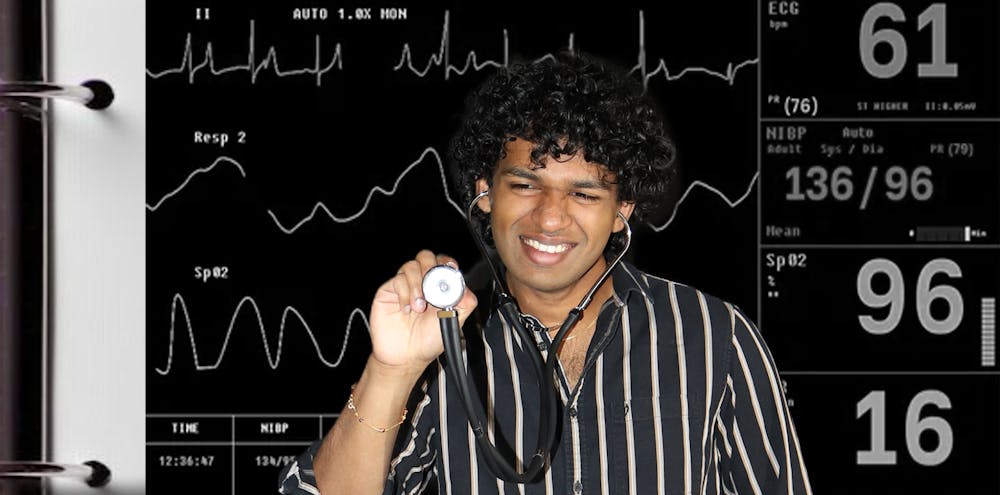
Have you ever been treated by a doctor in the emergency room, then seen the same guy shredding at a gig later that night?
Neither have I. But after meeting Aashish Codada (C ’26), I think I know exactly who that doctor could be.
“Duality” is, objectively, the wrong word to describe Aashish’s Penn career. Or maybe it’s simply insufficient. A senior in the Roy and Diana Vagelos Program in the Molecular Life Sciences, Aashish studies neurobiology and biophysics. As any MLS student will tell you, the mandatory double major already takes enough of a toll—but Aashish wasn’t fulfilled with just his STEM degree, opting to pick up a third major in architecture. On top of his academics, Aashish also works as an EMT in the suburbs of Springfield, Pa., and plays guitar in the Penn Glee Club band.
But when I sit down with him amidst the lunch crowd at Franklin’s Table, I don’t get the sense that he’s rushed, stressed, or counting down the minutes until he can run off to his next commitment. Maybe it’s because he’s taking a highly–warranted two credits this semester—a staggering step down from his usual six. Aashish would be the first to agree that a well–rounded schedule is an integral, unifying piece of his personality. His disparate commitments don’t fracture his life so much as allow it to coalesce, making him a more grounded and balanced person.
“I just get bored if I’m doing one thing all the time,” he tells me. “So I like having multiple communities where I’m putting forward different aspects of myself.”
Aashish understands how each of his interests weaves together to form the fabric of his life. Some people heed the call to pursue their less financially lucrative interests; others know that they probably should but continue down the path of least resistance and financial stability. But when asked if, provided he could guarantee himself a stable living, he would ever consider playing music as a career, it becomes clear that Aashish fits into neither of these categories.
“No, honestly,” he says, almost immediately. “Music was always a really fun hobby for me. And I would definitely play music in a professional band, but I don’t think I could ever see it as my main thing. I think the problem with music is that it’s really easy to get creatively burnt out. At least in my case, specifically, if I’m forced to do it or forced to create, eventually I [would] just kind of run out of steam, and I could never really imagine myself enjoying doing it if it feels like what my livelihood is based on. I like having it as a free thing—a creative outlet. Also, because, as the years went on, I got more and more into the idea of medicine as a career. And I think now I am fully locked into that.”
No matter how rewarding it may be in the long run, medicine is still a field that drives many to the point of burnout, so I was curious if juggling all of his commitments was ever too much for Aashish to handle; if there was ever a week where Glee Club tech week intersected with a brutal flood of midterms; if he ever considered dropping something to lighten the workload.
“Definitely sometimes,” he allows. But the fleeting thought would always dissipate when he remembered: “I’m doing this because I want to do it. And I get so much out of it. It’ll be fine. I’ll do it.”
Aashish believes that cultivating diverse interests is important for anyone, not just him. He explains that if you go through all of college identifying yourself with just one thing—a researcher, a biology student, an engineer—and you fail a midterm or a project, you have “nothing to fall back on.” His outside interests act as a necessary stabilizing force within the competitive world of pre–med classes and research at Penn, as well as in the rat race of medical school applications that looms on the horizon for him and many of his peers. Post–graduation, he’s planning to take a gap year to conduct research at a Penn neuroscience lab and apply to medical school over the summer.
Application season is a time when every hopeful medical student is faced with the task of representing their complexity on paper to be analyzed and judged. But beyond the opportunity to give one’s list of achievements a little more flavor, Aashish firmly believes that every pre–med student should pick up genuine interests outside the realms of volunteering and research. While the latter fields “are important for sure,” he says, you should “also explore your interests and feel free to dive into your interests, even if it doesn’t feel immediately relevant to your future career path. Because it can come back and help you in ways that you wouldn’t expect. It helps you grow as a person, and that’s really important for medicine too.”
While he’s still figuring out his exact medical path, his EMT work draws him towards the world of emergency medicine. What gives him pause, however, is the brutal lifestyle of the ER doctor: the grueling 12–hour shifts and inevitable desensitization to trauma. “I don’t think it’s very sustainable, especially if you want a family,” he admits. “And that’s something that I also am looking for. But I’m definitely thinking about it, because the actual practice of emergency medicine really appeals to me.”
I ask him if he has plans to use his architecture degree for anything tangible—building a hospital, maybe—or if it was simply another creative interest that added some spark to the STEM grind.
He laughs at this. “That’s always the default answer. ‘I guess I could design a hospital.’ And I did take a course about designing hospitals. It was called something like ‘Towards an Architecture of Health.’ It was actually really interesting.”
Ultimately, though, his perception of his architecture background is similar to how he views playing guitar. These pursuits are not worthwhile for how they can be commodified, but instead for how the skills they've taught him add to his figurative toolbox.
Aashish spent hours on his first design project, and it did not turn out well. “Architecture is working within a problem,” he says. “And I realized that you really have to get everything perfect. You can’t mess up a single corner—otherwise, it’ll mess up the rest of the building. It forced me to be more meticulous.” He credits architecture with giving him a new appreciation for creative thinking and time management, skills he may not have developed as fully if he had stayed within the parameters of science and math.
It is deeply human to explore our passions and to understand the world through art and music—Aashish is a perfect example of both these tendencies. Beyond expanding his capacity for creativity and problem solving, his outside interests have also allowed him to develop the kind of people skills that are crucial to working in tense situations with patients.
“I feel like one part of medicine that people miss is that being a good doctor is not the same as being good at science,” Aashish tells me. Slowly, everything about him clicks into place. His boundless wonder for the arts; his grounded sense of self; his willingness to talk and his genuine joy at being listened to. Later, after the interview officially ends, he’ll stay a few minutes longer to ask me questions about myself, and that will make sense, too.
“These are very different things,” he continues. “Being a good doctor is also understanding people and having a sense for how the world works … and how any random person would approach the world. And I feel like the more diverse experiences you have in anything, the better you get at that.”