The courtyard of Kelly Writers House is an oasis of concrete and metal chairs against an overgrown jungle teeming with bugs. While waiting for my subject, I have to switch tables three separate times as wasps swoop in and out of my line of sight, terrorizing me as I try to prepare for my interview.
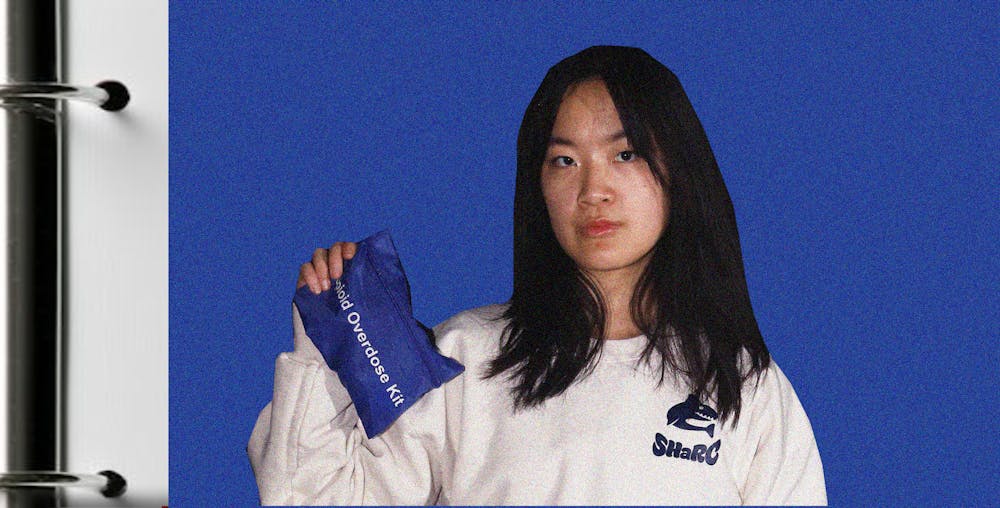
It’s in this chaos that I meet Allison Li (C ’26), whose first comment on the record is that she has a body hidden in her room—a joke (I think). But Allison is deadly serious about her work. As the former president of Penn’s Student Harm Reduction Coalition and a volunteer in harm reduction operations in Kensington, Pa., Allison has spent her time at Penn engaging deeply with the public health issues impacting Philadelphia the most.
Much of Allison’s work centers around doing outreach in the Philadelphia neighborhoods most affected by the opioid epidemic. “Going on outreaches just presents a whole different side of humanity,” she explains. Engaging in fieldwork allows Allison to better understand the technical principles of healthcare and neurology that she has learned as a neuroscience major, while also putting that knowledge into practice to improve people’s lives.
Allison’s engagement with harm reduction has sharpened her knowledge of the complex policy issues that shape the work that harm reduction workers are able to do. While few oppose helping those in need, how that help should be delivered in practice is an object of deep controversy as the opioid epidemic becomes a deepening national crisis. Nowhere is that clearer than in Philadelphia, where the City Council recently passed new restrictions on mobile medical service providers operating in Kensington and other neighborhoods. The ban was ostensibly motivated by community members’ goal to improve their communities and make the streets safer for their children—goals which they felt certain forms of harm reduction work were undermining.
Allison was there for the Philadelphia City Council meeting where the mobile services ban was debated, and she recalls being stunned by the amount of pushback harm reduction efforts received from the very communities they were meant to serve. “There’s so much moral injury in this field that it’s maddening,” Allison explains. After she says this, a table of people outside my line of sight (but within earshot) erupts into rapturous applause. Whether they were reacting to Allison or something else remains unknown.
The landscape of harm reduction and the public debates that shape its everyday practice are convoluted and deeply contradictory. “There’s no right way to do these things,” she explains. To make sense of it all, Allison turned to a new outlet to help her gather her thoughts: creative writing. Much of Allison’s early writing for The Woodlands Magazine—a creative writing and reported nonfiction magazine at Penn—centered around untangling the narratives and stigmas that surround harm reduction and drug addiction. Recently, she’s also engaged in a senior project interviewing the patients, healthcare providers, and outreach workers she labors alongside—a project she hopes will recenter the voices of those engaged in care work. She describes it as an attempt to gather “all the stories I’ve heard that make this space feel so alive, and worth … I don’t know. Worth, period.”
Not all of Allison’s creative work has stuck so closely to her experiences in harm reduction spaces. One of the experiences she cites as most rewarding was tutoring students as a member of Cosmic Writers. “I was working with this eighth grader who just had so many ideas,” she says. “I didn’t even have to do anything as a tutor or a coach—I just sat there, opened the Zoom, and he just yapped. It was amazing!” Another facet of her creative engagement is her involvement with The Excelano Project, Penn’s spoken–word poetry collective. Writing to be heard and not to be read, she explains, pushed her to look at the craft of writing in a radically different way. “Instead of just writing for yourself, you’re writing to perform in front of a crowd,” Allison says. “That changes what you say—and how you’re willing to say it.”
What’s common to all of Allison’s creative experiences is her focus on community, whether in serving others as a tutor or sustaining spaces for creative practice alongside Excelano. The most frequent theme in her work, however, remains her own lived experiences in the harm reduction space; she acknowledges that writing about harm reduction presents unique challenges when it comes to the ethics of representing people’s struggles without erasing their own voices. To illustrate just how dire that problem can get, she invokes Salman Rushdie, a novelist who was stabbed in 2022 over his criticisms of Islam—“If you write about the wrong thing,” Allison warns, “people can get very, very mad.” As a journalist, I can certainly empathize.
Allison is still unsure about precisely what her future holds. Though she describes herself as a pre–med student, she says her biggest post–graduate priority is “living in alignment with the morals and values I’ve built throughout four years of college.” Speaking to people involved in the harm reduction space has been sobering—one healthcare professional told her frankly that “you aren’t saving anyone.” She acknowledges that even being a doctor isn’t necessarily the best way to address the problem of addiction at its roots—after all, there’s only so much an individual care provider can do to “solve” systemic issues. Of course, none of that means that harm reduction isn’t still a worthy cause. “This work is still important,” Allison says. “And you do it anyway because you love the people.”
Years of engagement in community outreach and harm reduction has led Allison to think about how she could do the most good in confronting addiction—should she stick to her plans to be a doctor? Get a Ph.D.? Engage in advocacy or policy work to create stronger structures of care?
Allison regrets getting into creative spaces relatively late in her Penn career. After graduating, however, she hopes to keep her creative work and scientific career largely separate. She cites the convoluted ethics of care and the need to be professional as the reasons for not wanting her two passions to overlap—but she believes that a cross–disciplinary response to harm reduction is necessary to deal with addiction in all of its facets. “Combining … the objectivity of the clinical profession along with the expansiveness of literature and humanities,” Allison says, “is what will get you to that secret third thing that’s somewhere interesting.”
Allison appreciates the freedom that being a student has opened up to her, even as she acknowledges the fact that Penn encourages students to close themselves off too early. “The linear way of looking at life that this school tends to place on people is a little sad,” she says, encouraging students to keep their options open and explore everything that Penn—and Philadelphia—has to offer. “Discourse around the Penn bubble to me feels inane,” Allison says. “You’re here in Philadelphia; go see the world!”
The persistent buzzing of bees and hornets around us doesn’t faze Allison—she’s found a space of care and humanity for herself amidst the chaos of the world. As her time at Penn comes to an end, she holds no regrets as to how she’s spent her time here. Even the worst parts of her Penn experience, she says, had a key role in shaping who she is today. For her past self—and for future students—she only has one point of advice: “Do it scared.”