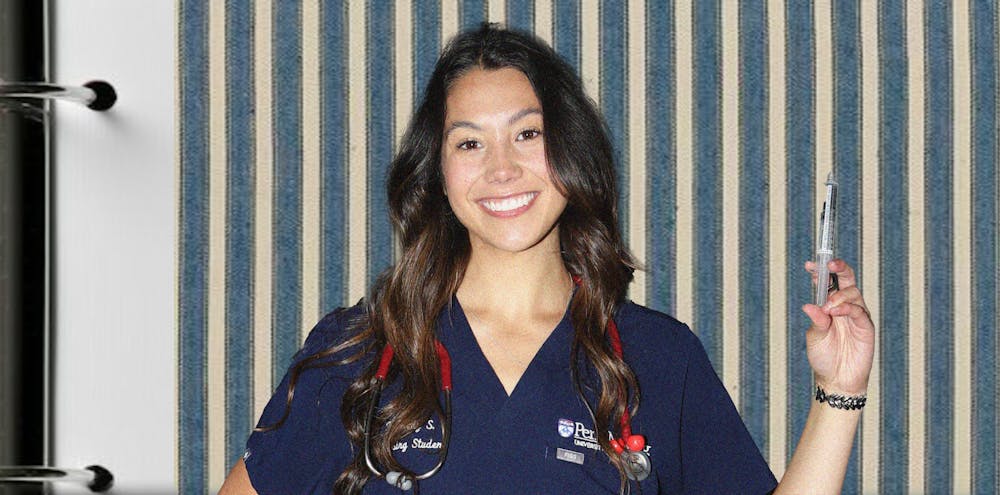
On Tuesdays and Thursdays, Kennedy Smihula (N ’26) clocks out of the cardiac intensive care unit at the Children’s Hospital of Philadelphia at 7:30 p.m. after spending nearly 13 hours beside some of the most seriously ill children in the city. Then, with barely any time to grab dinner, she immediately heads to Weightman Hall to meet her team for cheer practice.
Some days, a patient has passed away. Other days, she’s sat with a family through the toughest time of their life. But an hour later, without fail, she’s doing her stretches on the turf and chatting with her teammates about upcoming games.
“It’s very particular to be a nurse and a student at the same time,” she says.
Kennedy is a senior nursing student and a member of Penn Cheer. These two identities could not be more diametrically opposed—one asks her to hold space for grief, sickness, and the fragile inner workings of a child’s heart; the other asks her to show up in Penn’s red and blue and move her body with precision and joy. Kennedy has spent the past four years figuring out what it means to be both.
The story of how Kennedy ended up in nursing—and at Penn—is, in her own words, “kind of a funny one.” One day, amid casual conversation, Kennedy confessed to her high school cheer coach that she didn’t know what she wanted to do with her future. She had considered healthcare management, but she still wasn’t sure about it. Her coach, who was also an operating room nurse, responded by asking Kennedy, “Have you ever been in the hospital?” She hadn’t. So the coach offered to take her along for a day of shadowing at her private plastics practice.
“I was like, ‘Oh, it’s a free day off school,’” Kennedy recalls.
Her mom was convinced it would backfire. One look at the “guts and blood” would kill any interest in being a nurse, she figured. But instead, when Kennedy came home that night, she told her family, “This is what I want to do for the rest of my life.”
The moment she stepped into the operating room, Kennedy was instantly fascinated by both the science of medicine and the practice of being by the patient’s side, which Kennedy described as “walking them through these scary times.”
This was October of her senior year of high school, the middle of college application season. Kennedy immediately dropped all her plans and flew to Penn—home to the number one nursing school in the country—two days later. She loved the campus, and immediately got busy with working on her early decision application.
“The rest is history,” she laughs.
As she progressed in her studies and her work—today, she’s a nurse technician in the cardiac intensive care unit at CHOP—Kennedy fell more and more in love with caring for patients. She learned that translating and advocating for patients is a big part of a nurse’s job—oftentimes, doctors and surgeons may be too focused on the science behind their work to effectively engage with patients on a human level. But a nurse’s voice, both in interpreting a doctor’s words and in advocating for patient needs, is the difference between whether a patient feels heard or not.
“We are at the bedside,” Kennedy says. “We know them. We know their families. We know so much, and getting to be that person for them is so special.”
That’s not to say her work is without challenges, especially when it comes to managing her double life as a nurse and a cheerleader.
“There were a lot of days that I would go from … patients unfortunately passing and helping their families through that process, to immediately going to class [the] same day, or talking at practice about cheer, [or] talking with friends about situationships and boyfriends.”
Kennedy has discussed this struggle at length with her nursing peers. Working in healthcare comes with seeing the cycle of life, death, and suffering up close, every day; it’s jarring to go straight from a hospital to a classroom or practice session, where you suddenly have to be a normal college student.
“That’s something special about the nursing community here at Penn,” Kennedy says. “We’ve all seen more than what the average student has. That, in a way, has bonded us.”
Ultimately, Kennedy is grateful for the work—life separation that cheer provides her. Focusing on practice helps her “leave what is at the hospital, at the hospital” and has “kept [her] sane in certain times.” While the situations she encounters at the hospital are incredibly difficult, having a safe space to stay active around her friends and take her mind off of it is, in a way, “so eye–opening and refreshing.”
“I mean, it’s really what is preached to nurses all the time right now,” Kennedy says. “Take care of yourself so you can take care of others.”
Kennedy has participated in gymnastics and cheerleading her whole life. In high school, she was simultaneously competing in three highly competitive cheer teams, with two of them having three practices each week. Penn Cheer, by comparison, is much more relaxed—they practice twice a week, which is the “perfect” level of commitment, as it allows her to stay fit without consuming her life.
Through cheer, Kennedy has made some of her closest friends at Penn, and she praises her teammates and coaches for being incredibly supportive of her dual life. This has made it much easier to balance both commitments—the cheer practice schedule was even pushed later in order to accommodate nursing students’ clinical hours. On days she’d had a particularly difficult shift at the hospital, she is supported when she needs to miss practice.
“I’ve also definitely fallen asleep on a cheer mat,” she says.
Even though the life Kennedy signed up for comes with a lot of work and exhaustion—she jokes that she lives off of mango green tea Celsius—she’s grateful for the perspective it has brought her. Last winter—the coldest Philly winter in ten years—Kennedy was walking to the hospital, freezing. She was about to complain about it when she reminded herself of a patient who has been in and out of hospitals her whole life, battling difficult diagnoses and struggling to walk independently. After achieving a big milestone, the nursing team celebrated this patient by taking her on a little excursion to the garden right outside CHOP. It wasn’t much, but the patient was blown away, smiling the whole time—it was her first time being outside since she was transferred to the hospital several months ago.
“The fact that I get to walk outside is such a privilege, and something that is so easily taken for granted,” Kennedy says. “Being so much more grateful is how I navigated everything.”
The cardiac ICU, Kennedy says, is “probably the most intense” floor. “A lot of our patients, [the] majority of the time, are intubated, sedated, or are babies, so they can't really talk to us,” she says.
But once in a while, there is a patient who can. There was one patient who Kennedy “absolutely adore[s]” and calls “the cutest little girl you’ll ever meet.” After a particularly difficult recovery, she began to improve and was able to ingest her own liquids, so Kennedy and another nurse set up a fake lemonade stand in front of her room. “We had a little table, and we had a little sign, and she had her little lemons everywhere, and this big picture of hospital–made lemonade from the nutrition room,” she recalls.
For Kennedy, moments like these are magical.
“It’s these people’s worlds,” she says. “The happiness and excitement of the whole unit and the families is just such a privilege to be a part of.”
In the end, Kennedy doesn’t see her two lives as all that different.
“Cheer and nursing—I feel like it’s more of an intersect[ion] than people think,” she says. “I went from cheering on teams to cheering on patients.”