Stars and stripes, oil paintings of grandeur, and founding fathers: American art has long been thought of in an antiquated, narrowly focused light that calls upon the past. In its new exhibit, A Nation of Artists, the Philadelphia Museum of Art completely uproots this belief. Through unfolding the story of America, it both reflects on the past and calls upon the future.
In a milestone dual–venue exhibit at the Philadelphia Academy of Fine Arts and PMA, both museums position the art differently: the PMA’s is chronological to showcase evolution, while the PAFA’s presents pieces from different time periods in the same space to encourage discourse. Here, only the PMA’s exhibition will be explored. Still, the dual–venue set up is a welcome—and necessary—reminder during America’s 250th of the very thing deeply ingrained into the fabric of the country: variety.
Additionally, pieces from the previously unseen Middleton Collection are on display thanks to a collaboration with PAFA and the PMA. The Middleton family also has connections to Philly, as John Middleton is the managing partner of the Phillies.
The PMA’s exhibit on its second floor, curated by Kathleen A. Foster and Alexandra A. Kirtley, starts with a preview of what’s in store. Off to the left, the chronological element of the exhibit comes alive starting in the “A Nation of Artists” gallery, with much of the art coming from the 1800s. Artifacts like banjos and ditty boxes are placed alongside paintings and ceramics, supporting the idea of dimensions in the American story and how art is used to interpret experiences.
Foster and Kirtley wanted to get their point across: there is no one true way to be an artist. They do a phenomenal job opening the exhibit by meeting the audience where they’re at; the gallery includes pieces related to founding figures like George Washington in Washington Crossing the Delaware in proximity to a chair made by George Turner. It’s a subtle way of adding on to audience perceptions of American art. In a way, it feels as if they’re saying: “Yes, this is American art, but this is too.”
They aren’t denying that paintings of American independence are American art: they’re including other necessary parts of the American story. The gallery also featured a display case with Pennsylvania Ceramics in the right corner. While it’s understandable for them to be shown through a case, there’s potential for striking conversation to be made if the ceramics were placed throughout the gallery instead of in the corner. Jonas Weber’s trinket box in particular—along with a few other ceramics—could’ve used a bit more description for onlookers.
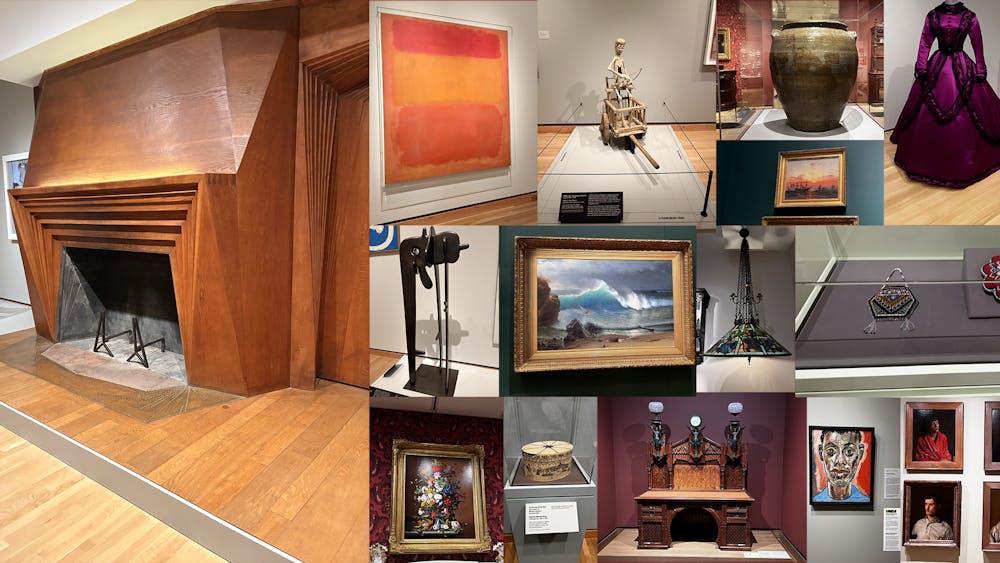
Proceeding into the next room titled “Prosperity, Abundance, and Inequity,” which covers art from 1840 to 1860, audiences view a room donned with French Rococo–style furnishing popular in America at the time, like the elaborate etagére made by Alexander Roux. The gallery juxtaposes this flourishing success with the reality of slavery with the Storage Jar by David Drake in the center of the room. This piece is a product of Drake’s work for Lewis Miles Pottery as an enslaved man and is an enormous vessel for storing meats, as per an inscription. The piece has an almost omniscient presence in the room because of its placement at the very center. From there, “Globalism and the Machine in the Decorative Arts” continues to venture into American history from 1860 to 1875 through Civil War Art and art with materials sourced from abroad, like the Woman’s Dress on display.
The “Nature and Nation” gallery installation in the next room is intentionally made to feel like “a late 19th–century art gallery in a tycoon’s mansion,” as Foster said during the curators’ talk about the exhibit. Its lush green walls and open space mirror the landscapes donning the walls of the room. Seascapes are included as well, some of the most prominent being The Shore of the Turquoise Sea by Albert Bierstadt. While America’s expansive landscapes are eternally glorified in these paintings, it’s a reminder of the oppressive tactics used against Indigenous people when it came to obtaining them—which is included in the gallery description. Audiences are directly confronted with this, looking out into the adjacent gallery where Indigenous art takes the spotlight.
“Crosscurrents” illuminates audiences on the progression of Indigenous art. With recently made pieces in the gallery, it does not depict Indigenous art as something of old, but something flourishing and "alive," which Foster says when elaborating on the direction that advisors had in mind. Auntie’s Purse—made in 2025 by Randee Spruce of the Heron Clan (Seneca Nation)—featured Onöndowa’ga’ (Seneca Nation) beadwork, marrying older patterns with personal renditions of designs. Additionally, Laura Watters Maynor created her 2023 Lenape honor blanket made for her granddaughter Marian in the same vein: taking inspiration from pictures of Marian’s great–great–great–great–grandmother in a blanket and applying this to the design. The works in this gallery were carefully chosen by a committee consisting of Indigenous individuals related to historic preservation, such as curators or scholars.
Modernism’s development in America is thoughtfully traced from gallery to gallery, from “Nature and Spirit” to “Modernism Takes Shape” and everything in between. “Natural and Spirit” lends itself to thoughts of mortality and religion like in Death Cart (Carreta de la Muerte) made in New Mexico, which eerily depicts a skeleton with a bow as a figure of death. “Modernism Takes Shape” is a tribute to geometric lines and shape and their emerging presence in the 1900s, as is seen in the fireplace on the left side of the gallery made by Wharton H. Esherick and Cactus by Charles Sheeler.
“Post–War American Modernism” rounds out the exhibit as the United States comes out of WWII, drawing many individuals to immigrate to the US and making it a hub for creatives. How well the Middleton Collection rounds out the exhibit is fully illustrated here with Mark Rothko’s Red, Yellow, Orange of 1956, its presence abstract and practical at the same time.
The presentation strikes a balance in being all–encompassing in its 19 galleries yet still being so deeply Philadelphian in its coverage of artists, including Frank Furness and Thomas Eakins. Furness was one of Philly’s foremost architects in the late 1800s and was responsible for designing the PAFA and the Fisher Fine Arts Library. His architectural style is imbued in the walnut desk on display in the gallery, seen in details such as the arched footwell.
Thomas Eakins’ works—which were already on display at the PMA before the exhibit—are integrated in pieces such as Between Rounds in the front of the exhibit and a variety of Eakins’ signature realism portraits. Eakins is associated with PAFA as well; he taught there, much like other artists shown in the exhibit, such as Robert Henri.
Eakins’ legacy is demonstrated in the gallery right next door, with many followers of his works on display. PMA’s commitment to Philly is embodied here, and the curators did great work to assist the public in understanding Eakins’ impact on the art world. The installation on Eakins is expansive to keep a balance in content; covering a Philadelphia artist from the Modernism period to this extent would be beneficial in detailing Philly’s legacy throughout time.
But this is the tip of the iceberg: Dox Thrash, Claude Clark, William J. Glackens, and more are part of this group. These are artists who have a unique connection to Philly and America, fueling their art: Thrash uses his experience as a WWII shipyard worker to funnel into his art, Clark paints Black Americans in their daily lives, and Glackens is distinctly influenced by his mentor Robert Henri at PAFA in his paintings. This theme is not exclusive to Philadelphian pieces; the museum displays art grounded in its identity to reflect on the power of art as a means of expression.
As the smoke from America’s birthday candles subside, the exhibit remains an allowance to contemplate patriotism. A love for a country doesn’t have to live in painting its majesty or using signature colors. It can be caring for one’s country enough to be critical of it, trusting that change can be ignited with every paint stroke or wood carving.
A Nation of Artists at the PMA celebrates American art and its infinite possibilities as it evolves, giving us hope for what’s beyond today’s horizons.