For pop music, the streaming era is no longer enough. Alongside it, social media platforms have transformed pop music’s dissemination. It’s obvious enough in lyrics that read as Instagram captions and melodies that can survive being sped up, slowed down, or detached entirely from their original context as a perfectly clippable 15–second soundbite.
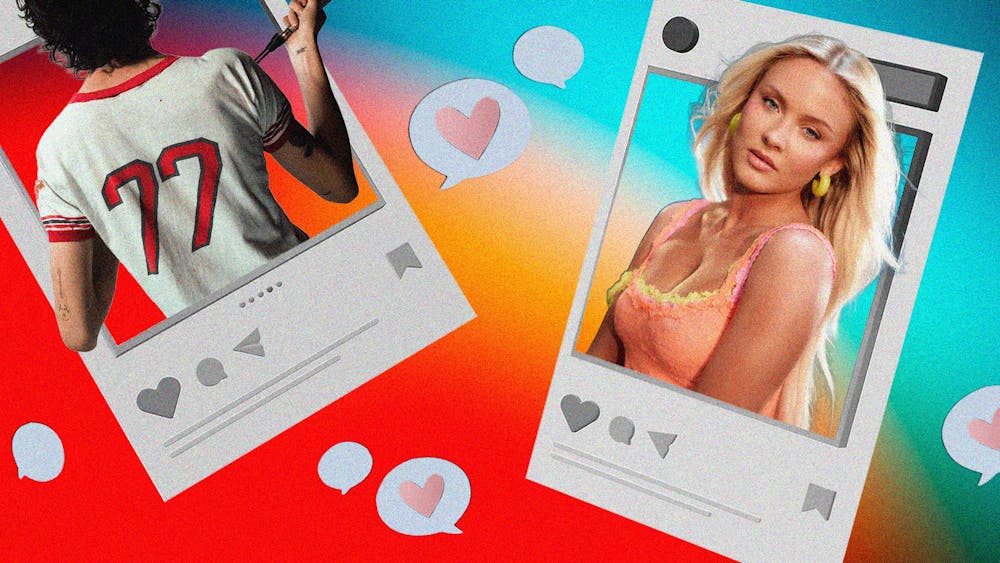
But social media’s demands no longer stop at the music itself. Increasingly, musicians are transforming their music into immersive experiences, building recognizable worlds that can circulate alongside and sustain attention around their songs. Zara Larsson, an artist who once achieved anonymous ubiquity with hits like “Lush Life” and “Never Forget You,” comes to mind after a resurgence of her song “Symphony”. Her works quickly became associated with tropical–dolphin–rainbow–positivity visuals due to TikTok memeification. A subsequent indulgence in that imagery, evident in the placement of lotus flowers on her album covers, became exciting to fans and enveloped them in the summery and vaguely hedonistic themes of the album Midnight Sun. Rather than disappearing with the meme cycle, Larsson has proven herself to be remarkably resillient: she has continued performing through her Midnight Sun tour and creating remixes like Midnight Sun: Girls Trip, a 2026 remix album that brought together artists like PinkPantheress, Kehlani, and Robyn.
The interactive environment was key to her success, elevating her music and marketing into a self–reinforcing system of cues: dolphins, rainbows, or hibiscus flowers meant Zara Larsson was near, and her voice meant “summer isn’t over yet,” as the single “Midnight Sun” declares. This aesthetic allowed her brand to transform from fan–made memes into an artistic identity without losing the participatory quality that produced it.
Sabrina Carpenter, similarly, finds explosive success in her inexplicable fluency with those pedestaling her social presence. Since emails i can’t send, she has not only adopted but arguably influenced the zeitgeist of post–TikTok interaction: irreverent, unserious, and unafraid. Carpenter doesn’t maintain the careful distance of a celebrity dodging strays online—she participates. Gen–Z’s idgaf attitude is only expounded upon by teasing an incompetent man that his subparness causes “tears to run down her thighs,” as she so charismatically declares on “Tears.”
Fans began speculating about Carpenter taking a liking to Bad Bunny after a viral clip in which she, perhaps, licked her lips while Bad Bunny accepted Album of the Year for DeBÍ TiRAR MáS FOToS. Rather than ignore the speculation, she leaned into the narrative, posting a TikTok using his song soon after which amassed over 13 million likes. Whether the crush existed hardly matters. Carpenter’s success comes in part from her willingness to participate in the discourse surrounding her—to entertain a ship, extend a joke, or acknowledge a narrative. In doing so, she collapses the distance between artist and audience: fans talk about Sabrina Carpenter, and, every so often, she talks back. It might have been the best way to advertise the South American leg of her tour.
Most revealing, though, are the methods employed by sombr. He appears to have a network of highly followed “fan accounts” that consistently post new clips of him singing alternative lyrics at shows, or engaging in deliberately awkward and meme–ready behavior. While fan accounts and their steadfast diligence are nothing new, the efficiency is uncanny: clips arrive almost instantly, often from identical angles, distances, and quality. It raises a question that hovers somewhere between conspiracy and common sense: are these truly fans, or a strategy by an extremely savvy publicity team? A quick search on SnapChat Spotlight—truly the backwash of all social media platforms—reveals that his official account has posted many of the “fan–made” videos.
Whether orchestrated or not, the effect is undeniable. The accounts celebrate a version of sombr that feels accessible, unpolished, and extremely Gen–Z. He evokes a certain, “we would be such good friends” attitude from his audience. If anything, the ambiguity is the point; even the discussion on those (perhaps) planted fan accounts is publicity in its own right. Whether or not the spontaneity is real, the intimacy is remarkably effective.
There’s been an industrial shift, curing the one–hit–wonder system of the streaming era, driven in part by the omnipresence of social media. These platforms allow artists to construct entire worlds, pulling listeners into something that feels intimate, interactive, and constant. For artists who know how to use them, social media provides the superpower to be everywhere and everything for their fans without needing to commit to being anywhere or anything in particular.
At its best, this deepens the impact of an artist’s work. At its worst, it invites us to question why a celebrity has become our best friend. Fans increasingly expect to influence the art itself, or at least see artists respond to bigger social media waves encircling them. When a viral trend tested the limits of editing Larsson’s “Midnight Sun” louder and louder with more and more grandiose harmonies, Larsson responded by releasing an official version that mirrored these typically unmarketable edits. Cynically, this reads as convenient marketing. However, the edits may be curiously appropriate on a song about almost blistering optimism that, presumably, takes place in a dark place—hence, “Midnight Sun.” For listeners that want to tune something out or for which to play loud music and ignore, Larsson personally said “I see you.” Well, as personal as a release to her 68 million monthly listeners can be.
But that same intimacy curdles just as quickly. That heightened sense of involvement can become a warped sense of ownership, encouraging fans to defend their favorites with unprompted intensity. When Meghan Trainor posted wearing a red sequined outfit sporting a 50s blowout and curtain bangs, many fans called out the look for its similarity to Carpenter’s tour glam. The backlash against Meghan Trainor’s perhaps derivative styling choices illustrates how easily loyalty becomes territorial militancy. While Carpenter may have stumbled upon legal complications trying to trademark her tour hair style, a fandom can protect her patent for a whole lot cheaper.
Artists unwilling to participate in this hyper–personalized ecosystem face more scrutiny for that choice. Chappell Roan, for instance, maintains a more elusive online presence—a TikTok page mostly consisting of unedited concert clips, largely detached from the discourse surrounding her persona. But that interpersonal distance hasn’t exactly shielded her from scrutiny, and, to an extent, has intensified it. TikTok users have combed through her past, attempting to undermine the authenticity she provides as a queer artist by pointing to markers of privilege. Oftentimes, users will stake claims that scarily blend the lines between the quality of her music and whether or not they like her. The reaction seems only natural when audiences have become accustomed not only to consuming an artist’s work, but to feeling that they know—and can evaluate—the person behind it. The conclusion reached is that she is ill–suited for celebrity status, but arguably, she might just be ill–suited to be our online friend.
Within the realm of pop music, this change marks a new definition of success. No longer is it solely determined by how well a track performs on the charts; it depends on an artist’s ability to sustain attention beyond the music itself. Musicians are no longer only responsible for creating songs, they must keep themselves current, respond swiftly, and maintain personalities that audiences can continuously engage with. In this context, the lines between art, performance, and publicity begin to blur, and the most successful artists are often those who can navigate all three. This does not make the music any less valuable, but it does make the music alone less sufficient. Each track instead becomes a point of entry into a larger world—one sustained through the artist’s persona, their audience, and the constant exchange between the two. In such a world, pop music risks evolving from something we listen to into something we are expected to join.