If you look at Wikipedia’s “List of teen films,” you’ll find both All Quiet on the Western Front and Frozen. Putting those two movies in the same category is the strongest argument teachers have ever had against using Wikipedia as a reliable source.
But keep scrolling and things don’t get much clearer: 21 Jump Street, Lady Bird, even Addison Rae’s abomination He’s All That. Apparently, the only requirement for admission into the teen movie canon is the presence of a teenager on screen.
So what, exactly, is a “teen movie?”
The simplest answer is that it’s a movie about teenagers. But that doesn’t work. All Quiet on the Western Front follows young soldiers barely out of school, Spider–Man: Homecoming stars a high schooler, and 21 Jump Street is about adults pretending to be kids. None quite fit, so age clearly isn’t enough.
Maybe it’s tone. Most obvious teen movies are funny: Fast Times at Ridgemont High, Clueless, American Pie, Mean Girls, Superbad, Easy A, Booksmart, Bottoms. But Lady Bird unmistakenly feels like a teen movie without primarily being a comedy, so that doesn’t work either.
Maybe “teen movie” is less of a genre than a shared language: school, parents, friends, crushes, cliques, and the looming threshold between adolescence and whatever comes next. Few settings capture that shared language better than the high school party. For decades, it was where every teen movie’s scattered relationships, anxieties, and social hierarchies finally convened. But while the party is still here, the teen movie—at least as a cultural institution—increasingly isn’t. So what changed?
To understand where the teen movie went, we can start by asking what the function of the on–screen party was in the first place. The party isn’t there simply because teenagers party. It solves one crucial storytelling problem: How do you fit an entire teenage social world into one room? American Pie, Mean Girls, and Superbad all arrive at roughly the same answer. Take the cliques normally separated by lunch tables and classrooms, remove the teachers and parents keeping them apart, put them under one roof, add alcohol, and wait. Your crush is there. Your best friend is there. The people you desperately want to impress are there. Every friendship, rivalry, and insecurity the movie has established is suddenly rubbing shoulders with each other. The stakes feel enormous because, at 17, getting invited somewhere might genuinely feel like the most important thing that has ever happened.
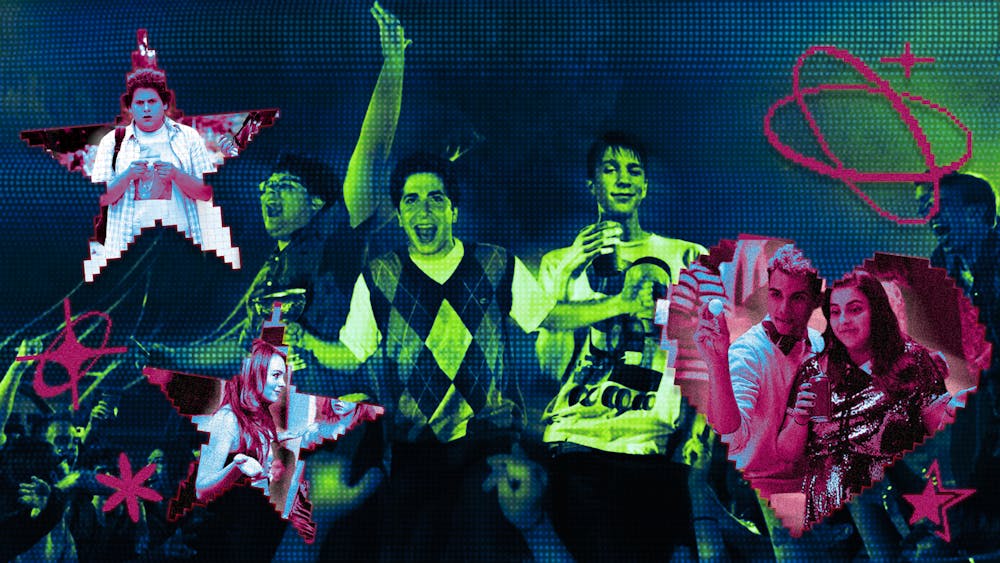
But the party doesn’t serve the same purpose in every film. In American Pie, it’s a finish line: the place its characters believe will finally transform them into the people they want to become. In Mean Girls, it’s a collision: Cady’s (Lindsay Lohan) carefully separated identities become impossible to maintain once everyone enters the same house. Superbad does a little bit of both. Seth (Jonah Hill) and Evan (Michael Cera) spend the entire movie trying to reach the party because they believe one night might rewrite their high school experience—before graduation ends it altogether.
Project X asks what happens when the teen movie stops building toward “the big party” and simply becomes one. It’s the teen movie party pushed about as far as it could possibly go. But it didn’t kill the party.
Booksmart returned to the Superbad model in 2019, sending Molly (Beanie Feldstein) and Amy (Kaitlyn Dever) on a one–night graduation–eve mission to experience the high school life they missed. Lady Bird uses parties to let Christine (Saoirse Ronan) test different versions of herself, while Bottoms gathers its teenage social order at a football game rather than a house. Today’s teen movies still find reasons to gather their characters in one place. What’s changed, however, is the world waiting outside the front door.
The digital revolution weakened the unique social significance of the party. Social media had already begun moving teenage life out of school hallways and into the computer, and COVID–19 only accelerated that shift. Group chats keep conversations running after everyone leaves; photos circulate instantly; relationships get hard launched online. Someone excluded from a party can watch it unfold from their bedroom, while someone who humiliates themselves at midnight might find the evidence waiting online the next morning for the entire world to see. The party is no longer the place where teenage status becomes public, because teenage life itself is now continuously public.
The teen movie once needed the party to showcase where everyone stood. Now, the party matters because it’s where everyone finally has to stand somewhere. The party has adapted to a changing teenage world, but the teen movie’s place in popular culture has had a harder time doing the same.
There are still teen movies being made. Netflix has kept the genre alive (or perhaps on life support) with movies like Do Revenge, Incoming, and You Are So Not Invited to My Bat Mitzvah. It’s not that Hollywood literally stopped making movies about high schoolers, but that the teen movie stopped occupying the same place in popular culture.
We could say that teenage stories just moved to television, or that recent teen movies simply haven’t had enough time to become generational landmarks. But that misses the larger change: the audience fragmented alongside the teenage social world.
Just as social media moved teenage life beyond one physical gathering place, streaming and the internet moved teen culture beyond a handful of movies everyone was expected to know. You no longer need to attend the same party to know what everyone is doing, and you no longer need to watch the same movie to participate in teenage culture.
One place teen stories have flourished is on television. Euphoria follows high school students through romance, drugs, friendship, violence, and identity. Never Have I Ever turned the high school romantic comedy into a multi–season story. Heartstopper, Outer Banks, and The Summer I Turned Pretty center young characters navigating the same relationships, status anxieties, and identity crises that once belonged to the teen movie.
And yes, they still party.
The advantage that television has over the teen movie lies in its longer time–scale. A show gets six, eight, ten episodes—or several seasons—to move characters between social groups. It can spend one episode at a party, another at school, another on a date, and another in someone’s bedroom. What Superbad needs one house to accomplish, Euphoria can spread across a season.
And teenage stories are particularly well suited to that extra time. So much of adolescence is defined by relationships that change slowly—friendships evolve, relationships form, how you act changes depending on who’s in the room. The longer we spend with these characters, the more those changes mean.
But TV hasn’t recreated the old monoculture either. Euphoria is huge, but it exists in a world with more shows, platforms, and creators competing for attention than Gossip Girl ever did. The teen story didn’t vanish, but the cultural shift has demonstrated that maybe it was ambitious to believe that one teen story could ever truly reach—and represent—everyone.
For all their differences, classic teen movies overwhelmingly represented the same slice of adolescence: straight, white, middle–class, and suburban. A more fragmented media ecosystem has made room for stories built around experiences previously left outside the mainstream. Bottoms and Heartstopper tell radically different queer stories. Never Have I Ever centers around a first–generation Indian American teenager. Smaller audiences now have the chance to watch more specific versions of themselves.
The tradeoff is that now it takes far more for any one of those stories to become a shared cultural object. We gained choice and specificity while losing some of the common language that let Mean Girls or Superbad belong to an entire generation.
Maybe that explains why, through all of this fragmentation, the party refuses to leave the teen story. Its old narrative job has been partly replaced by the phone; a filmmaker no longer needs to put every teenager under one roof to show us who belongs, who doesn’t, who wants whom, and who everyone is talking about. All of that can happen online before anyone walks through the door.
But eventually, a screen stops being enough. The crush has to become a conversation, the friendship an argument. Someone has to embarrass themselves without a delete button. The party, both on screen and in life, still forces teenagers into the same room at that age where being seen by the right people (and you haven’t yet figured out who you are) feels terrifyingly important.
Maybe we lost something when the teen movie stopped being one of the places an entire generation gathered. Maybe it’s better that teenagers now get dozens of different, personal stories instead of one supposedly universal version of adolescence. Either way, the party survives because some parts of growing up still have to happen in person.