
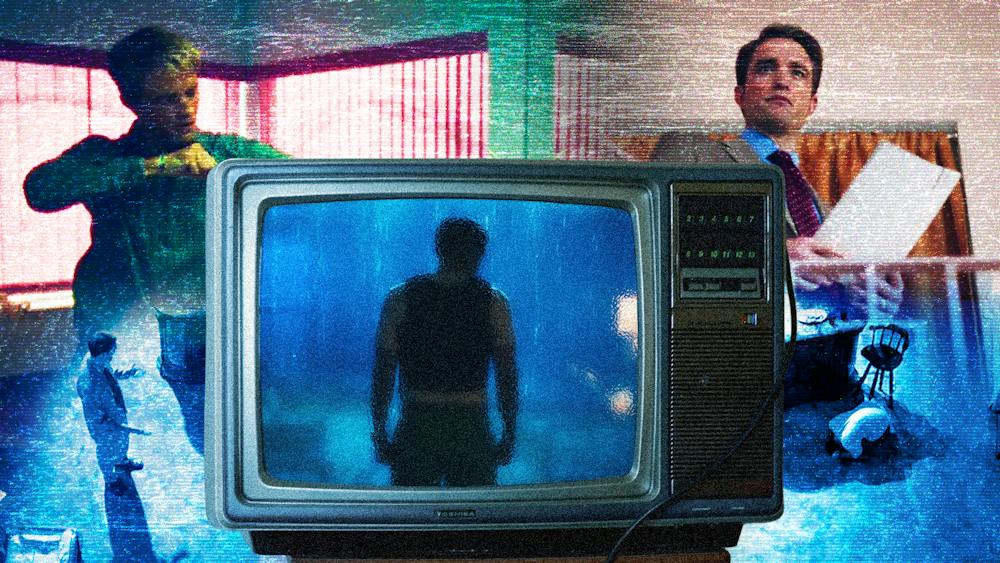
Is it okay to do the right things for the wrong reasons?
That’s the question stuck in my head after walking out of Lance Oppenheim’s Primetime, a dramatization of events surrounding Chris Hansen’s hit vigilante television show To Catch a Predator, whose sole premise is luring potential child predators into decoy houses and siccing the police on them. The film seems similarly fascinated by that question, but unfortunately, it’s far more interested in just raising it than truly wrestling with it.
The film lives in the increasingly blurry line between journalism, public service, and entertainment. On one level, the moral math seems pretty simple: adults attempt to meet children for sex, they are caught, and would–be (sometimes real, former) predators are exposed. Whatever else you think about the show that facilitated those outcomes, it’s difficult to argue that preventing sexual abuse is anything but good.
Then comes Robert Pattinson’s Chris Hansen. Personally, I don’t take anything in the movie as evidence of the actual Hansen’s private motivations or moral character, but the character Pattinson creates is captivating in every sense of the word. He’s ambitious, charismatic, self–assured, and just slippery enough that you’re never entirely sure whether his crusade against sexual predators is driven by moral conviction, professional ambition, or some inseparable combination of the two.
Put simply, Pattinson is impossible to look away from. His performance, combined with an unnerving visual aesthetic and often claustrophobic directorial choices, turns Primetime from a straightforward Wikipedia summary into something genuinely tense. Whatever issues I have with the movie, boredom isn’t one of them; I was entertained for the entire runtime.
But a more interesting version of the film might begin with a Hansen who genuinely believes every word of his crusade. When he tells a decoy that they are fighting an “ancient evil,” does he mean it? Did he begin To Catch a Predator because he wanted to protect children, because he wanted to make great TV, or—as seems infinitely more human—because he wanted both? And what happens when the ratings start coming in and those motivations become impossible to separate? Primetime never really lets us watch that transformation; Hansen instead begins the movie already slippery enough that his supposed moral deterioration has nowhere particularly interesting to go. Worse, he increasingly takes a backseat in his own story.
In his place, the movie takes small, incomplete bites out of several other ideas. We catch a glimpse of the mental toll this operation takes on those involved, from the “bait” actors tasked with posing as children to the show’s producer—who embodies the production’s growing unease, albeit with an allegiance that fluctuates too conveniently to feel convincing.
Then there’s Hansen’s cheating subplot, which feels particularly forced because it gives the audience such an easy, tangible reason to dislike him. It feels like the movie is spelling out to us that, even if we sympathize with Hansen’s cause, we shouldn’t sympathize too much with Hansen himself; giving us such an easy reason to condemn him only removes nuance.
But why does Hansen’s moral character matter in the first place? If he catches someone attempting to sexually exploit a child, does it matter whether he did so because he wanted to protect children or because he wanted 10 million people watching NBC? And why should his cheating on his wife change our answer?
Discourse surrounding To Catch a Predator has never solely been about Hansen’s intentions, though. The spectacle, humiliation, incentives created by ratings, psychological effects on those participating, and transformation of criminal behavior into entertainment all deserve scrutiny. Catching someone who intends to sexually exploit a child may be an obvious good, but that doesn’t mean every method of doing so is, too.
That distinction becomes especially uncomfortable when the show targets people with clear mental disabilities, which only further complicates the morality of turning them into television spectacle. Would it be better to identify these people and then try to help them instead of tackling them? Probably. But that exposes an uncomfortable reality: Hansen’s operation only exists because it makes television people want to watch. Perhaps treatment would produce a better long–term outcome, but it probably wouldn’t produce NBC ratings. And without those ratings, Hansen loses the money and resources that allow his operation to exist in the first place. The show therefore has to exist at the intersection of two separate standards: it has to be socially useful enough to justify itself yet entertaining enough to remain on television.
But I don’t think Primetime spends enough time untangling that conflict. Instead, the questionable motives and questionable methods begin bleeding together until the movie’s discomfort with the entire enterprise becomes clearer than what it actually wants to say about it.
Sure, there can absolutely be value in a movie that asks questions without answering them for its audience. I don’t need Primetime to explicitly tell me whether To Catch a Predator was good or bad or whether Hansen’s methods were justified, but if you already know the show and the events the movie dramatizes, you’re not given much that you couldn’t have already asked yourself beforehand. These questions aren’t discoveries the film creates—they’re questions already embedded in the story it chose to tell. If the movie isn’t going to answer them, I at least want it to complicate them, to leave me thinking about To Catch a Predator differently than I did when I walked in. Instead, I mostly walked out asking the same questions I already had.
My frustration comes to a head in the film’s climax. Arguably, the nail in the coffin for To Catch a Predator comes when a district attorney dies by suicide as a sting closes in on him. It’s a horrifying outcome, and one that effectively brings the whole show crashing down. But it also raises a question that may sound monstrous to even ask: How are we supposed to morally evaluate what happened?
The incident contains nearly every question Primetime is already asking about punishment, exploitation, public good, personal responsibility, and the consequences of turning justice into entertainment. I completely understand why someone would see all of this and make a movie out of it. Yet, like so many of its ideas, the movie moves on—there’s only one scene left afterward. The film juggles so much that it inevitably drops a few things along the way. I would have traded some of that breadth for an intense focus and unflinching exploration of even just one of these moral questions.
And so I kept thinking about what the movie could have been. If it wanted to be a character study, show me Hansen at the beginning. Let me watch his original combination of conviction and ambition slowly become warped by success. Make me wonder precisely when the mission stopped being the point and the show became a product—or whether there was ever a distinction to begin with.
If it wanted to interrogate the production itself, spend more time with the decoys, producers, cameras, and compromises behind the scenes. I’d like to see how a journalistic operation gradually hones the rhythms of entertainment and how everyone involved rationalizes the next crazy escalation.
And if it wanted to interrogate the ethics of To Catch a Predator, then really interrogate them. Let people vehemently disagree with one another and acknowledge that something can be exploitative yet simultaneously socially useful. Take that horrifying final sting and force us to really sit with everything it complicates. Make the audience walk out arguing over what the right answer was.
Somewhere inside Primetime are these three movies, all of which I desperately want to watch. I’d happily turn on a detailed behind–the–scenes drama about how To Catch a Predator became To Catch a Predator. I’d also watch two philosophers sit in a room for two hours arguing about whether a show built on humiliation, spectacle, and questionable motives can still make the world meaningfully better. Primetime tries, and fails, to be all of them at once.
But again, this frustration should not be confused with disinterest. I never checked my watch, Pattinson is undeniably magnetic, and the filmmaking brings a visual and psychological intensity that most biopics would kill for. I just walked out more interested in talking about the questions surrounding To Catch a Predator than anything Primetime itself had to say about them.