I’m convinced that the “casual fan” is a fictional character made up by people who don’t use the internet. As someone who’s probably, no, definitely, been on social media far too long (I made my X account when I was 10), nothing brings out the worst in fans like access to the internet. Fans are fickle. The tides of opinions on artists change quickly. One day, everyone loves you; the next, you’re the subject of a 30–tweet thread explaining why you’re a talentless industry plant—whatever that means.
But the problem isn’t just the fans—it’s the feed itself too. Your algorithm decides which version of the internet you get, and once it’s made up its mind, good luck changing it! However, between different platforms, the only consistent force is the passion of keyboard warriors. The mind of an app, or a website, is unique to its creation and purpose. The best example of this is Elon Musk’s purchase of Twitter, which preceded a total transformation into the modern X, shifting both the app’s policy and culture to breed infectious hate in its petri dish of pugnacity.
And yet, this volatility is not just unique to discourse on X. It’s just an established fact of the internet. Artists know this well, as album releases so easily become a field day for fans or lack thereof. This is especially true for Taylor Swift, whose success and billionaire status make her a particularly hot topic.
So, in pursuit of identifying which platform breeds the most devotion (or mania, depending on your perspective), I saw no better candidate for case study than Swift’s latest album release. The deluxe record, The Life of a Showgirl: Encore, has been accused of weak lyricism (her song, “Cleveland!,” featured gasps in place of profanities and references to her now–husband, Travis Kelce’s, podcast, “New Heights”) and its corporate, jaunty production evokes comparison to The Office theme song. But if that’s just what the critics are saying, what will fans, unbound by professional diplomacy, decide?
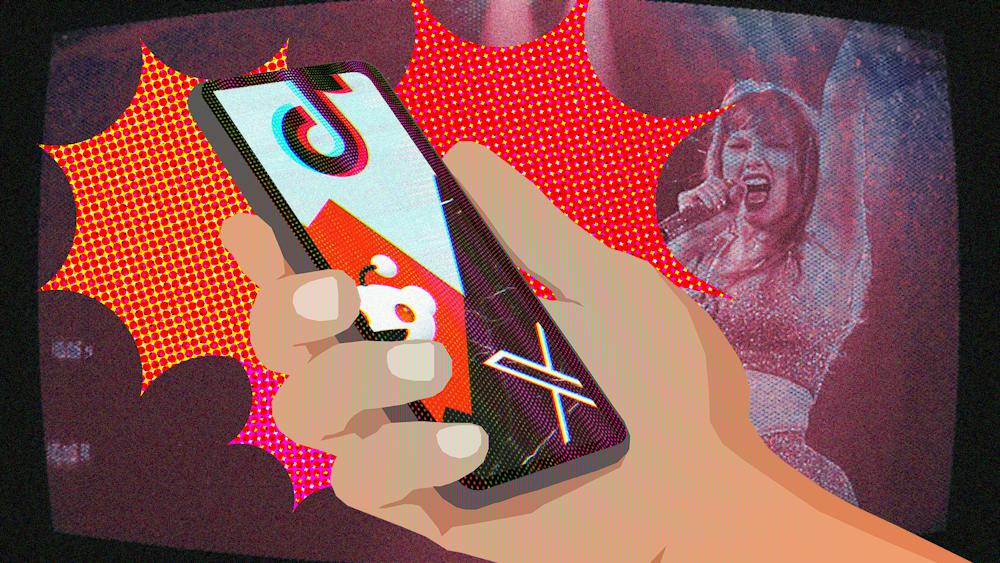
I search for Swift on X, TikTok, and Reddit, inspecting the posts that came up, what fans were talking about, and how they interact with each other. For better or worse (it’s worse), each social media platform has its own playbook for what it means to be a fan of someone.
X
X is the platform I know best, and “stan Twitter” has become a breeding ground for the most unhinged forms of discourse. My search for Swift makes that pretty clear—within minutes, I found tweets comparing her tastelessness to “a large jar of mayonnaise,” which, all things considered, is pretty tame for a dissatisfied user.
Five minutes after the release of her new single, “Patient Zero,” user Taylor Swift Updates wrote, “PATIENT ZERO IS SO GOOD WTF.” Other users were less enthusiastic, with one asking Swift to “come back to us please.”
One of my favorite findings was a tweet that stated: “the world is on fire, all of our taxes are funding multiple genocides, none of us will ever own a home … thank god the pop stars are writing corny funny songs to make us laugh and give us some fucking JOY!!!” Another user argued that many listeners are overly attached to her 2020 projects, folklore and evermore, while some repliers pushed back against that sentiment.
The conversation shifted between the quality of the music itself, Swift’s personal life, and what it means to be a Swiftie in general. One user questioned whether people who criticize Swift should still consider themselves fans of hers and enjoy her older works, telling users to “#getthefuckoutofourfamilybusiness.”
On Twitter, replies and quote tweets often end up dominating how discourse is remembered, whether the original poster likes it or not. The app has a unique way of turning every statement into an open invitation for commentary, even if it wasn’t requested. As one user so wisely put it, it’s “the only place where well articulated sentences get misinterpreted.”
TikTok
TikTok offers a similar mix of praise and criticism, but the dynamics of that discussion are less straightforward. While users might find and build an audience through hashtags, the circulation of posts remains largely at the whims of algorithms. I’d like to think that my For You page accurately reflects my sophisticated taste in media consumption—but that would be a lie.
Compared with a more text–based, overtly discursive platform like X, TikTok makes these conversations feel more incidental. Its emphasis on visual content also makes content more ambiguous—commentary can be embedded in a reaction or performance, rather than a direct statement.
One fan on the app danced along to “Pink Clouding,” with text saying, “My fav genre of Taylor is when she does this syncopated talking in songs,” while defending the song in the comments. Another user argued that Taylor made the album to have fun and annoy her haters, while a third explained her goal wasn’t to win a Grammy with The Life of a Showgirl. Instead, she was making the album with her 14–year–old self in mind, who “couldn’t wait to fall in love.”
But there is plenty of criticism, too. Some TikToks joked about the production of the music, calling it “90’s sitcom intro music,” while others got straight to the point, saying she had reached a new low in her music and lost the hunger she once had. One user used a clip of Wendy Williams crying over text that read, “How it feels to admit Taylor swifts music is getting worse despite defending her with my entire being.”
What I notice across all the videos I watch is the dramatization of these opinions, whether good or bad. Defenders call criticisms cyberbullying, while critics make several–minute–long videos explaining why Swift has lost her touch. The judgements themselves are not necessarily different from what I found on X, but the platform encourages a more theatrical delivery—whether through a dance, dramatic clip, or monologue, users find ways to make their feelings known.
My search on Reddit is a bit different than the last two. Yes, I know it’s embarrassing to be seen on Reddit or publicize the fact that you have an account. Despite all its flaws, Reddit, for the most part, can be a helpful place for discussion—trust me, any issue or idea you’ve ever had has likely been discussed at length on there.
In r/TaylorSwift, Redditors were largely focused on the music itself. Each new song on the deluxe received a megathread, giving Redditors a place to react to each song, compare it to past works, and delve deeper into everything from the lyrics to the production. For r/Swifties, the focus was on being a fan. The use of charts and streaming numbers is often used to justify the quality of her music and question music criticism in the streaming era.
On r/SwiftlyNeutral, posts focused more on Swift’s creative choices and her career as a whole. A post titled “She needs Jack Antonoff” turned into a discussion about the role of collaboration in her music, and the amount of pushback artists receive when creating.
User u/theladyjorts wrote: “I’m just gonna say it. I Knew It, I Knew You has come out within this era and was a certified cute little bop with a lovely lyrics and an introspection of childhood and watching it pass. She clearly still has it in her. Jack being that producer. Her largest amount of her best work was made with him.”
Even though all three of these subreddits have a common anchor in Swift and her music, the way they each went about approaching the subject varies greatly. On Reddit, where communities are divided into distinct spaces with their own expectations and levels of investment, the same album can be a conversation about the music, a defense of the fandom, or a broader critique of the artist’s career.
Users on X are far more argumentative than users on both TikTok and Reddit. The 280–character limit forces you to be succinct, or rather, curt. There’s not enough space for a nuanced argument—unless you’re interested in buying premium and funding Musk’s trillionaire status—so X users just skip it entirely. And without a need to post a video, use their camera, or risk being recognized, it’s so easy to keep your claws out and face hidden.
TikTok, as a fundamentally different media platform consisting of short–form videos, requires aggression to keep the audience’s quite limited attention span. Posters speak quickly, use pushy language, and look for controversy as a way to propel their video towards your “For You Page.” But then, if the audience’s engagement lasts long enough for them to go into the comment section, it becomes a lot easier to post a gif or sticker than write out a thoughtful rebuttal.
So Reddit, the only platform out of the three that is built for long–form written content, is undeniably more cordial. Literacy and media literacy are both active ambitions for its users, where the most “upvoted” posts are those that are nuanced, well–argued, and well–articulated. Its prophecy is self–fulfilling. If you are interested in reading other people’s extended takes, you yourself have more openness to learning and writing out your own. It’s a dialectic rather than an appetite for clout.
So Reddit, the only platform out of the three that is built for long–form written content, is undeniably more cordial. Literacy and media literacy are both active ambitions for its users, where the most “upvoted” posts are those that are nuanced, well–argued, and well–articulated. Its prophecy is self–fulfilling. If you are interested in reading other people’s extended takes, you yourself have more openness to learning and writing out your own. It’s a dialectic rather than an appetite for clout.
But still, somewhere out there, the silent majority listened to her new album, said “huh,” and moved on with their lives. The best part is: You’ll never hear from them. They’re not posting. Instead, the algorithm fills the gap with whoever’s loudest: the stans, the haters, or the stans who have become haters. If you stay in one app long enough, that noise becomes confused with consensus. Maybe the casual fan isn’t fictional after all. They’re just the only ones who logged off.