At half past five on Friday, May 10, 2024, I wake up to five missed calls from the then–editor–in–chief of The Daily Pennsylvanian. I can’t find my glasses, but I fumble my way over to my phone, praying I won’t wake my roommate on the other side of our KCECH apartment.
I already knew why he was calling. There was only one reason he would call me at that ungodly hour, especially after I had spent the previous two weeks walking out of Van Pelt-Dietrich Library at around 1 a.m. and waking up to head back there at 6 a.m.
The police were lined up outside College Green. The Gaza Solidarity Encampment, which had occupied the lawn since April 25 that year, was about to be cleared. Students, faculty, and community members were going to be forcibly removed.
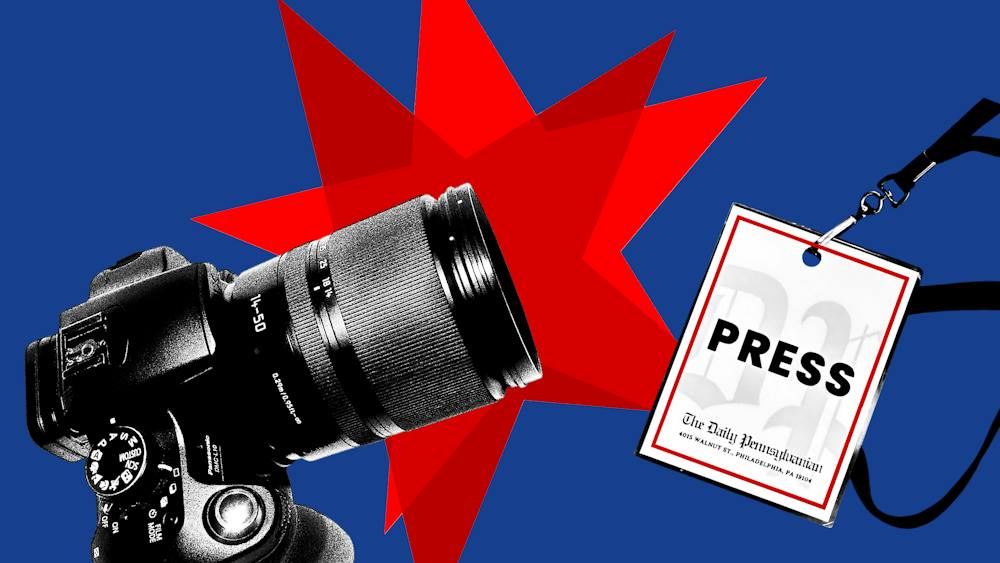
I grab my camera, trip over my shoes, and run out of my room before I can even grab my press pass.
I was the editor–in–chief of my high school newspaper. I loved editing. I loved picking through old issues and highlighting every single grammatical error or spacing mistake. I spent my free time thinking of timely angles and the photos that would go along with them. It’s funny—despite all the time and energy I poured into that newspaper, I always knew I wasn’t cut out to be a journalist. I just hated talking to people.
I could do an interview and write an article, but I hated meeting strangers and making phone calls. I could never think quickly enough to come up with the snappy follow–up that makes an interview sound interesting and investigative instead of a shitty interrogation from a nervous teenager.
I could take pictures, though. And I could take them pretty well. So, when I arrived at Penn, joining the photo department at the DP was the obvious first thing to do. The newsroom was hectic and chaotic and occasionally held together by sheer willpower, but I wasn’t particularly organized myself, so who was I to judge?
About a month into my freshman year, Penn hosted the three–day Palestine Writes festival. At the time, it barely registered in my day–to–day life. I knew it had made national news, but most of the programming was in Irvine Auditorium, and I don’t even remember walking past it.
Two weeks later, Oct. 7 happened. Looking back, it’s strange how quickly my life at Penn changed. I went from wondering whether I should apply for a dual degree at the Wharton School—it was never going to happen, but my parents were really hoping—to impatiently waiting for the next protest to happen.
One of the first things you learn in a journalism class is objectivity. If journalists want the public to trust them, they have to be impartial, unbiased, neutral reporters of the truth. I didn’t think much about that idea when I was younger. It seemed very obvious to me that objectivity was crucial, especially when covering politics. To me, politics was what happened in Congress, at local councils, in marches in the streets. Journalism was supposed to sit somewhere outside it all—watching, recording, and documenting. But I quickly realized that journalism has its own politics. Deciding what is news, whose voice gets quoted, which photograph runs and which one stays on the SD card aren’t decisions that happen in a vacuum. In high school, a friend of mine was doxxed and received hate mail after writing a simple article about changes to our social studies curriculum. The point of objectivity, I suppose, is to make sure a journalist’s politics don’t decide what is true. Death threats can certainly make that difficult.
I used to think photojournalism had an advantage. Words can be twisted. A reporter could choose a quote, a fact, a lede. But a photograph? It was what you saw. It was what was there.
Obviously, I was very wrong. The photographer still chooses where they stand, what to point their camera at, whom to photograph, when to click the shutter, and which frame to submit out of the hundreds (or, eventually, thousands) sitting on their memory card.
I also found that I didn’t just want to take pictures of protests. I wanted to take good pictures. I wanted action and feeling, dramatic compositions and beautiful light. I wanted photos that would make someone stop scrolling. I wanted the kind of photo that could tell you everything you need to know before you even read the caption.
Striving for perfect photos did not make me any better a journalist. In November 2023, I covered the Freedom School for Palestine as they occupied part of Houston Hall for a multi–day teach–in. Around midnight on the first day, any remaining students were asked to turn over their PennCards to Penn Police officers and staff from the Office of the Vice Provost for University Life. All who did would be referred to the Center for Community Standards and Accountability. While some of my fellow student reporters chose to remain, I left. And at the end of the day, Penn, like many schools, did not distinguish between the students protesting its actions and the students trying to document their protest. That spring, two Dartmouth reporters were arrested while covering a protest despite wearing press identification. Four Daily Bruin reporters were assaulted by counterprotesters while covering the UCLA encampment. Very little separates “student” from “journalist.”
The rest of that academic year gave me plenty of work to do. The University City Townhomes were demolished, Liz Magill resigned, and there was always something happening. I spent every Wednesday evening working on the photos for the weekly print issue. Ask me what was happening on campus and I could probably tell you. Of course, I wasn’t actually involved in any of it.
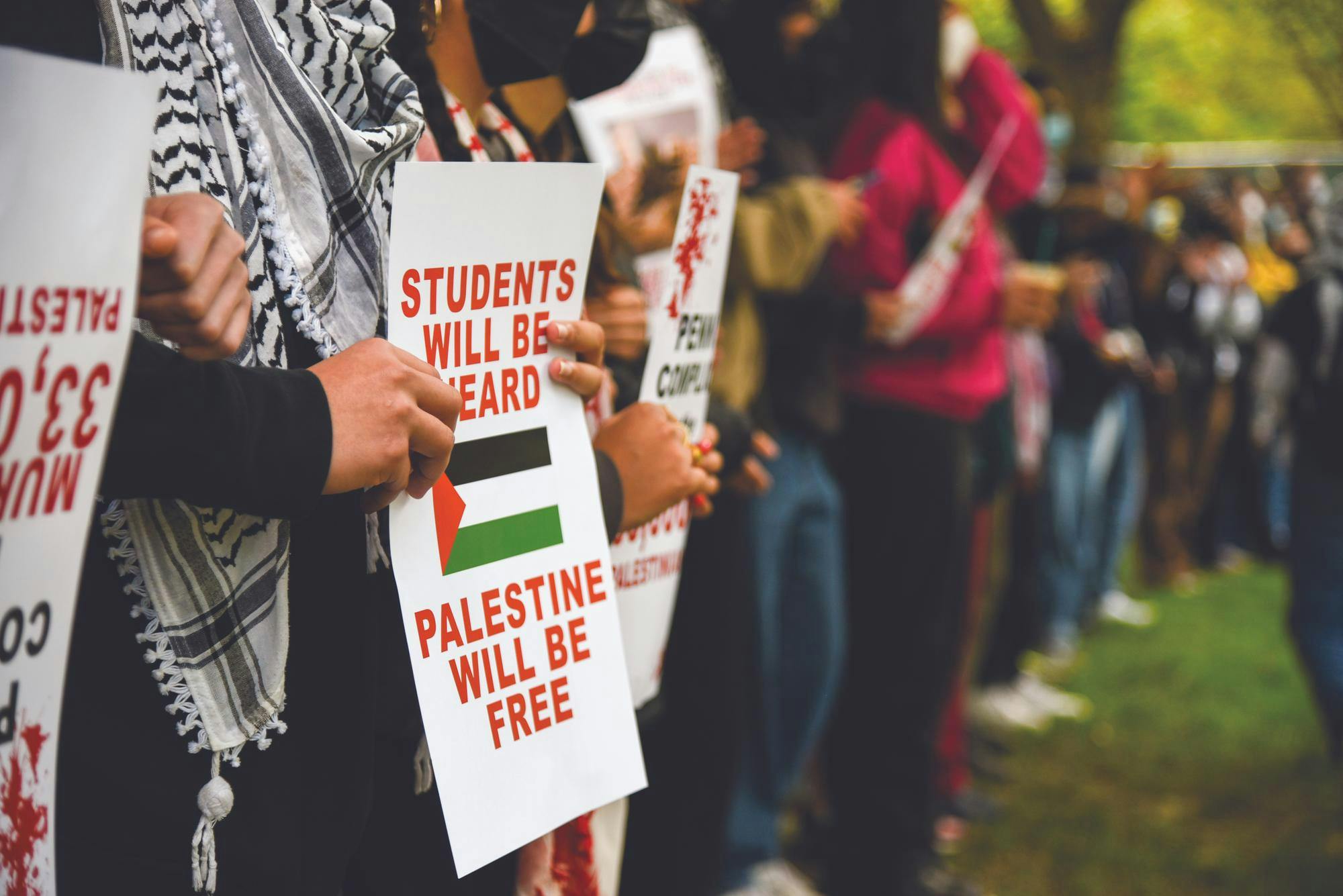
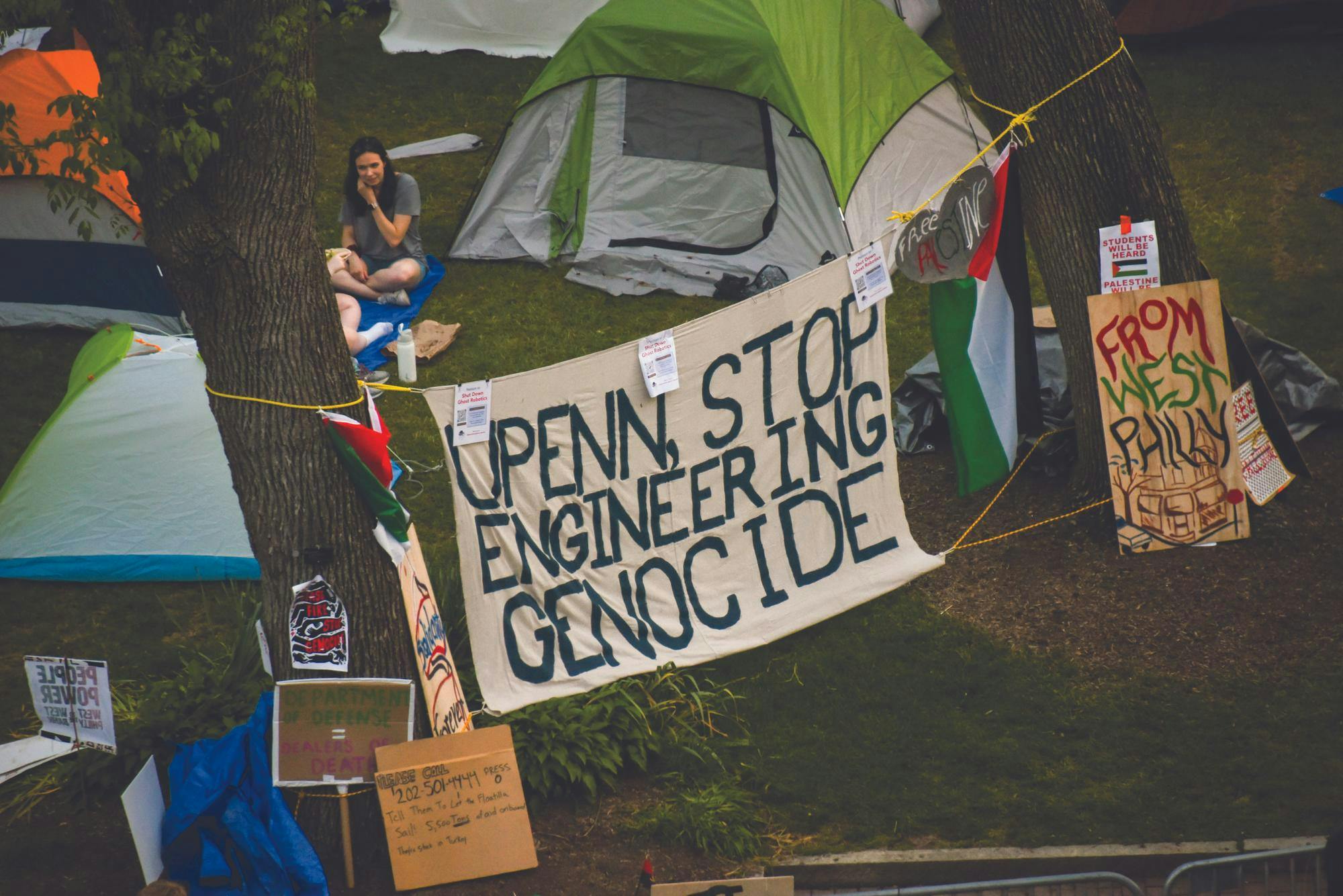
On April 25, 2024, everything changed. A crowd of students, faculty, and community members marched from City Hall and set up tents across College Green. The Gaza Solidarity Encampment, established and maintained by members of the Penn community, demanded transparency from the University and an end to the ongoing genocide in Gaza.
The encampment took over my life. Every morning I would wake up, grab my camera and whatever batteries I had managed to charge overnight, and walk toward College Green.
I got very good at figuring out where I would not be noticed. I also got very good at pretending I didn’t know or care about anyone. I knew plenty of people inside the encampment—people whose names I recognized, whom I’d spoken to in class, whom I’d eaten lunch with. But I worried that even looking too familiar with someone could be enough for a counterprotester to use it to discredit the DP’s coverage. I became minutely aware of every movement I made, every smile I flashed, and whether I was tapping my foot too much to the rhythmic chants.
So, I took a lot of pictures. There were often other photographers around—professionals with bigger cameras, journalists who had been doing this for longer than I had been alive, and people who seemed to know exactly whom to talk to and what to say. Sometimes, there were several students with me. Other times, I was the only one there.
The newsroom had to move quickly, but after the first three days, the photo team decided to slow down. Our first cohesive piece of coverage was a photo essay documenting the first 100 hours of the encampment. It was the exact opposite of breaking news. But we did our best to look for what could disappear into the chaos if nobody took a picture or wrote it down. People made art, lots and lots of art. There were lectures and poetry readings and sleeping bags and food, collections of signs taped to fences and hung up between hundred–year–old trees. There was a lot of talking and students walking in and out and going to class and peace and quiet that was interrupted every now and then by a particularly loud counterprotester or a man with a knife. Overall, however, it was quite calm.
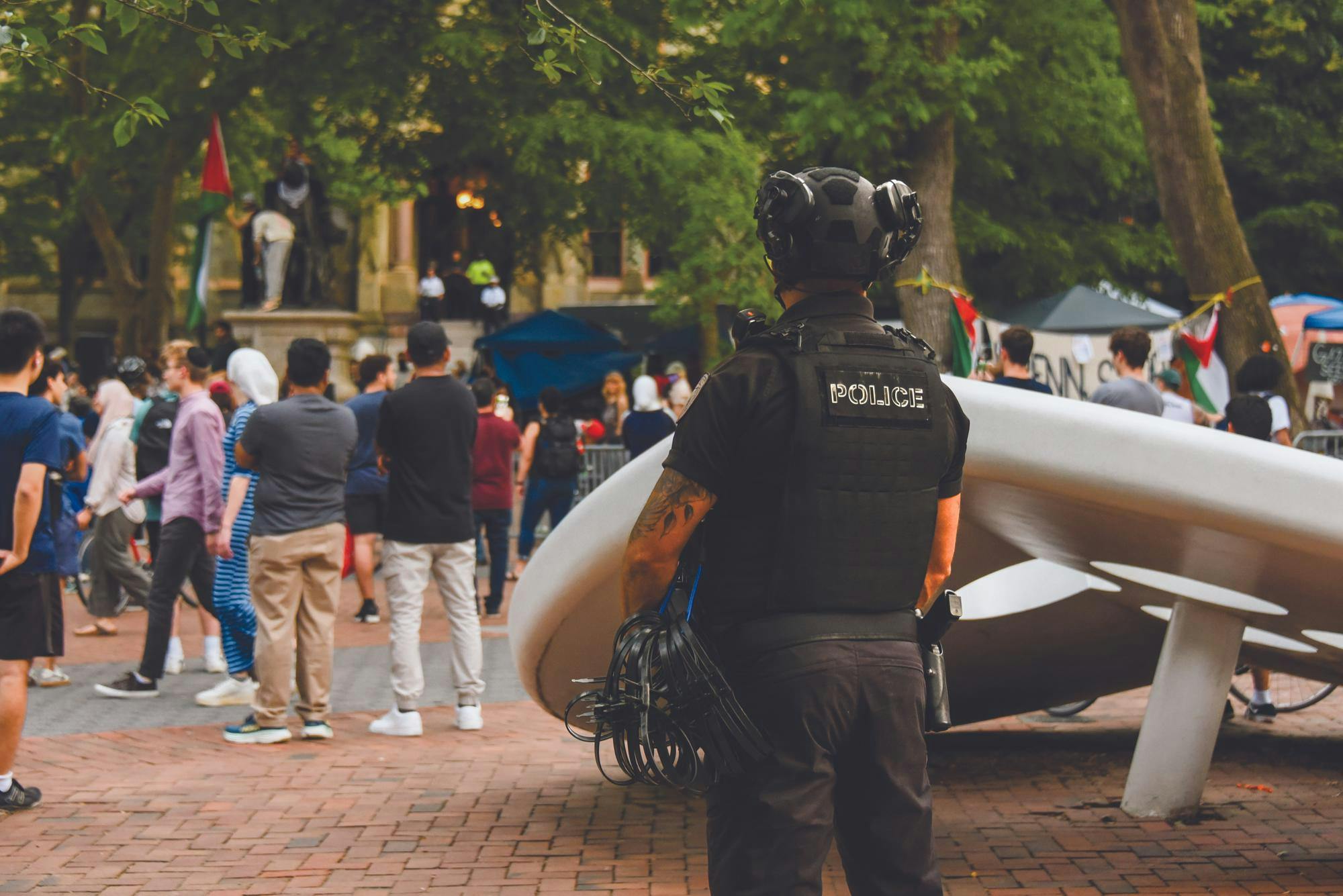
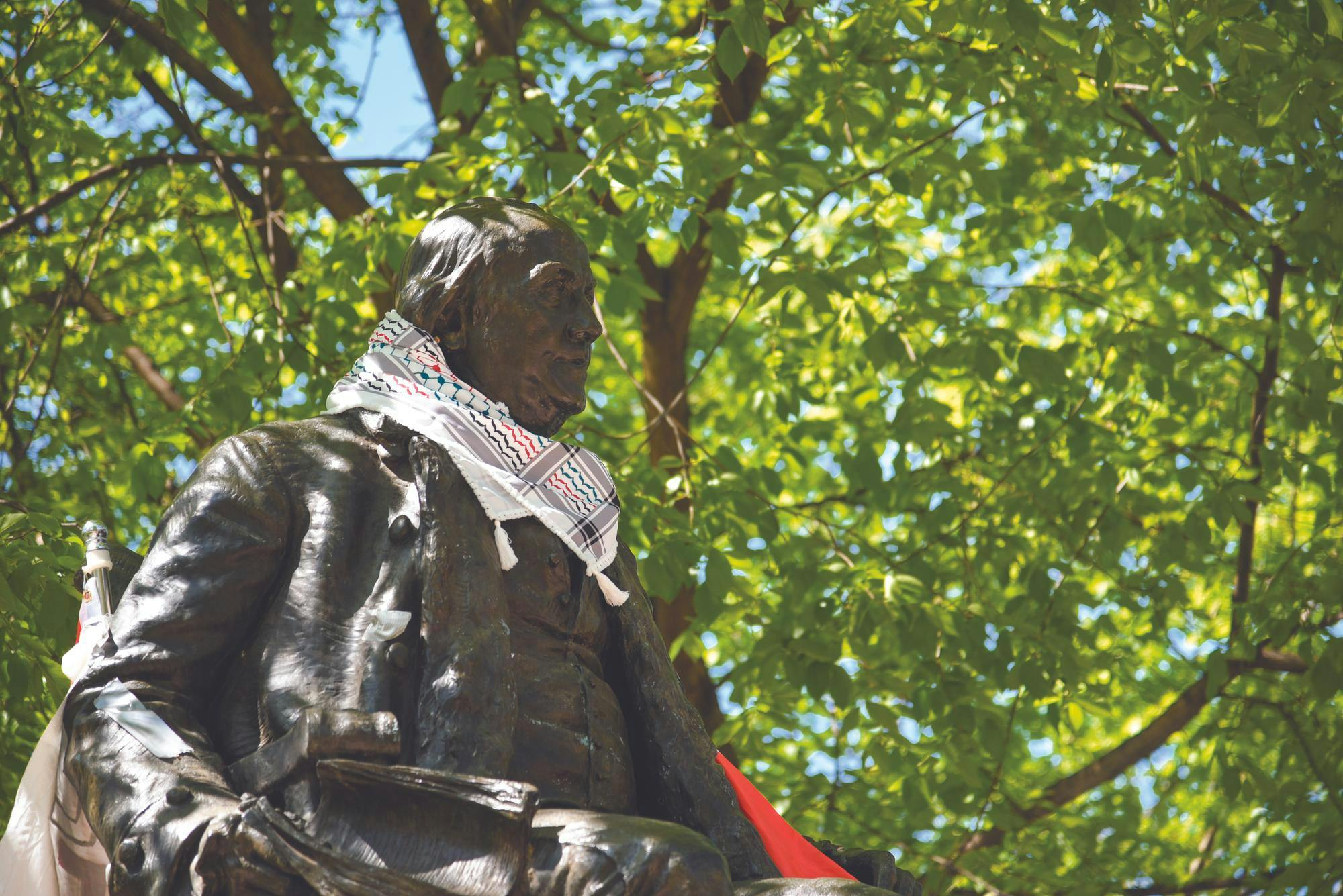
But that calm wouldn’t last. On May 10, at around 6 a.m., Penn and Philadelphia Police officers began dismantling the encampment. They overturned tents and pulled apart protesters who had linked arms and sat around the Ben Franklin statue. They handcuffed people and picked them up and put them into vans. It was raining and I was freezing. I couldn’t feel my fingers, and I thought it was a miracle that my shitty old camera was still working.
I remember trying to stick to our policies by not photographing people’s faces. I wondered how much that would matter if they got processed and charged and put in jail.
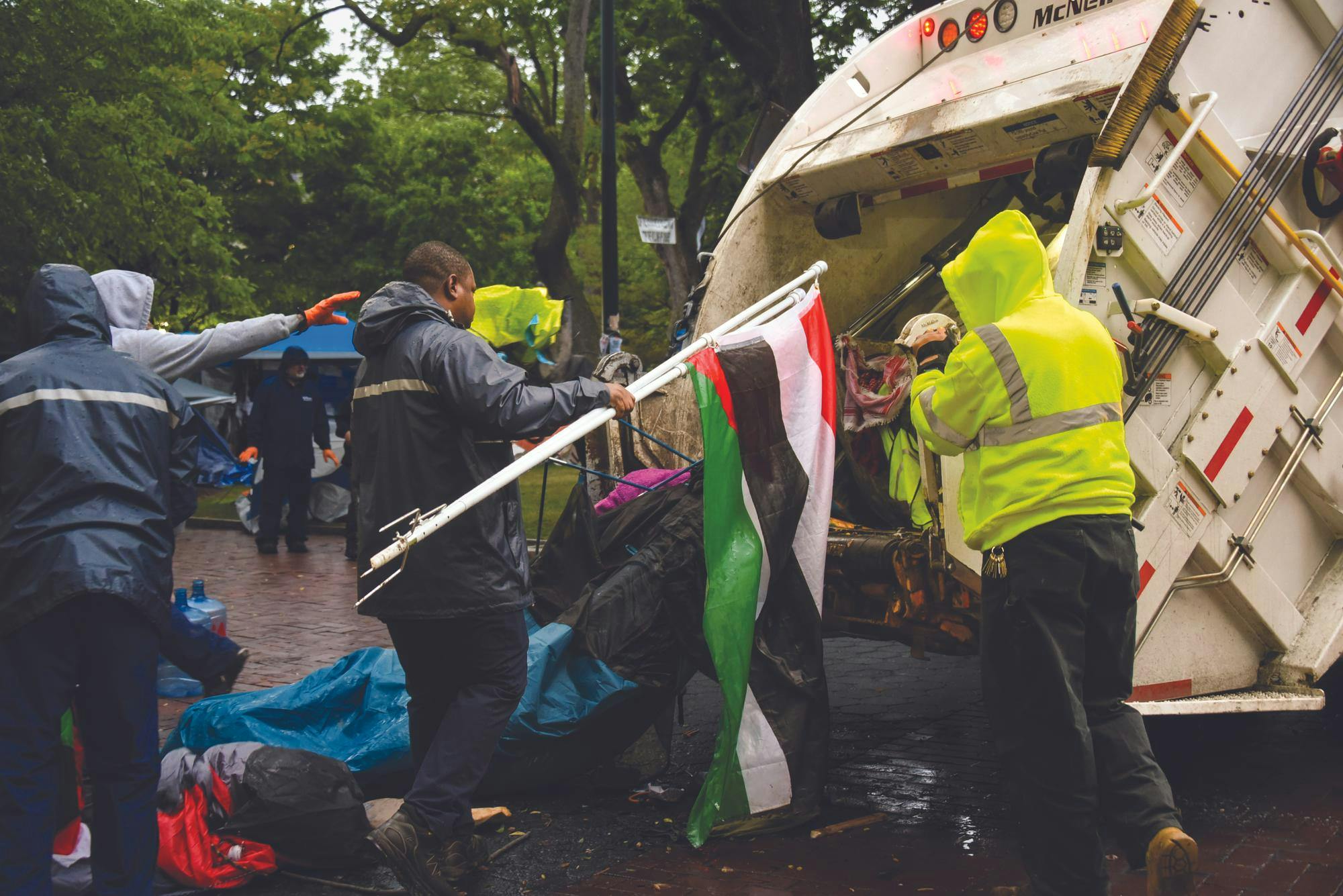
After the students were taken away, Penn employees and K–9 units began going through the remains of the encampment, which now looked like a ghost town. They took tents, signs, and personal belongings toward one of the three trash trucks brought onto Locust Walk. A staff member from Van Pelt came outside and asked whether we thought he could save any of the signs. “It’s a piece of history,” he said.
I watched as the trash trucks shredded the belongings of everyone who had been staying on College Green. I told him he could try.
After an action–packed start to my college career, I thought a lot harder about objectivity.
During the encampment and in the months afterward, the DP developed new guidelines for covering protests. I helped write some of the photography ones. They were quite easy to follow: Don’t try to doxx someone, don’t intentionally identify anyone who hasn’t identified themselves, don’t shove a camera in someone’s face.
One standard in particular became central very quickly—reporters could not participate publicly in activities that could be seen as taking a position on something they were covering. After all, objective journalism is less about what a reporter actually thinks and more about how they’re seen by their readers. A free press only works if the public believes that the people holding the cameras and writing the stories are doing their jobs honestly.
But it’s difficult to appear politically neutral when the work itself is so deeply connected to politics. We were documenting demonstrations about who had power at Penn, who was allowed to protest, whose speech was protected, whose speech was condemned, and what a university owed its students. Every investigation and report and article we wrote was, in its own way, a political act.
When the semester finally ended, I didn’t feel relieved. I had spent weeks sleeping badly, watching police lines and protest crowds and emergency Slack messages rearrange the rhythm of my life. I had caught a glimpse of what a normal Penn might have looked like during freshman year, before campus politics became something impossible to ignore. Then, I went home. For the first time in months, I woke up without checking my phone for breaking news. I didn’t wonder about who was on College Green. I didn’t have to charge three Nikon batteries before bed. I didn’t sit on a bench and pretend not to know the people I was photographing.
I also didn’t take a break. I spent most of my sophomore year even more committed to news photography. I started training other photographers on our new protest guidelines, went to demonstrations and marches and political rallies, and kept finding reasons to bring my camera with me. I can’t remember a single thing about my final exams during my first year. What I can remember is almost getting kettled in Center City and getting pulled away by my fellow reporter before the police closed around us. I barely remember the fun rehearsals I had when I started getting into theater. I do remember my heart pounding when a familiar–looking Penn Police officer pulled up to our walkshifting table and told us we were trespassing, despite having reserved the space with the Office of Student Affairs.
I love being in the newsroom and sitting around a table with dozens of people arguing about what needs to be done. I love the adrenaline rush of breaking news and the pressure to capture what’s unfolding through my viewfinder. I love the people I met, and it’s thrilling to watch them go on to write incredible features and report for national publications. But more and more, I couldn’t find the energy to walk out onto the street with a camera. Instead, I sat in the DP office, checking caption formats or the spacing between words on a page layout.
For a long time, I thought the problem was that I wasn’t made for journalism. But that doesn’t change the fact that a fundamental part of my Penn experience was protests, rallies, police lines, and the next assignment. It was pure chaos, but it was also really worth it. Maybe I was never a very good journalist, but it was good to be there.