
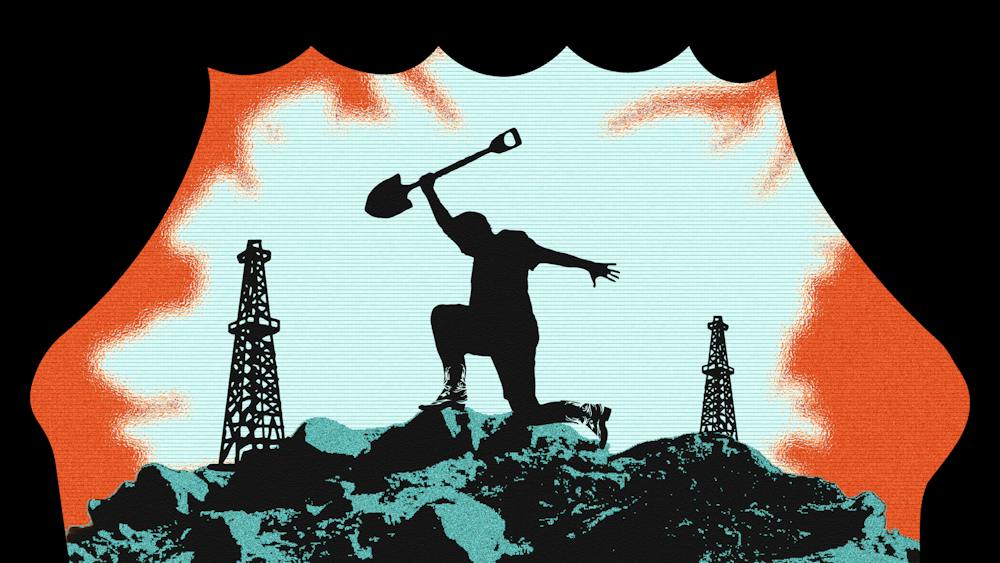
In its opening act, Alejandro G. Iñárritu’s new film seems to check all the boxes for another heavy–handed political satire. Methane! Climate change! Global warming! Al Gore! The conservative cronies in charge of the United States scramble over each other to name the keywords they want to censor from the internet, all while lounging in a decadent boardroom complete with murals of oil discoveries in the American frontier and sculptures of snakes eating their own tails. The impotent scientists can do nothing but fumble over meteorological projections as slimy politicians throw out zingers about COP30 climate summit and the Paris Agreement and a blink–and–you’ll–miss–it reference to the collapse of the Atlantic Meridional Overturning Circulation.
Of course, heavy–handed satire alone wouldn’t be enough to earn the absolute vitriol that critics have spat at Digger. It’s been called “strained” and “over the top,” yet “devoid of substance.” Its trailers and ad spots have cheerfully weaponized the bad reviews, going so far as to juxtapose negative American and positive international reviews as proof of its genius.
But when you finally watch the movie, you realize that all the insane trailers and engagement–driven marketing are a pretty good encapsulation of the film. Iñárritu has technically made a movie about a world being destroyed by climate change, but Digger is a film about climate change in the same way that Cabaret is a musical about fascism. The movie is much more interested in what we do with stories about catastrophe than the catastrophe itself. It wants to examine why we keep making art when the world is falling apart, whether art actually changes anything, whether making something beautiful in an ugly world is moral or immoral, and—most importantly—whether giving people catharsis can become a way of ensuring compliance.
If you haven’t seen the film yet—and you really should—there’s some major spoilers ahead. It’ll be best experienced if you go in blind, as there are twists aplenty.
At first, Digger plays like a relatively straightforward satire. Tom Cruise plays Digger Rockwell, a grotesquely wealthy oil magnate with a ten–gallon hat, a hideous dying cat, and no care for the rapidly deteriorating planet. A technician on Digger’s rig in Greenland calls to tell him that a methane leak has opened up a crack that threatens the stability of the enormous ice sheet. Before Digger can channel his full–blown corporate greed, company officials arrive to tell him even worse news: the rig has exploded, the ice sheet has collapsed, and now a massive iceberg is headed straight for Europe, where it’ll flood the entire continent. President Compson (John Goodman) and his catastrophically incompetent and overly religious Cabinet argue about public relations and shareholder value as Dr. Ganesh (Riz Ahmed), Rockwell Oil’s head of environmental safety, tries to make them realize that hundreds of thousands of people are about to die.
It’s exactly what you expect from a satire—cartoonish villains, absurd disasters, and obvious political incompetence. There’s even a level–headed yet melodramatic scientist for the audience to connect with—and Ahmed is definitely more sympathetic than Leonardo DiCaprio’s character in the celebrated satire Don’t Look Up. But just as everything starts to make sense, the world breaks in half. Of course! It’s all been a play. But it’s a play based on real events. There was a real Digger Rockwell—Europe really was flooded after a climate disaster—and to help the audience cope, the play transforms the story of civilizational collapse into a Broadway spectacle full of larger–than–life characters and witty quips.
The disaster setup puts Digger in dialogue with a long line of climate–change movies. Four years after Al Gore lost the presidential election to George W. Bush, The Day After Tomorrow condensed something impossibly complex—the interaction between greenhouse gas emissions, ocean circulation, feedback loops, and extreme weather—into giant waves, collapsing cities, and New York freezing over. Two decades later, Twisters does the same thing, glossing over the realities of climate change to showcase movie stars driving through increasingly destructive tornadoes in Oklahoma.
More than half a century ago, Susan Sontag argued that science–fiction disaster movies aren’t about science at all, but about disaster and the aesthetics of destruction. Sontag thought these fantasies helped audiences cope with collective anxieties, especially the atomic terror of her own era, by turning the unthinkable into something predictable and temporarily manageable. But there’s an uglier side to that coping mechanism—fantasy inures us to what should be unbearable.
Digger takes that spectacle to task. The play in the movie is an intentionally reductive satire of an actual in–universe catastrophe, one that started as a scrappy fringe show but is now a tacky, corporate–funded extravaganza with projections, dance, comedy, and drama. The evil men who knowingly let thousands die are turned into buffoons so that the masses can laugh at them. It’s everything you’d want from a propaganda piece and everything a show–hungry audience could ask for. But satire doesn’t just grant audiences catharsis. It also turns messy political realities into morality plays. The framing is comforting, but it’s a terrible way to process the moral responsibility distributed across systems, institutions, incentives, and people who can rarely be reduced to flat archetypes.
The film doesn’t fit neatly into either major tradition of satire: the Juvenalian, with its furious denunciation, or the Horatian, with its affectionate ridicule. Instead, it has a healthy disregard for the idea that satire is useful. Despite this skepticism, the film works because it remains sincere. Art can be propaganda and still be art. The film understands that the people making art can be compromised while still creating something emotionally resonant, and it understands that audiences can consume art to feel something real without ever acting on those feelings.
Kenny (Jesse Plemons), the play’s producer and the leader of a Palantir–like security firm, best embodies those contradictions. In his limited screen time, he flips the movie on its head with a monologue about why art matters. People respond to stories, he says, and when those stories turn powerful men into laughable caricatures, the audience gets the satisfaction of witnessing justice without any justice having to occur. And in a mean–spirited twist, he funds that catharsis with his own evil. If it’s entertaining enough, the system can thrive while financing its own condemnation.
But as foreshadowed by Plemons’ gaudy red wig, Kenny is also the real Digger’s nephew. After his long speech about art’s power, he ruffles the hair of the actor playing his younger self, taking a personal interest in how exactly art survives and what survives along with it. The Rockwells are a family obsessed with controlling their own endings–Digger won’t let his dying cat go, clings to the legend of his granddaddy’s shovel, and, even at the moment of his death, refuses to be killed on anyone else’s terms. Like the politicians brainstorming what words to censor online, the Rockwells are obsessed with controlling the narrative: if the world is going to remember them, it might as well be them telling the story.
Whatever remaining humanity Kenny has is brought to life through his relationship with art, but Digger raises the question of whether one’s humanity is premised on the experience of empathy or the hunger for control. While the emotions the performance produces are real, the machine that produced them is not. And as the final film under Warner Bros.’ independent producing power before its massive corporate merger with Paramount, Iñárritu’s film places its own origins under suspicion.
Most metafiction is a wink, with a character turning to the camera like Jim in The Office—the movie is a movie, the play is a play, and the audience feels so clever for figuring that out. Spoon–fed self–awareness becomes a way to flatter the audience watching. Digger uses all these same tricks, but instead of winking, it points a finger. It moves blame down the chain to implicate the people complicit in allowing the present system to persist. It first casts the oil barons as the villains, then the producers of the play, then those who bought tickets to laugh at it. Every frame moves the critique one step closer to us. ci
That’s why the form fits the subject so well. Climate change is the ultimate somebody–else’s–problem. It’s always happening in another country, to another generation, because of another guy in snakeskin boots. Disaster movies like The Day After Tomorrow keep it at an arm’s length by turning it into a spectacle. The floods are the same as in Digger, but in the former film, we have fun watching the great wave consume the world—in Iñárritu’s, we are denied that pleasure. We don’t ever see the initial flood in Europe. Instead, we are left with its aftermath, forced to live with its consequences. Where other films cast us as witnesses to cataclysm, Digger forces us to see ourselves as accomplices in Earth’s murder.
The film is by no means a hate letter to cinema—though it may be considered a hate letter to certain types of cinema. It hates the idea that filmmaking is enough, that art is inherently moral and valuable. Thus, every note of praise critics give to Digger is subverted by the message of the film itself, which questions what that praise actually means. Satires like Don’t Look Up may let us leave the theater feeling like we’ve taken a side just by watching, but Digger makes the act of watching the problem. Nobody pays twenty dollars to hear that. But a movie that sends you home comfortable only reinforces the docility that Digger takes as its object of critique.
So as the movie comes to an end, the play inside it does as well. In spite (or perhaps because) of its corporate grandeur, the audience is on its feet, applauding, laughing, crying. Children’s faces are wet from the drowning world that they’ve been born into. They’ve seen evil, they’ve laughed at it, and they’ve felt something real. Iñárritu has captured all the ways that art makes us human, both in sentiment and capitalist intent. Art might not save us, but as long as we survive, art will too.
Then, a “Level 4” warning interrupts the standing ovation. Gas masks are snapped onto faces and the audience files out of the theatre as fast as they filed in. As we get our first look outside the theater, we come to see what has become of this world: piles of cars, on top of which are the chrome corpses of robots (even they couldn’t save us), in front of apt graffiti reading “genOILcide” and “compliance = freedom.” The credits start to roll to the crooning tones of “Look What They’ve Done to My Song, Ma”—one last cry against the commercialization of art.
For most of its runtime, Digger gives its audience exactly what it gives the people inside the film: a world to disappear into, villains to hate and mock, and a catastrophe big enough to make us feel something. We feel that catharsis, too. But just when the credits have run long enough for people to start getting out of their seats, the same “Level 4” announcement plays again, louder. The music stops and is overtaken by a choir of insect chitters.
The ending reveals the only notable difference between the audience of the play and the audience of the movie: one has a world that’s already been destroyed, while the other is still destroying its own. Iñárritu says that we still have time to do something other than clap. We can resist compliance, comfort, and catharsis, so long as we finally choose to put down the shovels and stop digging our own graves.