On a humid, rainy day, I meet Alexis in the lounge of Gutmann College House. Now a senior, Alexis, who was granted anonymity for fear of retribution from the University, recalls their participation in the Gaza Solidarity Encampment—the flashpoint for the University’s latest crackdown on campus speech.
“As a student, it felt very existential,” they say. “When you’re sitting there debating whether or not your actions and the cause that you’re fighting for is going to cost you your enrollment in the school, whether it’s going to land you in prison … it forced me to really question what my values were, and that was caused by the response that the University had to a protest against a genocide.”
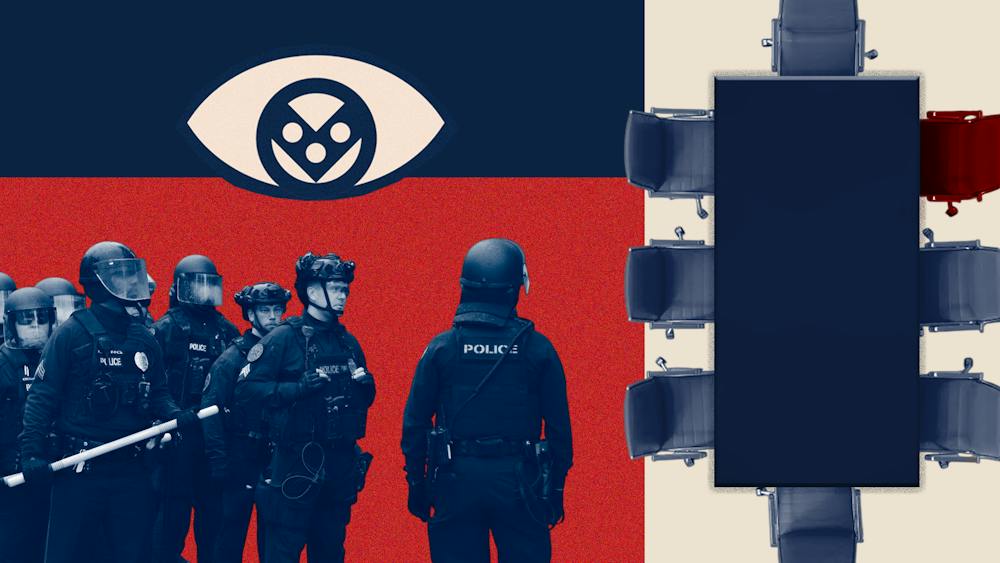
The force employed by the Philadelphia Police Department to sweep College Green and arrest protestors left Alexis and other activists involved traumatized to this day.
But the University’s campaign to suppress dissident speech wasn’t limited to crushing the encampment. On June 6, 2024, the University announced a new set of Temporary Standards and Procedures for Campus Events and Demonstrations, which contain a plethora of guidelines designed to limit the scope of acceptable on–campus speech.
Two–and–a–half years later, these guidelines remain in force. From faculty to students to those on the Committee on Open Expression, members of the Penn community lament the rapidly deteriorating state of free speech on Penn’s campus.
In 1968, in response to student protests against the Vietnam War, Penn’s administration formed the first iteration of the Committee on Open Expression. Composed of students and faculty, the COE had “ultimate power to interpret the proposed guidelines and to resolve all disputes arising under them.” The committee implemented the first Guidelines on Open Expression the following year at the behest of a student referendum. In a 1970 report, then–Penn President Gaylord Harnwell described the changes as a “shift in the power balance” away from “hierarchical and authoritarian patterns” and “toward shared responsibility for the institutional good.”
In June of 2023, however, the COE’s position was revised to render it an advisory body to the Vice Provost for University Life, giving the VPUL total authority over determining whether the guidelines were violated by a member of the University.
The erosion of the committee’s power didn’t stop there. The University proposed a new set of guidelines on March 31, 2026, without clear input from the committee. The University did not give the Penn community notice that they were being created in the first place.
The proposed guidelines define speech and expression as including “talking, writing, expressing views digitally or on signs, engaging in artistic expression, demonstrating, protesting, holding vigils, and other ways of making one’s views known peacefully.” The “Principles” are divided into the following four sections: Committee on Open Expression: Charge, Composition, and Procedures; Open Expression Observer Program; Open Expression Procedures and Referrals; and Inviting Speakers to Campus.
The Principles spell out the composition of and powers held by the Committee on Open Expression, most notably by emphasizing its purely advisory role. They also make clear that only the provost, after consulting the Faculty Senate tri–chairs, Council of Deans, and the University president, “may approve any amendments to—or repeal of—the Principles.” The COE is not listed as a necessary source of approval.
For on–campus non–academic events, the proposed guidelines require community members to register their events with University Life staff seven business days in advance. The amendment acknowledges that some events may require more immediate attention and note that “special requests for shorter notice will be considered on a case–by–case basis, and every effort will be made to support open expression without regard to viewpoint or content.” No event requiring a “security assessment” from the Division of Public Safety, however, will be permitted to an expedited timeline.
The most important amendments within the proposed guidelines are connected to University surveillance. The Principles extend to community members’ social media usage, which it says is “circumscribed by principles of respect, University policy, and local, state, or federal law.” Further, the guidelines establish a faculty–composed Open Expression Observer program, which would allow the University to send faculty “moderators” to any event they deem to be potentially disruptive.
Opposition to the proposed guidelines was immediate and widespread, leading to heated petitions against the new rules from both student and faculty leaders. Listening sessions were scheduled for April—neither of those sessions were attended by Penn administrators.
Jessa Lingel, president of Penn’s American Association of University Professors chapter, says that the proposed guidelines are intentionally open–ended, granting the administration wide–ranging controls over on–campus speech.
“The language is so vague that really any event could potentially fall under the auspices of open expression,” she says. “I literally mean anything, from the frisbee team decid[ing] to have an unscheduled picnic to a study group for organic chemistry.”
Lingel says this opacity is “by design,” utilizing “strategic ambiguity” to allow the University to “ban anything they want.”
The proposed creation of an admin–composed “Special Review Board,” which will require professors to clear all visiting speakers for admission onto campus, was another concern for AAUP members, who described the guidelines as infringing on faculty autonomy.
AAUP members emphasize that the proposed guidelines concentrate all power over campus speech in the Office of the Provost alone. Lingel argues that this combination of ambiguity and power concentration will allow the administration to “[crack] down on the ability of students to do what students have always done, which is express their political views.”
AAUP–Penn has placed themselves at the forefront of the fight over open expression. On Sept. 16, the group hosted an unregistered “Open Expression Meet–Up” in front of the LOVE statue, inviting student organizations, the graduate student union Graduate Employees Together — University of Pennsylvania, and interested faculty members to prepare a collective response to the release of the new guidelines.
“The University doesn’t run without us as a collective,” one individual argues. Another speaker argues that while the University seems willing to throw students or non–tenured faculty under the bus, they can hardly do the same to the whole Penn community.
Student organizers from a variety of clubs have expressed similar concerns about the proposed guidelines’ impact on campus speech.
For Simon Thomas (W ’28), president of the Asian Pacific Student Coalition, the biggest threat comes from the expanded powers of surveillance granted to the University by the new guidelines. For APSC, that means private member discussions on politics and identity may be conducted under the watchful eye of an Open Expression Observer.
“A lot of the conversations we have are very hard conversations,” Simon says. “Having a [moderator] present in that room immediately shuts that down.”
He recounts an event from last semester, when all representatives from the 7B met for a “Penn in Dialogue” event where they discussed University’s responses to immigration and other burning political questions. If that discussion was to be held with a “moderator” present, Simon says, “all of a sudden, no one wants to be in that room sharing those things.”
For the leaders of the Penn Association for Gender Equity and Penn Reproductive Justice, the proposed guidelines’ rules on online speech have also raised alarm bells.
The section’s vague references to limitations on free speech rights has left student leaders afraid of what they may actually be disciplined for. Ashley Kim (C ’27), chair of PAGE, has begun to shift the organization’s online presence in response. “[We’re] trying to be a little bit more careful [with] who we follow,” Ashley explains. For the moment, PAGE follows the Young Democratic Socialists of America due to the general political alignment between the two groups. Ashley worries, however, that continuing to do so could put her and PAGE’s board under further scrutiny from the administration.
PRJ co–Presidents Kimb Liu (C ’28) and Michelle Shi (C ’27) express similar fears about being policed, particularly in regard to their “strict pro–Palestinian stance” and their support of the pro–Palestinian United States House of Representatives candidate Chris Rabb.
“Everything kind of connects in a way, and some people might think that we’re overthinking things,” Kimb explains, “If we can make those connections ourselves, of course we’re gonna worry that somebody else is gonna make those connections and use that against us.”
What is most concerning for Kimb and Michelle is the lack of protections that the proposed guidelines provide for political expression. Last spring, Michelle explains, the group was putting together an oral history on the state of abortion access in other countries to compare against the United States. Increasing federal crackdowns over political speech by college students, however, led one international student to leave the committee for fear of government retaliation. Without an explicit statement of support for international students to express their beliefs openly, the pair is worried that international students will continue to avoid political organizing.
“There is definitely something going on with all the bureaucratic changes that Penn is making all of a sudden,” Ashley says. “I’m pretty sure part of it’s in reaction to what’s going on politically. I think Penn is trying to do too much, change too many structures all at once.”
“All of this has to be connected with Penn bureaucracy,” she contends.
While student and faculty protests against the proposed guidelines have been persistent and loud, they’ve largely been met with silence from the COE itself. Nearly all current and former members of the COE have declined to provide comment to Street, citing the organization’s strict confidentiality policies surrounding its discussions.
This confidentiality plays a role in the larger lack of a democratic process surrounding the Guidelines on Open Expression. Committee members are not elected by the groups they are said to represent, nor do they report back to those groups on the internal process of the COE deliberations. The wall of silence that surrounds the COE, while perhaps meant to insulate the group from outside political pressures, renders the body exempt from public oversight.
Under the proposed guidelines, Vice Provost of University Life Karu Kozuma holds ultimate authority over the rules’ implementation.
“The VPUL works collaboratively with students, faculty, staff, and campus partners to facilitate dialogue, address concerns, communicate expectations, and support the fair and consistent application of the Guidelines,” Kozuma wrote in a statement to Street.
Sources inside the committee, however, allege that faculty and students are less partners and more subordinates when it comes to the COE’s internal deliberations. Since the encampments, they allege, the administration has largely steamrolled over dissent within the committee, shaping the guidelines as they see fit.
In fall 2024, the Office of the Provost established a faculty–led task force tasked with reviewing the guidelines. The task force made recommendations for the “structure, standards, and processes” of the guidelines and reviewed the parties enforcing it.
However, sources within the 2025–26 committee claim that the recommendations made by the task force carried no real weight. This functional inefficacy mirrors that of the COE’s, underscoring the administration’s unwillingness to take the advice of the Penn community.
Sources within the 2025–26 committee claim that the temporary guidelines were the University’s way of telling pro–Palestinian members of the Penn community to—essentially—put a sock in it. They claim that despite the hope for a better set of guidelines, the proposed guidelines in the spring only reinforced that sentiment.
The 2025–26 COE did not meet until after the current draft proposal was released. From then on, they consistently held meetings for the rest of the year. Sources within the 2025–26 committee note that the sentiment within spring 2026 meetings were far from positive—one faculty member even left the committee in the spring due to dissatisfaction.
Ben Woods (C ’27)—the former director of the Undergraduate Assembly’s Academic Initiatives Committee—sat on the 2025–26 COE and says that the role a the committee is “completely advisory.” Woods says that meetings are home to disagreement and debate over policies, “but that doesn’t really have much connection at all to how they will be.”
In the fall, the Undergraduate Assembly was told they could appoint one member to the COE, so they put Ben’s name forward. They didn’t hear back until late in the spring semester. Ben says that both he and the representative before him were left in the dark for the majority of the school year.
The proposed guidelines had already been released by the time Ben joined, and conversations calling for a revision were already happening. He explains that he didn’t feel that there was “a strong direction to the meetings, because there’s not anything that the COE could really do outside of advisory input.”
There’s a lot that Ben doesn’t know about the situation. During his semester in the dark, he assumed the COE was meeting regardless of his presence; in reality, they weren’t meeting at all. When asked what he thinks the overall administrative goal is, he replies that he doesn’t think he could “hazard a guess.” He is unsure as to why admin wasn’t present at the listening sessions.
But one part of the proposed guidelines, Ben says, is particularly disturbing—the creation of the position of the Executive Director of Open Expression. The EDOE, who is appointed by the provost, is “the one that actually has authority on deciding whether something is a violation of the university’s rules on open expression,” Ben says. “They’re kind of the end of the appeals process.”
According to the proposed guidelines, the EDOE serves as a “non–voting ex officio member of the committee.” Whoever holds this position ultimately makes decisions on who gets referrals to the Office of the Provost and who doesn’t through their personally appointed group of OEOs—members of the Open Expression Observer program that the EDOE manages. Although community members can challenge the validity of an OEO’s decision by requesting an advisory opinion from the COE, the final outcome is at the discretion of the COE chair and the EDOE. When push comes to shove, it is the EDOE who has the final say: The guidelines make clear that “the COE’s advisory opinion shall not unreasonably delay any disciplinary process.”
Lingel refers to the EDOE as a “czar of open expression,” and finds the position to be the “most nefarious” part of the guidelines. “Who is that person and how are they appointed? How much transparency will there be about their role?” she asks.
In past years, the COE held a larger undergraduate membership than the two currently available positions. While Ben was unaware of the reduction in undergraduate membership, he concludes that student representation is of little importance.
“Doesn’t really matter if you have more sway in a committee that has no sway,” Ben says.
Regardless of the hypothetical content of future guidelines, the administration’s reign of terror over faculty and student expression has not stopped since the PPD swept College Green.
The most outrageous instance occurred on Oct. 18, 2024, when the University executed a search warrant at the home of pro–Palestinian student organizers. According to Penn Against the Occupation, students living in the home were held at gunpoint by Penn Police and PPD officers in riot gear who refused to show the students the warrant they claimed to be serving.
Bassil Kublaoui, professor of Clinical Pediatrics in the Perelman School of Medicine, was on the front lines of Penn’s fight for Palestine. A key member of Penn Faculty and Staff for Justice in Palestine, he helped organize the “die–in” protest in late January 2024, in which he and a group of other faculty members laid as though they were dead in front of College Hall. Since the 2023–24 school year, Kublaoui recounts the University’s endless hunt of pro–Palestinian faculty.
In the fall of 2023, Kublaoui and his wife, then a Ph.D. student, met with the Office of the Provost to express their support for Palestine and fear of being persecuted in some way for it. “They listened to us, he listened to us, but there was no follow up. There was no follow through,” he says. The ongoing repression, Kablaoui argues, has been “very specific to Palestine.”
Today, Kublaoui feels like “the University is no longer functioning like an institution of higher learning … they’re functioning like a corporation that responds to pressure from people with money, on its Board of Trustees and otherwise.”
He cites a recent moment at the Children’s Hospital of Philadelphia—whose pediatric department is a part of the University—where a pediatrician, in Kublaoui’s words, said that Israel has the right to respond how they see fit, even if their response results in the deaths of innocent Gazan children. He says that the professor got “a slap on the wrist,” whereas pro–Palestinian faculty were coerced into resigning simply for their pro–Palestinian social media posts (CHOP did not respond to requests for comment).
“I want to have the freedom and the comfort within the University to be able to say free Palestine without fear for my job or fear from persecution of any kind,” he says.
For Harun Küçük, professor of History and Sociology of Science, the 2023–24 school year fundamentally broke the social fabric of campus. “It was a very challenging time,” he says. “I think we’re still in very challenging times.”
He emphasizes the absolute importance of free speech to the strength of the United States—today, however, he believes “people have completely given up” on that core value. Penn’s campus, he argues, functions as a microcosm of that broader conflict.
Küçük believes that many people find comfort in attributing the University’s repression of on–campus speech to pressure from the Trump administration. However, “a lot of this is a hangover from the Biden era,” he says, citing the reforms proposed by pro–Israel University Trustee and billionaire Mark Rowan before Trump. Those proposals “have been enormously influential in setting the current administration’s education policy,” he claims.
“I think Trump is not as important. I think the problems are internal to the Penn community, and they precede Trump,” Küçük contends. “I think we’re in a long–term process of change for Penn.”
Thinking back to the hours before the encampment, Küçük remembers the final listening session between current Penn President Larry Jameson and the Penn community. One student approached him, telling Jameson, “you have been listening, [and] you have done nothing.” The “faux listening” approach admin adopted in the face of campus dissent is what Küçük claims segued to the encampment.
As AAUP continues to organize its coalition of voices for open expression, Jessa Lingel challenges the Penn community to “take a minute to think about what this university would look like” without open expression. She explains that the Weingarten Center, ADA regulations, the LGBT Center, the Penn Women’s Center, and many other key University institutions came out of student protest. An attack on open expression, she argues, poses an existential threat not only to freedom of speech, but to the University itself.
Outside of the proposed timeline of the release and implementation of the revised guidelines, the future remains uncertain. To many in the Penn community, however, it seems abundantly clear that things will become much worse before substantive change occurs.
To Küçük, the repressive speech climate of Penn today is unlikely to be improved by a new federal administration alone. He contends that at any given time, the University’s structures shape life at Penn independently of federal influence. Be it due to the administration’s internal politics or the student body’s, Penn showed itself to be capable of—and willing to—police its community before Trump’s reentry to the Oval Office. There is no indication it will stop doing so once he leaves.
The University’s progressive centralization of power continues to sideline student and faculty voices. For many, the most important question is not what specific clauses the next draft contains, but how much power it gives faculty and students to control the fate of the University. Drawing upon their experiences since the encampment, Alexis remains “hesitant to believe that any win on open expression in itself means anything fundamental.”
“When push comes to shove, whatever guidelines are written,” they say, “the University will use whatever tool it has in its disposal to repress that.”