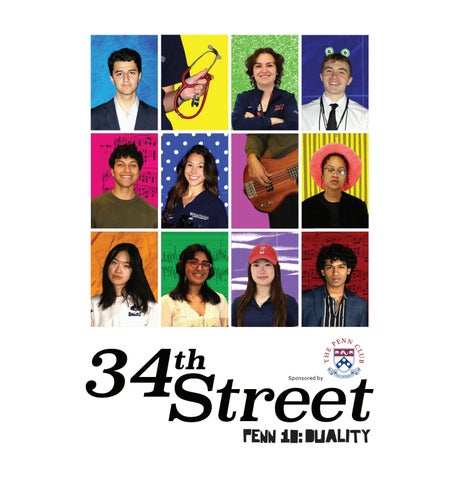

Matteo Busterna (C ’25), a former Daily Pennsylvanian staffer, was supposed to be back in Washington by now: White House badge clipped to a sensible blazer, Capitol Hill access pass in hand, and perhaps googling which coffee shops nearby serve cold brew strong enough to outpace existential dread. Instead, he’s here. Waiting.
“I thought it’d be a straight shot,” he says, “from Penn to policy to maybe burning out by 27.” But then Donald Trump surged in the polls, federal hiring stalled, and suddenly, Matteo’s entire plan detoured into Penn–tentative limbo.
Matteo’s introduction to politics wasn’t in a college classroom or a Capitol Hill internship. It was across a school district line. Growing up in Downingtown, Pa., Matteo attended a public magnet school that was well funded and reliable. Just next door, however, was the Coatesville Area School District—under–resourced and heavily affected by charter school expansion and school vouchers. “That contrast was striking. Seeing the difference in resources, in tech, in investment—it really opened my eyes,” he says.
Early in high school, he started getting involved in politics, founding a local chapter of the High School Democrats of America and working on community engagement efforts. By the time Matteo got to Penn, he had already found a rhythm—and a sense of urgency.
When he got to Penn, he continued surging onwards. “I joined Penn [Democrats] my freshman fall, and I was immediately surrounded by people who just cared so much,” he says. “That connection—that shared sense of wanting to help others—it really grounded me.”
There’s something almost old–fashioned about Matteo’s politics. Not in ideology, but in belief. He still thinks the system can work, even if it's broken. He still believes in compromise, in dialogue, in the power of doing your research before you open your mouth. He still wants a job in the institutions that have let him down—not because he’s naive, but because he’s invested.
When Matteo talks about his time in D.C., it’s with equal parts reverence and realism. He describes the Capitol as “the belly of the beast,” a place that surprised him by how much he loved it. “You have so much access to politicians. You see it up close—it’s surreal. Like something out of Veep or House of Cards. But it’s real.”
His most surreal moment? Giving a Capitol tour and seeing the awe in other people’s eyes. “That feeling I had when I first visited the Capitol—seeing that reflected in someone else, even after everything that’s happened … it reminded me why I care.”
Matteo has done all the Washington things: he interned at the House of Representatives, worked with the Victory Institute, delivered hearing summaries on AI legislation for Invariant, which is a bipartisan lobbying firm where he forged unlikely friendships across the aisle. “We all did the grunt work together,” he says. “It’s hard not to bond when you’re all overheating in suits and getting publicly flamed on Twitter for someone else’s press release.”
Over the election, he was not only caught off guard by the outcome, but also what ensued. “I was surprised by the first 100 days. How quickly things were dismantled, how deep the politicization went,” he says.
So, Matteo is adjusting. Slowly.
Now that the federal path is uncertain, Matteo’s looking at other ways to make an impact. “There’s a lot of work to be done, especially legally evaluating what this administration is doing. And there’s a lot of value in fighting disinformation, in defending truth. So that’s where I’m focusing now,” he says. Maybe it will be legal work. Maybe journalism. Maybe individual congressional offices. But Matteo’s learned to consider all the options, for now.
“The biggest thing is being flexible. Taking opportunities I didn’t expect. Adjusting.” That flexibility isn’t about giving up—it’s about finding new routes to the same goals. “Even if I can’t work in the federal agencies I wanted to, maybe I can still push for the issues I care about from the outside. Education policy, environmental protection, global stability—that work doesn’t stop just because the door’s closed.”
But, he admits, it’s not exactly easy, though it is necessary. “Truth, facts, entire narratives—there’s so much misinformation. But that just makes it more important to stay grounded, to keep showing up.”
Even his time at a bipartisan firm, where Democrats and Republicans shared desk space, didn’t shake his convictions. “Honestly, it was more cordial than I expected,” he says. “We didn’t always agree, but we could still connect on a human level. We were all doing grunt work together, and that created solidarity.”
At Penn, Matteo’s experience in student politics mirrored his national experience—equal parts empowering and unpredictable. His time in Penn Dems, especially as president, felt like a home base. “It was like a family,” he says. “Especially that year, when I had a seat at the table—I still hang out with people from that exec board. We’re all figuring it out together.” But like national politics, campus organizing also comes in waves. “With each new president, the [organization] shifts,” he says. “One year it’s about Republicans and bipartisanship, another year it’s internal school issues or community outreach. It’s always evolving.”
But despite finding community, Matteo never felt entirely at home in the Penn career pipeline. “It’s hard,” he says. “Everyone around you is going into finance or consulting. You do start to feel like the last man standing.” He’s considered consulting—“in the policy space, not finance”—but he doesn’t pretend it’s his first love. “I don’t think Penn has the same connections for people who want to do this kind of work,” he adds. “Especially when everyone’s in New York, and you’re looking at D.C.”
When asked if it’s ever felt lonely, he pauses. “Not lonely exactly. Just … different. But I’ve found my people.”
However, when asked what kind of role he sees himself in one day, Matteo doesn’t hesitate. “I’ve always preferred the behind–the–scenes work,” he says. “Maybe legislative director for a member of Congress. I’d love to work in the Justice Department or on education policy—just not in the hot seat.” He names Barack Obama and Maxwell Frost as inspirations. “Obama for his civility and humility. And Maxwell Frost—he’s young, he’s doing the work, and he hasn’t lost his optimism. I see myself in that.”
In a year where so much has slashed through the pillars of job stability, leaving many careers unstable, Matteo is still standing—maybe not where he expected, but still here. “I’ve learned so much,” he says. “Not just academically, but how to be a person. And I feel ready.”