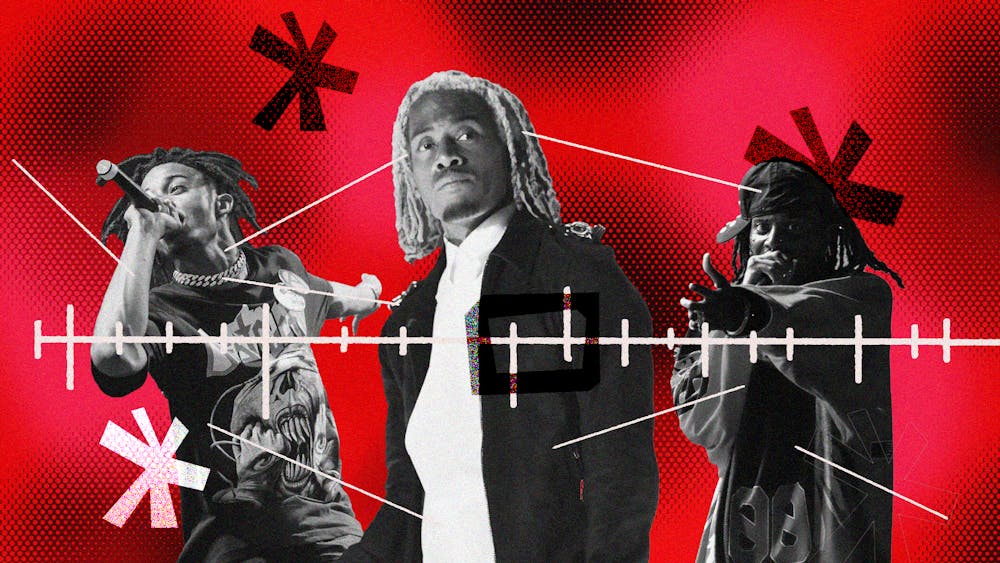
To the joy of insufferable teenagers and 20-somethings everywhere (myself included), Playboi Carti released his much–awaited MUSIC (followed by the rather aptly–named MUSIC—SORRY 4 DA WAIT) this March. After five long years of leaked songs and a stream of cryptic fit pics on Instagram, Carti reinforced his title as one of the more unorthodox and elusive figures in the rap scene. A part of that elusive identity is his ever–morphing visual persona—one that deserves as much critical attention as the music itself. NPR calls him an “anti–star”; Pitchfork coins him as a man of “eras, like you would Taylor Swift.” Reviewer Alphonse Pierre amusedly writes Carti from his time as the irreverent, high–energy face of SoundCloud rap at the beginning of his career through his transition into full–fledged Opium extravagance today. Carti isn’t just a chameleon; he’s a contradiction. A punk in luxury threads. A recluse who feeds a cult fanbase. An artist who skips the verse but nails the silhouette. So no, this isn’t a MUSIC review (there are plenty of those)—it’s a review of Playboi Carti’s many eras.
SoundCloud and Supreme
Carti first rises into popularity through the prime of the SoundCloud rap scene, and his visuals from this time seem to embody the kind of irreverent, cocksure energy that characterized it circa 2014. Like his songs from period, his choice of pieces is selective and a touch showy; he transitions away from the bright colors and tie–dyes of his high–school days—heavily inspired by the likes of Odd Future, including early Tyler, The Creator—and instead turns to conspicuous Supreme and archival streetwear. It feels transitory but functional, confident but without the kind of maximalist flair that would come to dominate his visual persona down the line. (7/10)
Self–titled, Die Lit, and Virgil
Just two years after releasing “Broke Boi” on SoundCloud, Carti clinches a deal with AWGE to release his self–titled album, Playboi Carti, launching him into the spheres of mainstream rap. His style has the feel of a continuation of what he began to piece together in his days as the face of Atlanta’s underground rap scene, only now with the kind of designer extravagance that comes with being signed with Interscope Records. Admittedly, it’s a style that depends heavily on the ascribed opulence of high fashion, but the pieces are certainly interesting enough on their own. He walks in Virgil Abloh’s 2018 debut show for Louis Vuitton. He wears vintage Gucci and Issey Miyake in his video for “Magnolia.” He even dictates a song with A$AP Mob to Raf Simons. It was a telling moment—Virgil, the bridge between high fashion and streetwear, and Carti, the poster child of internet–era rap cool, crystallizing the new definition of fashion legitimacy. The pieces speak to the kind of self–assured, celebratory energy of his early days as a big–label artist. (8/10)
Whole Lotta Red and Opium
Like the years leading up to MUSIC, Carti vanishes into a self–imposed musical exile after his release of Die Lit in 2018. Then, in 2020, he abruptly releases Whole Lotta Red—a dark, experimental monster of a rage rap album. His sound changes, and so does his visual persona. It’s vampy, maximalist, and gothic: It’s also the beginning of the Opium era named after Carti’s own record label established a year prior, which embodies this newfound visual persona. His style takes what was already a cultish corner of the rap scene in a much more literal direction: It draws heavily from avant–garde high fashion and punk influences in the ’70s and ’80s, matched with the irreverent energy of Atlanta rage rap. While the color palette is limited and monochromatic, the silhouettes oscillate between ballooning cuts of cargo and form–fitted leather. Rick Owens becomes synonymous with his fan base. Layers everywhere. Waxed denim. It’s theatrical and loud, and it also becomes a running joke for everybody else as a way to poke fun at his slightly pretentious and very much cult–like following. Personally, I think it’s fascinating; Black artists have a history of influence in the punk scene, and what’s there to say that this isn’t a modern–day reinvention? (8/10)
MUSIC
Then, finally, came MUSIC. For a man of visual “eras,” surprisingly enough, MUSIC can’t really be shaved down to a clear stage of reinvention. Pitchfork called his album an "overwhelmingly self–indulgent 30–track flood of everything,” yet his style is less so. During his five years of semi–hiatus after releasing Whole Lotta Red, Carti seemed to spend most of his time online posting fit pics and ignoring his fans’ desperate comments for new music under them. He remains more or less faithful to the fundamentals of the Opium aesthetic—dark colors, statement jewellery—like in his video for “2024,” but his outfits are certainly a little less extravagant than before, leaning less into punk influences and more into the kind of high–fashion streetwear of his earlier days. It’s well executed, but for a five–year hiatus from an artist notorious for reinvention, it doesn’t smack of anything new. (6/10)
Playboi Carti did not careen into the music industry as the shining anti–star of mainstream rap; rather, he slowly fashioned himself into that role, with a visual identity as constantly shifting and surprising as that of his sound. In that sense, he is very much an artist of eras; however, he is also an artist of slippery contradictions. He is, to borrow the words of NPR's Sheldon Pearce, “the rare rapper who seemed to want to skip the hassle of rapping itself” to embody the lifestyle that came with it. He vanishes into years–long silences, only to re–emerge and pour gasoline on the cultish worship that simmered in his absence. He at once draws heavy inspiration from the aesthetics of punk, a subculture often associated with anti–consumerism, and matches it with high–fashion extravagance. Ultimately, it is these contradictions that are at the heart of his ever–shifting style.