Freida McFadden’s The Housemaid is not a particularly intellectual read. It’s shocking, full of plot twists which keep the reader turning pages. I read this book in two sittings on a long car trip and can affirm that I was never bored. The characters at first appear a bit stereotypical: the broke city girl, the uptight housewife, the sheltered kid, the sad husband. But the novel soon reveals that these initial impressions are misleading, reframing the characters in far more unsettling ways. As in any beach–read thriller, the story is more plot–driven than character–driven, but part of the plot comes from the realization of their true personalities. In that way, the suspense comes as much from character as from action.
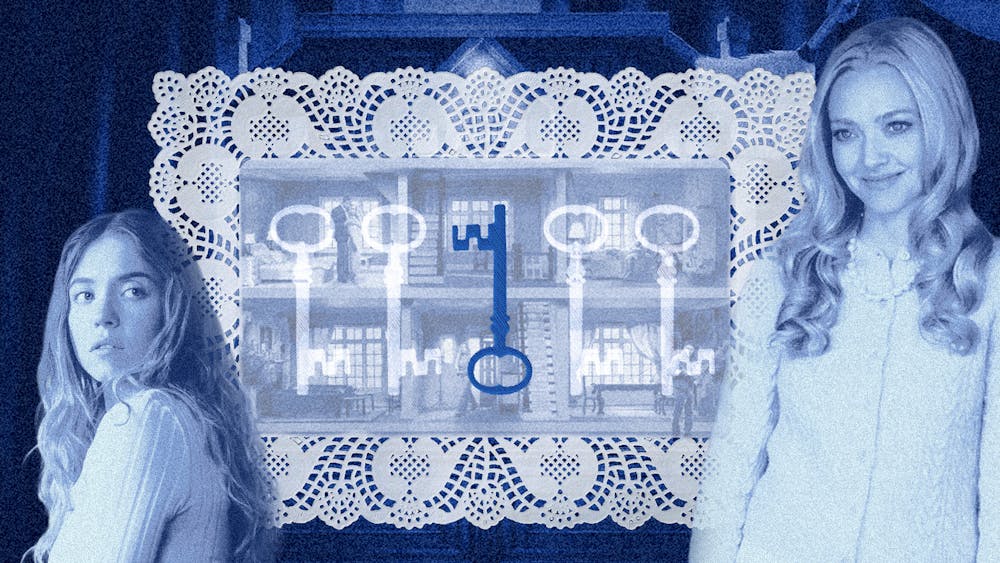
The movie adaptation takes a very different approach. With Sydney Sweeney and Amanda Seyfried leading the cast—plus a lineup of conventionally attractive men—it looks at first glance to be a by–the–books romantic drama. Fear not: It isn’t. Where the book builds tension slowly, the movie rushes through romance and jumps straight into chaos. It throws together thriller, erotic drama, and horror with little pause. Everything is heightened: more sex, more violence, more shock. Blood replaces suggestion, and subtlety is traded for spectacle. Still, it’s hard to deny that the movie is entertaining. It knows exactly what kind of crowd–pleasing thriller it wants to be.
Amanda Seyfried is one of the film’s highlights, even though her casting differs greatly from the book. In the novel, her character is described as overweight and neglected, which contrasts sharply with Seyfried’s polished, rich–girl appearance. Even when the film tries to make her look unstable or disheveled, she still appears carefully styled. That said, her performance works. She fully commits to the character’s unraveling, and her portrayal of psychosis feels convincingly unsettling.
Sydney Sweeney’s role is more complicated. The film is clearly aware of her physical appeal and leans into it heavily. In the book, the housemaid is a struggling, working–class outsider. In the movie, that rough edge disappears. Sexual tension is turned up to an extreme, far beyond what appears in the novel, where intimacy is slow and cautious. Characters make reckless choices that feel designed more to shock the audience than to make sense. The result is flashy but thinner, with no real character development.
The male characters are mostly forgettable. The husband (Brandon Sklenar) starts off mysterious and charming but becomes genuinely frightening by the end, and the transformation is disturbingly effective. However, Enzo (Michele Morrone) exists almost entirely as eye candy. He serves minimal story purpose and makes choices that don’t hold up under any scrutiny. These gaps create logical inconsistencies, but the film moves so quickly that it rarely stops to address them.
Stylistically, the movie is sleek and controlled. From Paul Feig, director of A Simple Favor, it shares a clean visual style, sharp cinematography, and an eerie soundtrack that mixes instrumentals with gospel elements. The film looks polished and expensive, even when the story itself becomes messy.
So why did The Housemaid do so well? The movie has grossed over $300 million worldwide on a $35 million budget, especially impressive when compared to the failure of other recent Sydney Sweeney projects. One factor is timing: Audiences have recently embraced stylish thrillers again—Drop, Influencers—mixing sleek visuals, wealthy settings, and psychological tension while remaining accessible and entertaining. The Housemaid fits neatly into that trend, offering beautiful people, shocking twists, and a glossy sense of menace designed for mass appeal.
Public perception may also have played a role. Around the same time, Sweeney faced backlash over an American Eagle ad that played on the words “jeans” and “genes,” which many people interpreted as promoting racialized beauty ideals. Her political affiliation and public praise from Donald Trump also stirred controversy—especially since Christy, another 2025 release, dealt with sensitive topics like domestic abuse and queer identity. That film flopped badly at the box office, grossing just $1.3 million domestically on its opening weekend and suffering one of the steepest second–weekend drops of the year, effectively disappearing from theaters almost immediately.
In Christy, Sweeney dramatically changed her appearance, gaining weight and stripping away glamour to play a rough boxer. In The Housemaid, her beauty is emphasized instead. It’s hard not to wonder whether that difference mattered. This contrast reflects her roles in Euphoria and Anyone But You, where her appearance is emphasized arguably more than her performance. How much of her success comes from her acting ability, and how much from how she looks on screen?
With four books in McFadden’s series, it’s no surprise that the film has already been renewed for a sequel set for production this year. Whether the next installment leans further into spectacle or returns to the book’s slower psychological tension remains to be seen. Either way, audiences can expect more twists, more blood, and another glossy thriller built to shock and entertain.