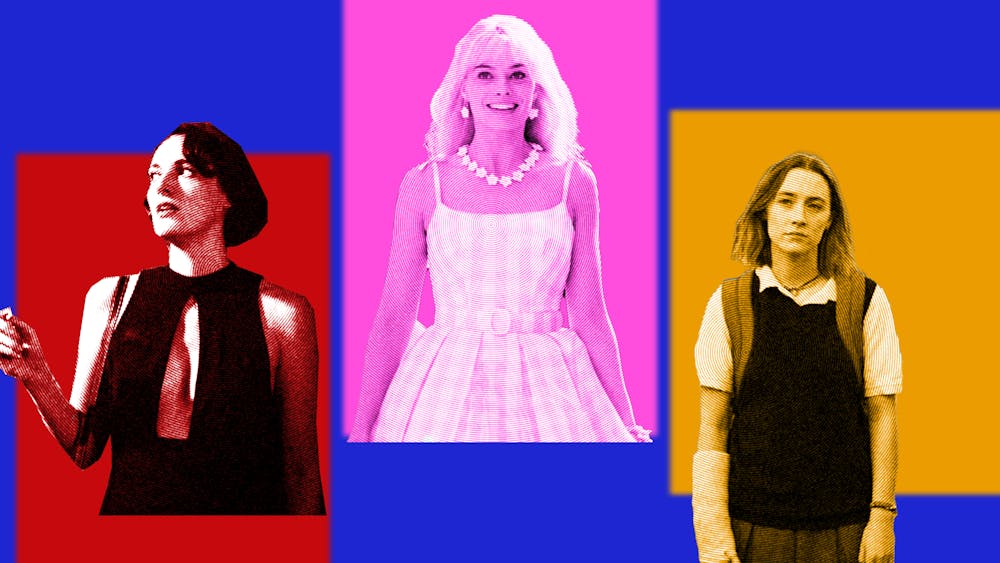
If there’s a defining genre of television and film for women in their late teens and 20s today, it’s what might be called “girl TV.” The term refers to pieces of media that center on messy, self–aware, and often self–destructive female protagonists who narrate their own lives with a blend of brutal honesty and ironic detachment. These are characters who oscillate between shame and self–celebration, who live in small apartments and make bad decisions in good lighting, and who seem to exist in a world where the line between therapy and spectacle is intentionally blurred. The genre’s canon includes Fleabag, Lady Bird, and Barbie, and while each film or series has its own flavor, together they reflect a deeper cultural fixation: a collective fascination with women behaving badly and taking control of their own stories.
What unites these works isn’t just a focus on women’s lives, but how those lives are framed. Their protagonists are narrators, performers, and unreliable witnesses to their own dysfunction. They speak directly to the audience, both literally—as in Fleabag, where Phoebe Waller–Bridge’s character breaks the fourth wall with smirks and side eye—and structurally, as in Lady Bird, where Greta Gerwig’s script invites the audience to sit in the tension between self–delusion and self–awareness. Barbie pushes this even further, using hyper–femininity, satire, and self–parody to not just dissect the impossibility of living up to what a woman is “supposed” to be, but to deliver that message in dialogue with its audience. The film explicitly acknowledges its own contradictions and invites viewers to laugh, cringe, and reflect alongside it. These characters are not role models, and they’re not trying to be. They’re telling us, in no uncertain terms, that they are selfish, impulsive, and sometimes cruel. Yet there’s something in the chaos, the humor, the refusal to behave, that keeps us watching—sometimes with admiration, sometimes with unease, but always with our full attention.
The rise of “girl TV” coincides with a larger cultural shift in how women are allowed—or expected—to perform their lives in public. In the 2000s, media representations of women were defined by a kind of curated aspirationalism: the Carrie Bradshaws and Serena van der Woodsens of television were glamorous even in their messiness. Their problems were real, but they were also softened by wealth, style, and the promise of redemption. Fleabag marked a break from this tradition—when it premiered in 2016, it felt revolutionary not just because its protagonist was flawed, but because the show refused to grant her a neat resolution that “excused” her behavior. Her story was hers to tell, and she told it without apology.
Lady Bird, released a year later, captures a similar ethos in film. Christine “Lady Bird” McPherson (Saoirse Ronan) is both endearing and insufferable, a teenager who fights with her mother, lies to her friends, and romanticizes her own life to the point of absurdity. Lady Bird was not a story about triumph, or even about resolution; it was a story about a girl who doesn’t know how to be—a young woman caught between the roles she’s told to play and the person she might become, a woman flailing through friendships, family expectations, and her own inflated sense of self. Lady Bird acutely captures the silent desperation of trying to reinvent yourself while still being tethered to the people and places that shaped you.
In 2023, Barbie took this even further, becoming a global phenomenon by explicitly framing the female experience as one of cognitive dissonance: You can be everything and nothing, powerful and powerless, an object and a person, all at once. In one monologue that’s already become a cultural touchstone, America Ferrera’s character gives voice to what many women already feel: “You’re supposed to love being a mother, but don’t talk about your kids all the damn time. … You have to answer for men’s bad behavior, which is insane, but if you point that out, you’re accused of complaining.” Like Fleabag or Lady Bird, Barbie gives voice to the latent contradictions that structure women’s lives, pulling the audience directly into the tension between self–awareness and self–critique that defines “girl TV.” It’s a self–referential, confessional project, now with a blockbuster budget.
The self–aware genre of “girl TV” resonates with younger viewers, especially women, because it mirrors how we consume and create content in 2025. Social media has trained us to view our lives as material for storytelling: We only recognize ourselves through Instagram captions, TikTok voiceovers, and BeReal snapshots. Similarly, the women depicted in “girl TV” are both protagonists and influencers—curating, self–critiquing, and inviting the audience into the performance of their pain. They are not “likable,” but they are captivating.
Of course, there’s a risk that “girl TV” can become a genre with diminishing returns. As more shows and films adopt the formula of chaotic womanhood, the aesthetic of messiness can start to feel less like a radical act and more like a branding strategy. The “hot mess” character has become a type in its own right, complete with the trappings of aestheticized dysfunction: oversized button–downs, artfully messy apartments, and a curated playlist of sad–girl pop. At times, it can feel like we’re watching a genre parody itself—an endless loop of women looking into the camera, confessing their flaws, and cueing up Phoebe Bridgers.
Still, for many viewers, the appeal of “girl TV” endures in its refusal to sanitize the female experience. These stories don’t offer neat moral lessons or redemption arcs. Instead, they present a world where women can be funny, petty, angry, and sad—sometimes all at once—and where that complexity is the point, not a problem to be solved. If “girl TV” is a mirror, it’s a deliberately cracked one, reflecting back the contradictions of a generation raised to perform empowerment while still navigating the same old pressures of gender, class, and identity.
In the end, watching Fleabag’s daughters spiral through their crises isn’t just entertainment. It’s a kind of collective processing: a way to acknowledge that we are all, in some way, performing throughout our own messy, imperfect lives.