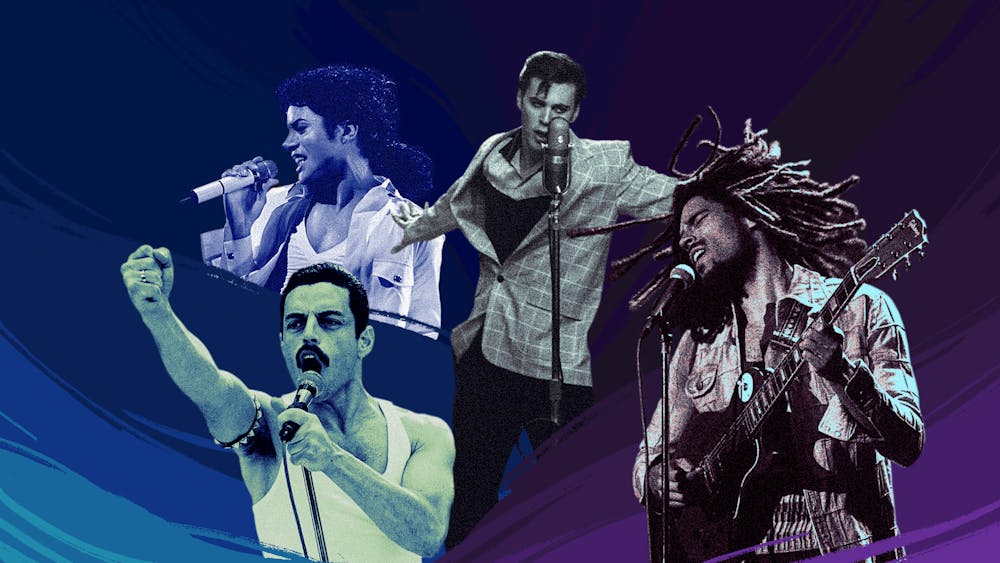
In Bohemian Rhapsody, Rami Malek’s prosthetic teeth do a lot of heavy lifting. They must—they’re tasked not only with helping Malek channel Freddie Mercury, but with chewing through a script so sanitized it could’ve been written by a public relations team for the Mercury estate (because, well, it was). Queen emerges from the film not as the messy, electric, and debauched band that defined a generation, but as stock characters in a series of triumphant montage sequences that culminate in Live Aid.
The formula worked. The film made nearly a billion dollars. Malek took home an Oscar. Unfortunately, just six years later, the film feels like a relic. Younger viewers—the kind who spend their free time sifting through leaked demos on Reddit and fact–checking tour dates on TikTok—aren’t buying it anymore.
Today’s audiences don't want the rock god on a pedestal. They want to see someone caught on grainy backstage footage: someone sweaty, flawed, and, most importantly, real. That’s the fundamental question facing the modern biopic: who gets to tell the story, and what happens when the subject of the story warps their own narrative?
The musical biopic has long been a Hollywood favorite. It offers a ready–made narrative structure (rise, fall, and redemption), a built–in soundtrack, and a marketing campaign that writes itself. For decades, it has been the go–to genre for Oscar–bait performances and Baby Boomer nostalgia. Yet in recent years, the formula has begun to show cracks.
Take Elvis, Baz Luhrmann’s latest glitter–filled visual onslaught, which turned the King of Rock into a bedazzled tragic hero and painted Colonel Tom Parker as a cartoon villain with an accent that sounds suspiciously like Dracula doing an impression of a Southern lawyer. Despite its box–office success and the praise Austin Butler received for his method–acting marathon, the film plays like it's being told with the estate’s hand on the wheel—and a branded Pepsi can in the cupholder. Gone are the pills, the paranoia, and the darker corners of Presley’s appropriation of Black music. Instead, we get a sanitized myth—one that lets the jumpsuits sparkle while the legacy stays clean.
Similarly, Bob Marley: One Love offers less of a portrait and more of a monument to an imagined Marley. It skips the controversies, the infidelities, the contradictions, and instead depicts Marley as a peace–preaching icon bathed in golden light—less man, more marketable figure. Scandals are muted, complexities are rounded off, and the revolution that Marley stood for gets shrink–wrapped and turned into an advertising slogan. What’s left is a biopic that feels like a “best of” playlist intercut with inspirational voiceovers.
Compare these sterile projects to something like Pavements, the recent biopic–documentary hybrid about the lo–fi indie band Pavement, which feels like a collage pulled from a bedroom wall. Directed with healthy doses of both irony and affection, the film breaks the fourth wall, uses archival footage like found poetry, and plays with its own construction in a way that mirrors the band’s messy ethos. It’s a project not of mythology, but of memory—fragmented, weird, and refreshingly uninterested in hero–worship.
Biopics like Pavements resonate with Gen Z not in spite of their messiness, but because of it. These films play with form, mix mediums, and blur the line between performance and reality. That fragmentation mirrors how younger audiences already consume stories: in bits and pieces, across platforms, and from multiple perspectives. To a generation raised on backstage clips, leaked demos, and fan edits, these experimental biopics feel more honest precisely because they don’t pretend to have it all figured out.
Or take Better Man, the Robbie Williams biopic in which the pop star is portrayed—seriously—by a CGI monkey. It sounds like a joke until you watch the trailer, where Williams’ own voice narrates scenes of fame, addiction, and loneliness while an uncanny primate version of himself stares into the middle distance. It’s surreal, self–aware, and oddly poignant. And unlike Bohemian Rhapsody, it doesn’t pretend to have all the answers. It just asks: what if the version of me you loved wasn’t really me at all?
Strangely enough, it works. In one interview, Williams quips, “We care for animals more than we care for humans.” It’s funny, but also revealing. By presenting himself as something non–human but still sympathetic, Williams invites a kind of empathy that fame often strips away. Younger audiences—fluent in irony and exhausted by perfection—now connect with the alienated, self–aware figure who dares to show them what it really felt like. A monkey, after all, doesn’t have to be real to be relatable.
The transformation of the biopic also reflects a broader cultural shift. There’s a growing skepticism among younger audiences toward legacy curation—especially when it’s done by estates, brands, or living legends with one eye on the merch. The moment something feels manicured, it loses its edge. Take Bohemian Rhapsody: despite its success, fans slammed it for sanitizing Mercury’s life and rewriting the timeline. To younger audiences, it felt less like truth and more like brand management. Authenticity, even when it’s messy, sells. Manufactured myth? Not so much.
We’ve entered what some have called the “post–biopic biopic” era. These are films that reject the polished arc of rise–and–redemption in favor of something looser, more meta, and more self–aware. Think of I’m Not There, the 2007 Dylan film where six different actors (including Cate Blanchett) play versions of Bob Dylan. Or even Weird: The Al Yankovic Story, which parodies biopic tropes while accidentally saying more about fame and identity than any Oscar contender.
Of course, the old–school biopic isn’t going away. Michael, the upcoming Michael Jackson biopic backed by his estate, is slated for release in 2025. It promises to “celebrate the King of Pop’s life and music,” which is exactly the problem. When a story becomes a monument, it stops being a mirror.
But maybe that’s the trade–off. For every sanitized narrative, there’s a countercultural answer—a fan documentary, an experimental film, or a CGI monkey waiting in the wings. Biopics aren’t dying. They’re mutating. The truth is, we’re not bored of stories about our idols. We’re just done being told what to believe about them.
So if you’re planning the next great music biopic, here’s a suggestion: skip the stadium montage. Show us the voicemail. Show us the panic attack. Show us the part where the icon flinches at their own reflection.
Or, failing that, at least make them a monkey.